Blind Boone: Missouri’s Ragtime Pioneer

Posted in Arts, Biography, Books, History, Media Archive, Monographs, United States on 2009-10-26 21:16Z by Steven

Blind Boone: Missouri’s Ragtime Pioneer

University of Missouri Press
1998
136 pages
6 x 9.
Biblio. Index. 25 illus.
ISBN: 0-8262-1198-4

Jack A. Batterson

Often overlooked by ragtime historians, John William “Blind” Boone had a remarkably successful and influential music career that endured for almost fifty years. Blind Boone: Missouri’s Ragtime Pioneer provides the first full account of the Missouri-born musician’s amazing story of overcoming the odds.

Boone’s background and his approach to music contributed to his ability to bridge gaps–gaps between blacks and whites and gaps between popular and classical music. Boone’s thousands of performances from 1879 to 1927 brought blacks and whites into the same concert halls as he played a mixture of popular and classical tunes.  A pioneer of ragtime music, Boone was the first performer to give the musical style legitimacy by bringing it to the concert stage.

The mulatto child of a former slave and a Union soldier, Boone was born in Miami, Missouri, in 1864 amid the chaos of the Civil War.  At six months he was diagnosed with “brain fever.” Doctors, believing they were performing a lifesaving procedure, removed Boone’s eyes and sewed his eyelids shut.

Despite blindness and poverty, Boone was a fun-loving, cheerful child.  Growing up in Warrensburg, Missouri, he played freely with both black and white children, undaunted by racial differences or his own disabilities. He exhibited a keen ear and musical promise early in life; at only five years of age he recruited older boys and formed a band.

Recognizing Boone’s talent, the town’s prominent citizens sent him to the St. Louis School for the Blind. There he excelled at music and amazed his instructors. However, Boone became increasingly unhappy with the school’s treatment of him and he frequently ran away to the tenderloin district of the city, where he first experienced ragtime. As a result of his forays, he was expelled after only two and a half years.

After some harrowing experiences, Boone met John Lange Jr., a benevolent black contractor and philanthropist in Columbia, Missouri. Boone and Lange began a lifelong friendship, which developed from their partnership in the Blind Boone Concert Company.  Although the two experienced hardships and racism, fires and train wrecks, Lange’s guidance and Boone’s talent secured 8,650 concerts in the United States, Canada, and Mexico.

Blind Boone: Missouri’s Ragtime Pioneer offers an engaging and readable account of the personal and professional life of Blind Boone. This book will appeal to the general reader as well as anyone interested in African American studies or music history.

Tags: , , , , , , , ,

Injun Joe’s Ghost: The Indian Mixed-Blood in American Writing

Posted in Anthropology, Books, History, Literary/Artistic Criticism, Media Archive, Monographs, Native Americans/First Nation, United States on 2009-10-26 20:55Z by Steven

Injun Joe’s Ghost: The Indian Mixed-Blood in American Writing

University of Missouri Press
2004
ISBN 978-0-8262-1530-7
288 pages
6 x 9

Harry J. Brown, Assistant Professor of English
DePauw University

What does it mean to be a “mixed-blood,” and how has our understanding of this term changed over the last two centuries? What processes have shaped American thinking on racial blending?  Why has the figure of the mixed-blood, thought too offensive for polite conversation in the nineteenth century, become a major representative of twentieth-century native consciousness?

In Injun Joe’s Ghost, Harry J. Brown addresses these questions within the interrelated contexts of anthropology, U.S. Indian policy, and popular fiction by white and mixed-blood writers, mapping the evolution of “hybridity” from a biological to a cultural category. Brown traces the processes that once mandated the mixed-blood’s exile as a grotesque or criminal outcast and that have recently brought about his ascendance as a cultural hero in contemporary Native American writing.

Because the myth of the demise of the Indian and the ascendance of the Anglo-Saxon is traditionally tied to America’s national idea, nationalist literature depicts Indian-white hybrids in images of degeneracy, atavism, madness, and even criminality. A competing tradition of popular writing, however, often created by mixed-blood writers themselves, contests these images of the outcast half-breed by envisioning “hybrid vigor,” both biologically and linguistically, as a model for a culturally heterogeneous nation.

Injun Joe’s Ghost focuses on a significant figure in American history and culture that has, until now, remained on the periphery of academic discourse. Brown offers an in-depth discussion of many texts, including dime novels and Depression- era magazine fiction, that have been almost entirely neglected by scholars. This volume also covers texts such as the historical romances of the 1820s and the novels of the twentieth-century “Native American Renaissance” from a fresh perspective. Investigating a broad range of genres and subject over two hundred year of American writing, Injun Joe’s Ghost will be useful to students and professionals in the fields of American literature, popular culture, and native studies.

Tags: , , ,

Race Mixing: Southern Fiction since the Sixties

Posted in Books, Literary/Artistic Criticism, Media Archive, Monographs, United States on 2009-10-23 18:23Z by Steven

Race Mixing: Southern Fiction since the Sixties

Johns Hopkins University Press
2004
360 pages
Hardback ISBN: 9780801873935
Paperback ISBN: 9780801883934

Suzanne W. Jones, Professor of English; Tucker-Boatwright Professor of the Humanities
University of Richmond

In the southern United States, there remains a deep need among both black and white writers to examine the topic of race relations, whether they grew up during segregation or belong to the younger generation that graduated from integrated schools. In Race Mixing, Suzanne Jones offers insightful and provocative readings of contemporary novels, the work of a wide range of writers—black and white, established and emerging. Their stories explore the possibilities of cross-racial friendships, examine the repressed history of interracial love, reimagine the Civil Rights era through children’s eyes, herald the reemergence of the racially mixed character, investigate acts of racial violence, and interrogate both rural and urban racial dynamics.

Employing a dynamic model of the relationship between text and context, Jones shows how more than thirty relevant writers — including Madison Smartt Bell, Larry Brown, Bebe Moore Campbell, Thulani Davis, Ellen Douglas, Ernest Gaines, Josephine Humphreys, Randall Kenan, Reynolds Price, Alice Walker, and Tom Wolfe — illuminate the complexities of the color line and the problems in defining racial identity today. While an earlier generation of black and white southern writers challenged the mythic unity of southern communities in order to lay bare racial divisions, Jones finds in the novels of contemporary writers a challenge to the mythic sameness within racial communities—and a broader definition of community and identity.

Closely reading these stories about race in America, Race Mixing ultimately points to new ways of thinking about race relations. “We need these fictions,” Jones writes, “to help us imagine our way out of the social structures and mind-sets that mythologize the past, fragment individuals, prejudge people, and divide communities.”

Tags: , , , , , , , , , , , , ,

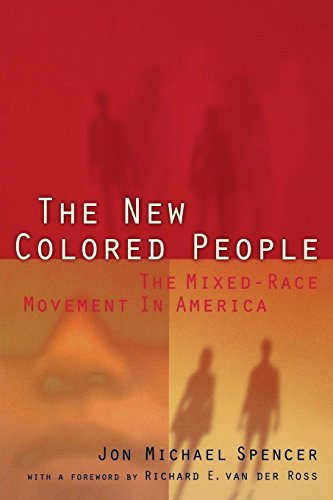
The New Colored People: The Mixed-Race Movement in America

Posted in Books, Media Archive, Monographs, Social Science, South Africa, United States on 2009-10-23 18:01Z by Steven

The New Colored People: The Mixed-Race Movement in America

New York University Press
1997-03-01
224 pages
ISBN: 9780814780725

Jon Michael Spencer (Yahya Jongintaba), Tyler and Alice Haynes Professor of American Studies and Professor of Music
University of Richmond

foreword by Richard E. Vander Ross

In recent years, dramatic increases in racial intermarriage have given birth to a generation who refuse to be shoehorned into neat, pre-existing racial categories. Energized by a refusal to allow mixed-race people to be rendered invisible, this movement lobbies aggressively to have the category multiracial added to official racial classifications.

While applauding the self-awareness and activism at the root of this movement, Jon Michael Spencer questions its ultimate usefulness, deeply concerned that it will unintentionally weaken minority power. Focusing specifically on mixed-race blacks, Spencer argues that the mixed-race movement in the United States would benefit from consideration of how multiracial categories have evolved in South Africa. Americans, he shows us, are deeply uninformed about the tragic consequences of the former white South African government’s classification of mixed-race people as Coloured. Spencer maintains that a multiracial category in the U.S. could be equally tragic, not only for blacks but formultiracials themselves.

Further, splintering people of color into such classifications of race and mixed race aggravates race relations among society’s oppressed. A group that can attain some privilege through a multiracial identity is unlikely to identify with the lesser status group, blacks. It may be that the undoing of racial classification will come not by initiating a new classification, but by our increased recognition that there are millions of people who simply defy easy classification.

TABLE OF CONTENTS

  • Foreword by Richard E. van der Ross
  • Preface
  • Introduction
  • ONE: The Rainbow People of God
  • TWO: The Blessings of the One-Drop Rule
  • THREE: The Curses of the Amorphous Middle Status
  • FOUR: Thou Shalt Not Racially Classify
  • Postscript
  • Notes
  • Bibliography
  • Index
Tags: , , , , ,

Race in another America: the significance of skin color in Brazil

Posted in Books, Brazil, Caribbean/Latin America, History, Media Archive, Monographs, Politics/Public Policy, Social Science on 2009-10-23 01:42Z by Steven

Race in another America: the significance of skin color in Brazil

Princeton University Press
2004
336 pages
27 line illus. 5 halftones
6 x 9 1/4
Hardcover ISBN: 9780691127927
Ebook ISBN: 9781400837434

Edward E. Telles, Professor of Sociology
University of California, Santa Barbara

  • Winner of the 2006 Oliver Cromwell Cox Award, Section on Race and Ethnic Minorities, American Sociological Association
  • Winner of the 2006 Distinguished Book Award, American Sociological Association
  • Winner of the 2005 Otis Dudley Duncan Award, Section on Sociology of Population, American Sociological Association
  • Winner of the 2005 Hubert Herring Award, Pacific Coast Council of Latin American Studies
  • Winner of the 2005 Best Book on Brazil in English, Brazil Section of the Latin American Studies Association

This is the most comprehensive and up-to-date book on the increasingly important and controversial subject of race relations in Brazil. North American scholars of race relations frequently turn to Brazil for comparisons, since its history has many key similarities to that of the United States. Brazilians have commonly compared themselves with North Americans, and have traditionally argued that race relations in Brazil are far more harmonious because the country encourages race mixture rather than formal or informal segregation.

More recently, however, scholars have challenged this national myth, seeking to show that race relations are characterized by exclusion, not inclusion, and that fair-skinned Brazilians continue to be privileged and hold a disproportionate share of wealth and power.

In this sociological and demographic study, Edward Telles seeks to understand the reality of race in Brazil and how well it squares with these traditional and revisionist views of race relations. He shows that both schools have it partly right–that there is far more miscegenation in Brazil than in the United States–but that exclusion remains a serious problem. He blends his demographic analysis with ethnographic fieldwork, history, and political theory to try to “understand” the enigma of Brazilian race relations–how inclusiveness can coexist with exclusiveness.

The book also seeks to understand some of the political pathologies of buying too readily into unexamined ideas about race relations. In the end, Telles contends, the traditional myth that Brazil had harmonious race relations compared with the United States encouraged the government to do almost nothing to address its shortcomings.

Read the entire first chapter in HTML or PDF format.

Read a book review here.

Tags: , ,

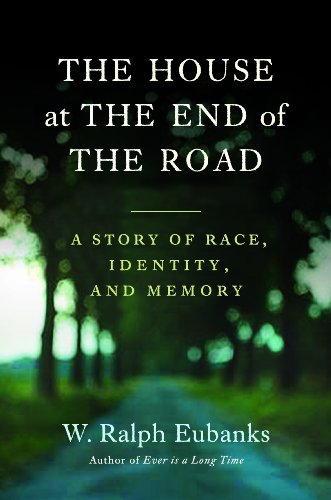
The House at the End of the Road: The Story of Three Generations of an Interracial Family in the American South

Posted in Books, Family/Parenting, History, Identity Development/Psychology, Media Archive, Monographs, United States on 2009-10-21 19:43Z by Steven

The House at the End of the Road: The Story of Three Generations of an Interracial Family in the American South

HarperCollins
Imprint: Smithsonian
2009-05-19
224 pages
Hardcover ISBN: 9780061375736; ISBN10: 006137573X
On Sale: 2009-05-19

W. Ralph Eubanks, Bernard Schwartz Fellow
New America Foundation

In 1914, in defiance of his middle-class landowning family, a young white man named James Morgan Richardson married a light-skinned black woman named Edna Howell. Over more than twenty years of marriage, they formed a strong family and built a house at the end of a winding sandy road in South Alabama, a place where their safety from the hostile world around them was assured, and where they developed a unique racial and cultural identity. Jim and Edna Richardson were Ralph Eubanks’s grandparents.

Part personal journey, part cultural biography, The House at the End of the Road examines a little-known piece of this country’s past: interracial families that survived and prevailed despite Jim Crow laws, including those prohibiting mixed-race marriage. As he did in his acclaimed 2003 memoir, Ever Is a Long Time, Eubanks uses interviews, oral history, and archival research to tell a story about race in American life that few readers have experienced. Using the Richardson family as a microcosm of American views on race and identity, The House at the End of the Road examines why ideas about racial identity rooted in the eighteenth century persist today. In lyrical, evocative prose, this extraordinary book pierces the heart of issues of race and racial identity, leaving us ultimately hopeful about the world as our children might see it.

Browse the contents of the book here.

Tags: , ,

Scattered Belongings: Cultural Paradoxes of Race, Nation and Gender

Posted in Books, Identity Development/Psychology, Media Archive, Monographs, United Kingdom, Women on 2009-10-21 04:28Z by Steven

Scattered Belongings: Cultural Paradoxes of Race, Nation and Gender

Routledge an imprint of the Taylor & Francis Group
1999-01-14
240 pages
234×156 mm
Paperback ISBN: 978-0-415-17096-3

Jayne O. Ifekwunigwe, Visiting Associate Professor of African and African American Studies
Duke University

When the American golfer Tiger Woods proclaimed himself a “Caublinasian”, affirming his mixed Caucasian, Black, Native American and Asian ancestry, a storm of controversy was created.  This book is about people faced by the strain of belonging and not belonging within the narrow confines of the terms ‘Black’ or ‘White’.

This is a unique and radical study. It interweaves the stories of six women of mixed African/African Caribbean and white European heritage with an analysis of the concepts of hybridity and mixed race identity.

Table of Contents

  • Illustrations
  • Prologue
  • Acknowledgements
  • 1. Cracking the Coconut:Resisting Popular Folk Discourses on “Race,” “Mixed Race” and Social Hierarchies
  • 2. Returning(s):Relocating the Critical Feminist Auto- Ethnographer
  • 3. Setting the Stage:Invoking the Griot(te)Traditions as Textual Strategies
  • 4. Ruby
  • 5. Similola
  • 6. Akousa
  • 7. Sarah
  • 8. Bisi
  • 9. Yemi
  • 10. Let Blackness and Whiteness Wash Through: Competing Discourses on Bi-Racialization and the Compulsion of Genealogical Erasures
  • Epilogue
  • Select Bibiographies
  • Index
Tags: , , ,

Black, White or Mixed Race? Race and Racism in the Lives of Young People of Mixed Parentage, 2nd Edition

Posted in Books, Identity Development/Psychology, Media Archive, Monographs, Social Science, United Kingdom, United States on 2009-10-21 04:09Z by Steven

Black, White or Mixed Race? Race and Racism in the Lives of Young People of Mixed Parentage, 2nd Edition

Routledge an imprint of the Taylor & Francis Group
2001-11-22
272 pages
ISBN: 978-0-415-25982-8 Binding: Paperback (also available in Hardback)
Trim Size: 216 x 138

Ann Phoenix, Professor and Co-Director of the Thomas Coram Research Unit
University of London, Institute of Education

Barbara Tizard, Professor Emeritus
University of London, Institute of Education

The number of people in racially mixed relationships has grown steadily over the last thirty years, yet these people often feel stigmatised and unhappy about their identities.

The first edition of Black, White or Mixed Race? was a ground-breaking study: this revised edition uses new literature to consider what is now known about racialised identities and changes in the official use of ‘mixed’ categories. All new developments are placed in a historical framework and in the context of up-to-date literature on mixed parentage in Britain and the USA.

Based on research with young people from a range of social backgrounds the book examines their attitudes to black and white people; their identity; their cultural origins; their friendships; their experiences of racism. This was the first study to concentrate on adolescents of black and white parentage and it continues to provide unique insights into their identities. It is a valuable resource for all those concerned with social work and policy.

Table of Contents

  1. Setting the Scene
  2. People of Mixed Black and White Parentage in Britain: A Brief History
  3. Identity and Mixed Parentage: Theory, Policy and Research
  4. The ‘Transracial Adoption’/’same race’ Placement Debate
  5. How the Research Was Carried Out
  6. The Radicalised Identities of Young People of Mixed Parentage Today
  7. Friendships and Allegiances
  8. Experiencing Racism
  9. Dealing with Racism
  10. Some Parents’ Accounts
  11. But What About the Children? An Overview, With Some Comments
Tags: , ,

Race Mixture in Nineteenth-Century U.S. and Spanish American Fictions: Gender, Culture, and Nation Building

Posted in Books, Caribbean/Latin America, Literary/Artistic Criticism, Media Archive, Monographs, Social Science, United States on 2009-10-21 03:07Z by Steven

Race Mixture in Nineteenth-Century U.S. and Spanish American Fictions: Gender, Culture, and Nation Building

University of North Carolina Press
October 2004
192 pages
5.5 x 8.5, notes, bibl., index
Paper ISBN:  978-0-8078-5564-5

Debra J. Rosenthal, Associate Professor of English
John Carroll University

Race mixture has played a formative role in the history of the Americas, from the western expansion of the United States to the political consolidation of emerging nations in Latin America. Debra J. Rosenthal examines nineteenth-century authors in the United States and Spanish America who struggled to give voice to these contemporary dilemmas about interracial sexual and cultural mixing.

Rosenthal argues that many literary representations of intimacy or sex took on political dimensions, whether advocating assimilation or miscegenation or defending the status quo. She also examines the degree to which novelists reacted to beliefs about skin differences, blood taboos, incest, desire, or inheritance laws. Rosenthal discusses U.S. authors such as James Fenimore Cooper, Catharine Maria Sedgwick, Walt Whitman, William Dean Howells, and Lydia Maria Child as well as contemporary novelists from Cuba, Peru, and Ecuador, such as Gertrudis Gómez de Avellaneda, Clorinda Matto de Turner, and Juan León Mera. With her multinational approach, Rosenthal explores the significance of racial hybridity to national and literary identity and participates in the wider scholarly effort to broaden critical discussions about America to include the Americas.

Tags: , , , , , , , , , , , , ,

Queer in Black and White: Interraciality, Same Sex Desire, and Contemporary African American Culture

Posted in Arts, Books, Communications/Media Studies, Gay & Lesbian, Literary/Artistic Criticism, Media Archive, Monographs, United States on 2009-10-21 00:06Z by Steven

Queer in Black and White: Interraciality, Same Sex Desire, and Contemporary African American Culture

Indiana University Press
2009-04-21
152 pages
5 b&w photos, 5.5 x 8.25
ISBN-13: 978-0-253-22109-4

Stefanie K. Dunning, Associate Professor
Miami University, Oxford, Ohio

This book analyzes representative works of African American fiction, film, and music in which interracial desire appears in the context of same sex desire. In close readings of these “texts,” Stefanie K. Dunning explores the ways in which the interracial intersects with queerness, blackness, whiteness, class, and black national identity. She shows that representations of interracial desire do not follow the logic of racial exclusion. Instead they are metaphorical and anti-biological. Rather than diluting race, interracial desire makes race visible. By invoking the interracial, black gay and lesbian artists can remake our conception of blackness.

Table of Contents

  • Acknowledgments
  • Introduction
  • 1. “Ironic Soil”: Recuperative Rhythms and Negotiated Nationalism
  • 2. “No Tender Mercy”: Same-Sex Desire, Interraciality, and the Black Nation
  • 3. (Not) Loving Her: A Locus of Contradictions
  • 4. “She’s a B*(u)tch”: Centering Blackness in The Watermelon Woman
  • Epilogue: Reading Robert Reid-Pharr
  • Notes
  • Index
Tags: , , , ,