In-between Places

Posted in Books, Media Archive, Monographs, Native Americans/First Nation on 2009-12-12 20:23Z by Steven

In-between Places

University of Arizona Press
2005
119 pages
6.0 x 9.0
2005
Cloth ISBN: 978-0-8165-2385-6
Paper ISBN: 978-0-8165-2387-0

Diane Glancy, Professor of Native American Literature and Creative Writing
Macalester College in St. Paul, Minnesota

There is a map you decide to call a book. A book of the territories you’ve traveled. A map is a meaning you hold against the unknowing. The places you speak in many directions.In-Between Places would be enjoyed by anyone interested in thoughtful, careful prose that investigates complex issues of the self and the world. Energetic and beautifully constructed prose.  For Diane Glancy, there are books that you open like a map. In-between Places is such a book: a collection of eleven essays unified by a common concern with landscape and its relation both to our spiritual life and to the craft of writing. Taking readers on a trip to New Mexico, a voyage across the sea of middle America, even a journey to China, Glancy has crafted a sustained meditation on the nature and workings of language, stories, and poems; on travel and motion as metaphors for life and literature; and on the relationships between Native American and Judeo-Christian ways of thinking and being in the world. Reflecting on strip mines in Missouri (“as long as there is anything left to take, human industry will take it”) and hog barns in Iowa (writing about them from the hogs’ perspective), Glancy speaks in the margins of cross-cultural issues and from the places in-between as she explores the middle ground between places that we handle with the potholder of language. She leaves in her wake a dance of words and the structures left after the collision of cultures. A writer who has often examined her native heritage, Glancy also asks here what it means to be part white. “What does whiteness look like viewed from the other, especially when that other is also within oneself?” And in considering the legacy of Christianity, she ponders “how it is when the Holy Ghost enters your life like a brother-in-law you know is going to be there a while.” Insightful and provocative, In-between Places is a book for anyone interested in a sense of place and in the relationship between religion and our stance toward nature. It is also a book for anyone who loves thoughtful writing and wishes to learn from a modern master of language.

Tags: ,

Dislocating the Color Line: Identity, Hybridity, and Singularity in African-American Narrative

Posted in Books, History, Literary/Artistic Criticism, Media Archive, Monographs, Slavery, United States on 2009-12-12 02:39Z by Steven

Dislocating the Color Line: Identity, Hybridity, and Singularity in African-American Narrative

Stanford University Press
1997
280 pages
Cloth ISBN-10: 0804727740; ISBN-13: 9780804727747
Paper ISBN-10: 0804727759; ISBN-13: 9780804727754

Samira Kawash, Associate Professor Women’s and Gender Studies
Rutgers, The State University of New Jersey

Inquiries into the meaning and force of race in American culture have largely focused on questions of identity and difference—What does it mean to have a racial identity? What constitutes racial difference? Such questions assume the basic principle of racial division, which todays seems to be becoming an increasingly bitter and seemingly irreparable chasm between black and white.

This book confronts this contemporary problem by shifting the focus of analysis from understanding differences to analyzing division. It provides a historical context for the recent resurgence of racial division by tracing the path of the color line as it appears in the narrative writings of African-Americans in the nineteenth and twentieth centuries. In readings of slave narratives, “passing novels,” and the writings of Charles Chesnutt and Zora Neale Hurston, the author asks: What is the work of division? How does division work?

The history of the color line in the United States is coeval with that of the nation. The author suggests that throughout this history, the color line has not functioned simply to name biological or cultural difference, but more important, it has served as a principle of division, classification, and order. In this way, the color line marks the inseparability of knowledge and power in a racially demarcated society. The author shows how, from the time of slavery to today, the color line has figured as the locus of such central tenets of American political life as citizenship, subjectivity, community, law, freedom, and justice.

This book seeks not only to understand, but also to bring critical pressure on the interpretations, practices, and assumptions that correspond to and buttress representations of racial difference. The work of dislocating the color line lies in uncovering the uncertainty, the incoherency, and the discontinuity that the common sense of the color line masks, while at the same time elucidating the pressures that transform the contingent relations of the color line into common sense.

Tags: , , , , ,

Race and Ethnicity: Culture, Identity and Representation

Posted in Books, Caribbean/Latin America, Identity Development/Psychology, Media Archive, Monographs, Social Science, United Kingdom on 2009-12-11 21:45Z by Steven

Race and Ethnicity: Culture, Identity and Representation

Routledge
2006-03-02
296 pages
Hardback ISBN: 978-0-415-35124-9
Paperback ISBN: 978-0-415-35125-6
Trim Size: 234X156

Stephen Spencer, Senior Lecturer in Sociology
Sheffield Hallam University

Broad-ranging and comprehensive, this incisive new textbook examines the shifting meanings of ‘race’ and ethnicity and collates the essential concepts in one indispensable companion volume. From Marxist views to post-colonialism, this book investigates the attendant debates, issues and analyses within the context of global change.

Using international case studies from Australia, Malaysia, the Caribbean, Mexico and the UK and examples of popular imagery that help to explain the more difficult elements of theory, this key text focuses on everyday life issues such as:

  • ethnic conflicts and polarized states
  • racism(s) and policies of multiculturalism
  • diasporas, asylum seekers and refugees
  • mixed race and hybrid identity

Incorporating summaries, questions, illustrations, exercises and a glossary of terms, this student-friendly text also puts forward suggestions for further project work. Broad in scope, interactive and accessible, this book is a key resource for undergraduate and postgraduate level students of ‘race’ and ethnicity across the social sciences.

Table of Contents

  1. ‘Race’/Ethnicity and Representation
  2. The Politics of Naming
  3. Colonialism: Invisible Histories
  4. Theories
  5. Identity: Marginal Voices and the Politics of Difference
  6. Major Case Study: Indigenous Australians
  7. Conflict
  8. Living the Contradiction
  9. Futures
Tags: ,

Borderlands/La Frontera: The New Mestiza (Third Edition)

Posted in Books, Caribbean/Latin America, Gay & Lesbian, Identity Development/Psychology, Latino Studies, Monographs, United States on 2009-12-11 20:03Z by Steven

Borderlands/La Frontera: The New Mestiza (Third Edition)

Aunt Lute Books
1987
ISBN 1879960125

Gloria Anzaldúa

  • Chosen one of the “Best Books of 1987” by Library Journal.
  • Selected by Utne Reader as part of its “Alternative Canon” in 1998.
  • One of Hungry Mind Review’s “Best 100 Books of the 20th Century”

Rooted in Gloria Anzaldúa’s experience as a Chicana, a lesbian, an activist, and a writer, the groundbreaking essays and poems in this volume profoundly challenge how we think about identity. Borderlands/La Frontera remaps understandings of what a “border” is, seeing it not as a simple divide between here and there, us and them, but as a psychic, social, and cultural terrain that we inhabit, and that inhabits all of us.

New to this edition:

Includes an Introduction by Sonia Saldívar-Hull; an interview with Gloria Anzaldúa; and contributions by Norma Alarcón, Julia Alvarez, Paola Bacchetta, Rusty Barcelo, Norma Elia Cantú, Sandra Cisneros, T. Jackie Cuevas, Claire Joysmith, and AnaLouise Keating.

Tags: , , , , , , , , , , , ,

Interracial Intimacy: The Regulation of Race and Romance

Posted in Books, History, Identity Development/Psychology, Law, Media Archive, Monographs, Politics/Public Policy, Social Science on 2009-12-09 18:46Z by Steven

Interracial Intimacy: The Regulation of Race and Romance

The University of Chicago Press
2001
232 pages
6 x 9
Paper ISBN: 9780226536637

Rachel F. Moran, Michael J. Connell Distinguished Professor of Law
University of California, Los Angeles

As late as the 1960s, states could legally punish minorities who either had sex with or married persons outside of their racial groups. In this first comprehensive study of the legal regulation of interracial relationships, Rachel Moran grapples with the consequences of that history, candidly confronting its profound effects on not only conceptions of race and identity, but on ideas about sex, marriage, and family.

Table of Contents

  • Preface
  • 1. Insights from Interracial Intimacy
  • 2. Antimiscegenation Laws and the Enforcement of Racial Boundaries
  • 3. Subverting Racial Boundaries: Identity, Ambiguity, and Interracial Intimacy
  • 4. Antimiscegenation Laws and Norms of Sexual and Marital Propriety
  • 5. Judicial Review of Antimiscegenation Laws: The Long Road to Loving
  • 6. Race and Romanticism: The Persistence of Racial Endogamy after Loving
  • 7. Race and the Family: The Best Interest of the Child in Interracial Custody and Adoption Disputes
  • 8. Race and Identity: The New Multiracialism
  • 9. The Lessons of Interracial Intimacy
  • Notes
  • Index
Tags: , , , ,

Asian Americans: From Racial Category to Multiple Identities

Posted in Asian Diaspora, Books, Census/Demographics, Identity Development/Psychology, Media Archive, Monographs, Politics/Public Policy, Social Science, United States on 2009-12-08 21:24Z by Steven

Asian Americans: From Racial Category to Multiple Identities

Alta Mira Press
April 1998
116 pages
Cloth: 2 0-7619-9172-7 / 978-0-7619-9172-4 
Paper: 2 0-7619-9173-5 / 978-0-7619-9173-1 

Juanita Tamayo Lott

Does race matter? Having witnessed the civil rights movement and changes in immigration laws, we continue to ask ourselves this complex question. In the United States, racial status and identity has historically been defined by the White majority. Asian Americans: From Racial Category to Multiple Identities shows that race continues to be a major organizing principle in the US.  Using census data on “Blacks,” “White Ethnics,” and “Nonblack Minorities,” Lott deconstructs widely accepted majority/minority classifications to reveal the multiplicity of identities surrounding each group.

Table of Contents

  • About the Author
  • Acknowledgment
  • Dedication
  • What Are You
  • Chapter One Race: A Major Organizing Principle
  • Chapter Two Directive 15 Origins
  • Chapter Three Continuing Utility of Directive 15
  • Chapter Four Asian Americans: A Racial Category
  • Chapter Five Asian Americans: A Multiplicity of Identities
  • Bibliography
  • Index
Tags: ,

How Race Is Made: Slavery, Segregation, and the Senses

Posted in Books, History, Media Archive, Monographs, Slavery, Social Science, United States on 2009-12-07 23:02Z by Steven

How Race Is Made: Slavery, Segregation, and the Senses

University of North Carolina Press
2006
208 pages
6.125 x 9.25
7 illus., notes, index
Paper ISBN: 978-0-8078-5925-4

Mark M. Smith, Carolina Distinguished Professor of History
University of South Carolina

2007 Choice Outstanding Academic Title

For at least two centuries, argues Mark Smith, white southerners used all of their senses–not just their eyes–to construct racial difference and define race. His provocative analysis, extending from the colonial period to the mid-twentieth century, shows how whites of all classes used the artificial binary of “black” and “white” to justify slavery and erect the political, legal, and social structure of segregation.

Based on painstaking research, How Race Is Made is a highly original, always frank, and often disturbing book. After enslaved Africans were initially brought to America, the offspring of black and white sexual relationships (consensual and forced) complicated the purely visual sense of racial typing. As mixed-race people became more and more common and as antebellum race-based slavery and then postbellum racial segregation became central to southern society, white southerners asserted that they could rely on their other senses–touch, smell, sound, and taste–to identify who was “white” and who was not. Sensory racial stereotypes were invented and irrational, but at every turn, Smith shows, these constructions of race, immune to logic, signified difference and perpetuated inequality.

Smith argues that the history of southern race relations and the construction of racial difference on which that history is built cannot be understood fully on the basis of sight alone. In order to come to terms with the South’s past and present, Smith says, we must explore the sensory dynamics underpinning the deeply emotional construction of race. How Race Is Made takes a bold step toward that understanding.

Table of Contents

Introduction: Making Sense of Race
1. Learning to Make Sense
2. Fooling Senses, Calming Crisis
3. Senses Reconstructed, Nonsense Redeemed
4. Finding Homer Plessy, Fixing Race
5. The Black Mind of the South
6. The Brown Concertina
Notes
Acknowledgement
Index

Tags: , ,

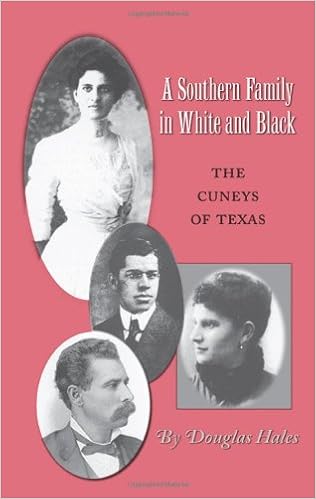
A Southern Family in White and Black: The Cuneys of Texas

Posted in Biography, Books, History, Media Archive, Monographs, Passing, Slavery, Texas, United States on 2009-12-06 01:46Z by Steven

A Southern Family in White and Black: The Cuneys of Texas

Texas A&M University Press
2002-12-06
192 pages
6.125 x 9.25
4 b&w photos.
ISBN 13: 978-1-58544-200-3

Douglas Hales, Professor of History
Temple College, Temple, Texas

The complex issues of race and politics in nineteenth-century Texas may be nowhere more dramatically embodied than in three generations of the family of Norris Wright Cuney, mulatto labor and political leader. Douglas Hales explores the birthright Cuney received from his white plantation-owner father, Philip Cuney, and the way his heritage played out in the life of his daughter Maud Cuney-Hare. This intergenerational study casts light on the experience of race in the South before Emancipation, after Reconstruction, and in the diaspora that eventually led cultural leaders of African American heritage into the cities of the North.

Most Texas history books name Norris Wright Cuney as one of the most influential African American politicians in nineteenth-century Texas, but they tell little about him beyond his elected positions. In The Cuneys, Douglas Hales not only fills in the details of Cuney’s life and contributions but places him in the context of his family’s generations.

A politically active plantation owner and slaveholder in Austin County, Philip Cuney participated in the annexation of Texas to the United States and supported the role of slavery and cotton in the developing economy of the new state. Wealthy and powerful, he fathered eight slave children whom he later freed and saw educated. Hales explores how and why Cuney differed from other planters of his time and place.

He then turns to the better-known Norris Wright Cuney to study how the black elite worked for political and economic opportunity in the reactionary period that followed Reconstruction in the South. Cuney led the Texas Republican Party in those turbulent years and, through his position as collection of customs at Galveston, distributed federal patronage to both white and black Texans. As the most powerful African American in Texas, and arguably in the entire South, Cuney became the focal point of white hostility, from both Democrats and members of the “Lily White” faction of his own party. His effective leadership won not only continued office for him but also a position of power within the Republican Party for Texas blacks at a time when the party of Lincoln repudiated African Americans in many other Southern states. From his position on the Galveston City Council, Cuney worked tirelessly for African American education and challenged the domination of white labor within the growing unions.

Norris Wright Cuney’s daughter, Maud, who was graced with a prestigious education, pursued a successful career in the arts as a concert pianist, musicologist, and playwright. A friend of W. E. B. Du Bois, she became actively involved in the racial uplift movement of the early twentieth century. Hales illuminates her role in the intellectual and political “awakening” of black America that culminated in the Harlem Renaissance of the 1920s. He adroitly explores her decision against “passing” as white and her commitment to uplift.

Through these three members of a single mixed-race family, Douglas Hales gives insight into the issues, challenges, and strengths of individuals. His work adds an important chapter to the history of Texas and of African Americans more broadly.

Tags: , , , , ,

One Nation, One Blood: Interracial Marriage in American Fiction, Scandal, and Law, 1820–1870

Posted in Books, History, Law, Literary/Artistic Criticism, Media Archive, Monographs, Native Americans/First Nation, Politics/Public Policy, Slavery, Social Science, United States on 2009-12-05 23:05Z by Steven

One Nation, One Blood: Interracial Marriage in American Fiction, Scandal, and Law, 1820–1870

University of Massachusetts Press
June 2005
288 pages
Cloth ISBN: 978-1-55849-483-1

Karen Woods Weierman, Associate Professor of English
Worcester State University

Examines the roots of a pernicious and persistent American taboo

The proscription against interracial marriage was for many years a flashpoint in American culture. In One Nation, One Blood, Karen Woods Weierman explores this taboo by investigating the traditional link between marriage and property. Her research reveals that the opposition to intermarriage originated in large measure in the nineteenth-century desire for Indian land and African labor. Yet despite the white majority’s overwhelming rejection of nonwhite peoples as marriage partners, citizens, and social equals, nineteenth-century reformers challenged the rule against intermarriage. Dismissing the new “race science” that purported to prove white superiority, reformers held fast to the religious notion of a common humanity and the republican rhetoric of freedom and equality, arguing that God made all people “of one blood.”

The years from 1820 to 1870 marked a crucial period in the history of this prejudice. Tales of interracial marriage recounted in fiction, real-life scandals, and legal statutes figured prominently in public discussion of both slavery and the fate of Native Americans. In Part One of this book, Weierman focuses on Indian-white marriages during the 1820s, when Indian removal became a rallying cry for New England intellectuals.

In Part Two she shifts her attention to black-white marriages from the antebellum period through the early years of Reconstruction. In both cases she finds that the combination of a highly publicized intermarriage scandal, new legislation prohibiting interracial marriage, and fictional portrayals of the ills associated with such unions served to reinforce popular prejudice, justifying the displacement of Indians from their lands and upholding the system of slavery. Even after the demise of slavery, restrictions against intermarriage remained in place in many parts of the country long into the twentieth century. Not until the 1967 Loving v. Virginia decision did the Supreme Court finally rule that such laws were unconstitutional.

Finishing on a contemporary note, Weierman suggests that the stories Americans tell about intermarriage today—stories defining family, racial identity, and citizenship—still reflect a struggle for resources and power.

Tags: , , , ,

The Two Lives of Sally Miller: A Case of Mistaken Racial Identity in Antebellum New Orleans

Posted in Biography, Books, History, Law, Louisiana, Media Archive, Monographs, Slavery, United States, Women on 2009-12-05 17:28Z by Steven

The Two Lives of Sally Miller: A Case of Mistaken Racial Identity in Antebellum New Orleans

Rutgers University Press
2007-03-28
168 pages
9 b&w illustrations
Paper ISBN: 978-0-8135-4058-0
Cloth ISBN: 978-0-8135-4057-3

Carol Wilson, Arthur A. and Elizabeth R. Knapp Professor of American History
Washington College, Chestertown, Maryland

In 1843, the Louisiana Supreme Court heard the case of a slave named Sally Miller, who claimed to have been born a free white person in Germany. Sally, a very light-skinned slave girl working in a New Orleans cafe, might not have known she had a case were it not for a woman who recognized her as Salom Muller, with whom she had emigrated from Germany over twenty years earlier. Sally decided to sue for her freedom, and was ultimately freed, despite strong evidence contrary to her claim.

In The Two Lives of Sally Miller, Carol Wilson explores this fascinating legal case and its reflection on broader questions about race, society, and law in the antebellum South. Why did a court system known for its extreme bias against African Americans help to free a woman who was believed by many to be a black slave? Wilson explains that while the notion of white enslavement was shocking, it was easier for society to acknowledge that possibility than the alternative-an African slave who deceived whites and triumphed over the system.

Comments by Carol Wilson from her website:

…My book on the case of Sally Miller looks at a similar issue of status. As a society we have recently begun openly acknowledging that many people in the United States are of mixed racial background. The restrictive categorization of people as either white or black has begun to collapse. Many people assume, however, that this is the result of relaxing of racial barriers over the last few decades. Scholars of pre-Civil War American history, however, are well aware of the extensiveness of racial mixing in our nation’s past, albeit a practice usually illegal and denied. Because of the not uncommon existence of enslaved mulattoes, antebellum Americans were not unused to seeing slaves who looked “white.” With racial identity a feature imposed by those in power in society, it was only a matter of time before “whites” (people of European ancestry) found themselves illegally enslaved. Because white status was impossible to prove, some whites did find themselves in slavery…

Tags: , , ,