African Mexicans and the Discourse on Modern Nation

Posted in Books, Caribbean/Latin America, History, Media Archive, Monographs, Social Science on 2009-12-21 01:39Z by Steven

African Mexicans and the Discourse on Modern Nation

University Press of America
June 2004
136 pages
Paper ISBN: 0-7618-2858-3 / 978-0-7618-2858-7

Marco Polo Hernández Cuevas, Asssociate Professor of Spanish
North Carolina Central University

In African Mexicans and the Discourse on Modern Nation, author Marco Polo Hernández-Cuevas explores how the Africaness of Mexican mestizaje was erased from the national memory and identity and how national African ethnic contributions were plagiarized by the criollo elite in modern Mexico. The book cites the concept of a Caucasian standard of beauty prevalent in narrative, film, and popular culture in the period between 1920 and 1968, which the author dubs as the “cultural phase of the Mexican Revolution.”

The author also delves into how criollo elite disenfranchised non-white Mexicans as a whole by institutionalizing a Eurocentric myth whereby Mexicans learned to negate part of their ethnic makeup. During this time period, wherever African Mexicans, visibly black or not, are mentioned, they appear as “mestizo,” many of them oblivious of their African heritage, and others part of a willing movement toward becoming “white.” This analysis adopts as a critical foundation Richard Jackson’s ideas about black phobia and the white aesthetic, as well as James Snead’s coding of blacks.

Table of Contents

  • Foreword
  • Preface
  • Acknowledgments
  • Introduction
  • The Revolution and Invisibility: African Mexicans and the Ideology of Mestizaje in La raza cósmica
  • The Erased Africaness of Mexican Icons
  • La vida inútil de Pito Pérez: Tracking the African Contribution to the Mexican Picaresque Sense of Humor
  • Angelitos negros, a Film from the “Golden Age” of Mexican Cinema: Coding Visibly Black Mestizos By and Through a Far-Reaching Medium
  • Modern National Discourse and La muerte de Artemio Cruz: The Illusory “Death” of African Mexican Lineage
  • Conclusion
  • Bibliography
  • Index
Tags: , , , , ,

Winnefred and Agnes: The Story of Two Women

Posted in Africa, Autobiography, Books, History, Identity Development/Psychology, Media Archive, Monographs, Religion, Social Science, South Africa, Women on 2009-12-19 23:29Z by Steven

Winnefred and Agnes: The Story of Two Women

Independent Publishing Group
September 2002
288 pages, Cloth, 5 1/2 x 8 1/2
6 B/W Photos, 1 Chart, 1 Map
ISBN: 9780795701139 (0795701136)

Agnes Lottering

This is a rare, possibly the first, first-person account of being part of the group of mixed-race families who came into existence at Ngome in the province of KwaZulu-Natal when, in the late 19th century, well-to-do British and Irish traders took Zulu wives and adopted Zulu cultural practices, including polygamy. The author recounts her life and that of her mother in this true account of a Zululand family whose lives were touched in equal measure by tribal belief and Christianity, healing herbs, magical birds, and the tokeloshe, a mischievous creature surrounded by myth and sexual innuendo. It is also a tale of betrayal, grand passion, bewitchment, abuse, and the triumph of love. Part love story and family saga, part social history, it is above all a uniquely South African tale.

Agnes Lottering was born in Ngome Forest in 1937. Due to financial and other constraints, she never completed her schooling. Yet she is a gifted storyteller, telling her tale with freshness and authenticity. She lives in Durban, South Africa.

Tags: , , , ,

Between Camps: Nations, Cultures and the Allure of Race

Posted in Books, Media Archive, Monographs, Politics/Public Policy, Social Science on 2009-12-19 20:59Z by Steven

Between Camps: Nations, Cultures and the Allure of Race (Also published in the United States by Harvard University Press as Against Race: Imagining Political Culture beyond the Color Line)

Routledge
2004-08-26
424 pages
Trim Size: 234X156
Paperback ISBN: 978-0-415-34365-7

Paul Gilroy, Anthony Giddens Professorship in Social Theory
The London School of Economics and Political Science


In this provocative book, now reissued with a new introduction, Paul Gilroy contends that race-thinking has distorted the finest promises of modern democracy.  He compels us to see that fascism was the principal political innovation of the twentieth century – and that its power to seduce did not die in a bunker in Berlin.

Between Camps addresses questions such as:

Gilroy examines the ways in which media and commodity culture have become pre-eminent in our lives in the years since the 1960s and especially in the 1980s with the rise of hip-hop and other militancies. With this trend, he contends, much that was valuable about black culture has been sacrificed in the service of corporate interests and new forms of cultural expression tied to visual technologies. He argues that the triumph of the image spells death to politics and reduces people to mere symbols.

At its heart, Between Camps is a Utopian project calling for the renunciation of race. Gilroy champions a new humanism, global and cosmopolitan, and he offers a new political language and a new moral vision for what was once called ‘anti-racism’.

Tags: ,

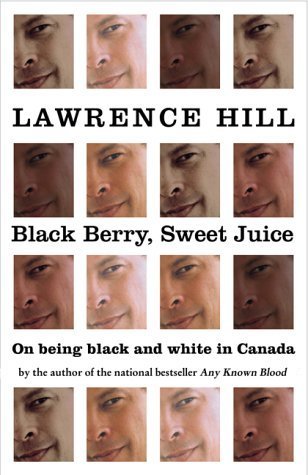
Black Berry, Sweet Juice: On Being Black and White in Canada

Posted in Books, Canada, Identity Development/Psychology, Media Archive, Monographs, Politics/Public Policy, Social Science on 2009-12-15 20:07Z by Steven

Black Berry, Sweet Juice: On Being Black and White in Canada

Harper Collins Canada
September 2001
256 pages
Paperback ISBN: 9780006385080; ISBN10: 0006385087

Lawrence Hill

Lawrence Hill’s remarkable novel, Any Known Blood, a multi-generational story about a Canadian man of mixed race, was met with critical acclaim and it marked the emergence of a powerful new voice in Canadian writing. Now Hill, himself a child of a black father and white mother, brings us Black Berry, Sweet Juice, Hill: On Being Black and White in Canada, a provocative and unprecedented look at a timely and engrossing topic.

In Black Berry, Sweet Juice, Hill movingly reveals his struggle to understand his own personal and racial identity. Raised by human rights activist parents in a predominantly white Ontario suburb, he is imbued with lingering memories and offers a unique perspective. In a satirical yet serious tone, Hill describes the ambiguity involved in searching for his identity – an especially complex and difficult journey in a country that prefers to see him as neither black nor white.

Interspersed with slices of his personal experiences, fascinating family history and the experiences of thirty-six other Canadians of mixed race interviewed for this book, Black Berry, Sweet Juice also examines contemporary racial issues in Canadian society. Hill explores the terms used to describe children of mixed race, the unrelenting hostility towards mix-race couples and the real meaning of the black Canadian experience. It arrives at a critical time when, in the highly publicized and controversial case of Elijah Van de Perre, the son of a white mother and black father [Theodore “Blue” Edwards] in British Columbia, the Supreme Court of Canada has just granted custody to Elijah’s mother, Kimberly Van de Perre.

A reflective, sensitive and often humourous book, Black Berry, Sweet Juice is a thought provoking discourse on the current status of race relations in Canada and it’s a fascinating and important read for us all.

Tags: ,

Love’s Revolution: Interracial Marriage

Posted in Books, Family/Parenting, Identity Development/Psychology, Law, Media Archive, Monographs, Social Science on 2009-12-15 03:13Z by Steven

Love’s Revolution: Interracial Marriage

Temple University Press
January 2001
240 pages
6×9
3 tables 1 figure
Paper: EAN: 978-1-56639-826-8; ISBN: 1-56639-826-6
Cloth: EAN: 978-1-56639-825-1; ISBN: 1-56639-825-8

Maria P. P. Root

When the Baby Boom generation was in college, the last miscegenation laws were declared unconstitutional, but interracial romances retained an aura of taboo. Since 1960 the number of mixed race marriages has doubled every decade. Today, the trend toward intermarriage continues, and the growing presence of interracial couples in the media, on college campuses, in the shopping malls and other public places draws little notice.

Love’s Revolution traces the social changes that account for the growth of intermarriage as well as the lingering prejudices and false beliefs that oppress racially mixed families. For this book author Maria P.P. Root, a clinical psychologist, interviewed some 200 people from a wide spectrum of racial and ethnic backgrounds. Speaking out about their views and experiences, these partners, family members, and children of mixed race marriages confirm that the barriers are gradually eroding; but they also testify to the heartache caused by family opposition and disapproving strangers.

Root traces race prejudice to the various institutions that were structured to maintain white privilege, but the heart of the book is her analysis of what happens when people of different races decide to marry. Developing an analogy between families and types of businesses, she shows how both positive and negative reactions to such marriages are largely a matter of shared concepts of family rather than individual feelings about race. She probes into the identity issues that multiracial children confront and draws on her clinical experience to offer child-rearing recommendations for multiracial families. Root’s “Bill of Rights for Racially Mixed People” is a document that at once empowers multiracial people and educates those who ominously ask, “What about the children?”

Love’s Revolution paints an optimistic but not idealized picture of contemporary relationships. The “Ten Truths about Interracial Marriage” that close the book acknowledge that mixed race couples experience the same stresses as everyone else in addition to those arising from other people’s prejudice or curiosity. Their divorce rates are only slightly higher than those of single race couples, which suggests that their success or failure at marriage is not necessarily a racial issue. And that is a revolutionary idea!

Read an exceprt from Chapter 1 here.

Table of Contents

Acknowledgments
1. Love and Revolution
2. Love and Fear
3. Sex, Race, and Love
4. The Business of Families
5. Open and Closed Families
6. The Life Cycle and Interracial Marriage
7. Parents, Children, and Race
8. Ten Truths of Interracial Marriage
Appendix
Notes
References
Index

Tags: , , ,

Dispatches from the Color Line: The Press and Multiracial America

Posted in Books, Census/Demographics, Communications/Media Studies, Media Archive, Monographs, Politics/Public Policy, Social Science, United States on 2009-12-14 18:52Z by Steven

Dispatches from the Color Line: The Press and Multiracial America

State University of New York Press
July 2007
295 pages
Hardcover ISBN10: 0-7914-7099-7; ISBN13: 978-0-7914-7099-2
Paperback ISBN10: 0-7914-7100-4; ISBN13: 978-0-7914-7100-5

Catherine R. Squires, Cowles Professor of Journalism, Diversity and Equality
University of Minnesota

Explores contemporary news media coverage of multiracial people and identities.

When modern news media choose to focus attention on people of multiracial descent, how does this fit with broader contemporary and historical racial discourses? Do these news narratives complicate common understandings of race and race relations? Dispatches from the Color Line explores these issues by examining contemporary news media coverage of multiracial people and identities. Catherine R. Squires looks at how journalists utilize information from many sources—including politicians, bureaucrats, activists, scholars, demographers, and marketers—to link multiracial identity to particular racial norms, policy preferences, and cultural trends. She considers individuals who were accused (rightly or wrongly) of misrepresenting their racial identity to the public for personal gain, and also compares the new racial categories of Census 2000 as reported in Black owned, Asian American owned, and mainstream newspapers. These comparisons reveal how a new racial group is framed in mass media, and how different media sources reinforce or challenge long-standing assumptions about racial identity and belonging in the United States.

Tags: , ,

Race in the Making: Cognition, Culture, and the Child’s Construction of Human Kinds

Posted in Anthropology, Books, Media Archive, Monographs, Social Science on 2009-12-14 01:10Z by Steven

Race in the Making: Cognition, Culture, and the Child’s Construction of Human Kinds

The MIT Press
May 1996
243 pages
19 illus.
Cloth ISBN-13: 978-0-262-08247-1
Paper ISBN-13: 978-0-262-58172-1

Lawrence A. Hirschfeld, Professor of Anthropology & Psychology
Eugene Lang College, The New School for Liberal Arts

Race in the Making provides a new understanding of how people conceptualize social categories and shows why this knowledge is so readily recruited to create and maintain systems of unequal power.

Hirschfeld argues that knowledge of race is not derived from observations of physical difference nor does it develop in the same way as knowledge of other social categories. Instead, his central claim is that racial thinking is the product of a special-purpose cognitive competence for understanding and representing human kinds. The book also challenges the conventional wisdom that race is purely a social construction by demonstrating that a common set of abstract principles underlies all systems of racial thinking, whatever other historical and cultural specificities may be associated with them.

Starting from the commonplace observation that race is a category of both power and the mind, Race in the Making directly tackles this issue. Through a sustained exploration of continuity and change in the child’s notion of race and across historical variations in the race concept, Hirschfeld shows that a singular commonsense theory about human kinds constrains the way racial thinking changes, whether in historical time or during childhood.

After surveying the literature on the development of a cultural psychology of race, Hirschfeld presents original studies that examine children’s (and occasionally adults’) representations of race. He sketches how a jointly cultural and psychological approach to race might proceed, showing how this approach yields new insights into the emergence and elaboration of racial thinking.

Table of Contents

Series Foreword
Preface
Acknowledgements
Introduction
1 Representing Race: Universal and Comparative Perspectives
On the Notion of Human Kinds
The Psychological Study of Race
Psychology, Race, and Causality
Psychology and the Reality of Racial Categories
On the Historical Specificity of Race
The Modernity of Race
Race and Instrumentality
Racial Thinking and Racial Theories
2 Mining History for Psychological Wisdom: Rethinking Racial Thinking
Common Sense and Race: A Proposal
Racial Differences Are Embodied
Racial Differences Are Natural
Race Is Enduring
Race Encompasses Nonobvious and Inner Qualities as Well as Outward Physical Ones
Conclusions: Causality, History, and Psychology
3 Domain Specificity and the Study of Race1
Language and the Domain-Specificity Hypothesis
Issues in Domain Specificity
Constraints
Theories
The Acquisition of Domain-Specific Theories
Evolution and Domain Specificity
Domain Specificity and Problems of Cultural Variation
Domain-Specific Competence: A Characterization
Domain-Specific Competences as Guides to Partitioning the World
Domain-Specific Competences as Explanatory Frames
Domain-Specific Competences as Functional and Widely Distributed Devices
Domain-Specific Competences as Dedicated Mechanisms
Do Domain-Specific Competences Correspond to Domains of the External World?
Conclusion: Toward a Domain-Specific Account of Racial Thinking
4 Do Children Have a Theory of Race?1
Cognition, Race, and “Mature” Representations
Children’s Racial Thinking
A Note on Methodology
How Do We Know What the Young Child Thinks When Thinking Racially?
Study 4.1: The Identity of Race
Results
Follow-up 1
Follow-up 2
Follow-up 3
Follow-up 4
Study 4.2: Switched at Birth: Race, Inheritability, and Essence
Follow-up 1
Follow-up 2
Follow-up 3
Conclusions: The Conceptual Origins of Folk Sociology
5 Race, Language, and Collective Inference1
Categories and Inference
Language, Society, and Inductive Inference
Children’s Understanding of Language Variation
Study 5.1: Mapping Languages onto Social Categories
Study 5.2: Are All Social Contrasts Informative of Language Differences?
Language Differences and Social Contrast
Race and Social Contrast
Study 5.3: Intelligibility, Language Structure, and Race
Conclusions
6 The Appearance of Race: Perception in the Construction of Racial Categories1
An Alternative Model
Implications of the Alternative Model
Testing the Model
Study 6.1: Appearances and Memory for Narrative
Results
Study 6.2: Verbal Descriptions from Visual Narratives
Labeling and Sorting Results
Narrative Tasks
Conclusion
7 The Cultural Biology of Race1
Race, Biology, and Society
Children’s Understanding of the Inheritability of Race
Social versus Biological Interpretation
Essentialism in Children’s Reasoning about Race
Study 7.1: Mixed Parentage, Category Membership, and Resemblance
Results from Category-Identity Task
Study 7.2: The Inheritance of Racial and Nonracial Features
Results
Study 7.3: Inheritance of Skin Color and Hair Color in Animals
Results
Study 7.4: Community, Race, and Beliefs about Inheritability
Results
Conclusions
Children’s Biological and Racial Thinking
Racial Identity and Essentialist Reasoning
Conclusion
Summary of Results
Race and Other Intrinsic Kinds
Race, Biology, and Perception
Race and Culture
Human Kinds in Culture and Cognition
Appendix
Experiment 7.1: Stimulus Story, Character Assignment 1
French
English
References
Index
Tags: ,

Nobody’s Son: Notes from an American Life

Posted in Autobiography, Books, Caribbean/Latin America, Identity Development/Psychology, Media Archive, Monographs, United States on 2009-12-13 02:21Z by Steven

Nobody’s Son: Notes from an American Life

University of Arizona Press
1998
188 pages
5.0 x 8.0
Paper ISBN: 978-0-8165-2270-5

Luis Alberto Urrea

Here’s a story about a family that comes from Tijuana and settles into the ‘hood, hoping for the American Dream.

…I’m not saying it’s our story. I’m not saying it isn’t. It might be yours. “How do you tell a story that cannot be told?” writes Luis Alberto Urrea in this potent memoir of a childhood divided. Born in Tijuana to a Mexican father and an Anglo mother from Staten Island, Urrea moved to San Diego when he was three. His childhood was a mix of opposites, a clash of cultures and languages. In prose that seethes with energy and crackles with dark humor, Urrea tells a story that is both troubling and wildly entertaining. Urrea endured violence and fear in the black and Mexican barrio of his youth. But the true battlefield was inside his home, where his parents waged daily war over their son’s ethnicity. “You are not a Mexican!” his mother once screamed at him. “Why can’t you be called Louis instead of Luis?” He suffers disease and abuse and he learns brutal lessons about machismo. But there are gentler moments as well: a simple interlude with his father, sitting on the back of a bakery truck; witnessing the ultimate gesture of tenderness between the godparents who taught him the magical power of love. “I am nobody’s son. I am everybody’s brother,” writes Urrea. His story is unique, but it is not unlike thousands of other stories being played out across the United States, stories of other Americans who have waged war—both in the political arena and in their own homes—to claim their own personal and cultural identity. It is a story of what it means to belong to a nation that is sometimes painfully multicultural, where even the language both separates and unites us. Brutally honest and deeply moving, Nobody’s Son is a testament to the borders that divide us all.

Read an excerpt here.

Tags: ,

Feminist Readings of Native American Literature: Coming to Voice

Posted in Books, Canada, Literary/Artistic Criticism, Media Archive, Monographs, Native Americans/First Nation, United States, Women on 2009-12-13 02:02Z by Steven

Feminist Readings of Native American Literature: Coming to Voice

University of Arizona Press
1998
181 pages
6.0 x 9.0
Paper ISBN: 978-0-8165-1633-9

Kathleen M. Donovan, Professor and Department Head of English
South Dakota State University, Brookings

Who in a society can speak, and under what circumstances? These questions are at the heart of both Native American literature and feminist literary and cultural theory. Despite the recent explosion of publication in each of these fields, almost nothing has been written to date that explores the links between the two. With Feminist Readings of Native American Literature, Kathleen Donovan takes an important first step in examining how studies in these two fields inform and influence one another. Focusing on the works of N. Scott Momaday, Joy Harjo, Paula Gunn Allen, and others, Donovan analyzes the texts of these well-known writers, weaving a supporting web of feminist criticism throughout. With careful and gracefully offered insights, the book explores the reciprocally illuminating nature of culture and gender issues. The author demonstrates how Canadian women of mixed-blood ancestry achieve a voice through autobiographies and autobiographical novels. Using a framework of feminist reader response theory, she considers an underlying misogyny in the writings of N. Scott Momaday. And in examining commonalities between specific cultures, she discusses how two women of color, Paula Gunn Allen and Toni Morrison, explore representations of femaleness in their respective cultures. By synthesizing a broad spectrum of critical writing that overlaps women’s voices and Native American literature, Donovan expands on the frame of dialogue within feminist literary and cultural theory. Drawing on the related fields of ethnography, ethnopoetics, ecofeminism, and post-colonialism, Feminist Readings of Native American Literature offers the first systematic study of the intersection between two dynamic arenas in literary studies today.

Read an excerpt here.

Tags: , , , , , ,

Maya Ethnolinguistic Identity: Violence, Cultural Rights, and Modernity in Highland Guatemala

Posted in Anthropology, Books, Caribbean/Latin America, Identity Development/Psychology, Media Archive, Monographs, Politics/Public Policy, Social Science on 2009-12-12 20:36Z by Steven

Maya Ethnolinguistic Identity: Violence, Cultural Rights, and Modernity in Highland Guatemala

University of Arizona Press
2010
192 pages
6.0 x 9.0
Cloth ISBN: 978-0-8165-2767-0

Brigittine M. French, Assistant Professor of Anthropology
Grinnell College

In this valuable book, ethnographer and anthropologist Brigittine French mobilizes new critical-theoretical perspectives in linguistic anthropology, applying them to the politically charged context of contemporary Guatemala. Beginning with an examination of the “nationalist project” that has been ongoing since the end of the colonial period, French interrogates the “Guatemalan/indigenous binary.” In Guatemala, “Ladino” refers to the Spanish-speaking minority of the population, who are of mixed European, usually Spanish, and indigenous ancestry; “Indian” is understood to mean the majority of Guatemala’s population, who speak one of the twenty-one languages in the Maya linguistic groups of the country, although levels of bilingualism are very high among most Maya communities. As French shows, the Guatemalan state has actively promoted a racialized, essentialized notion of “Indians” as an undifferentiated, inherently inferior group that has stood stubbornly in the way of national progress, unity, and development—which are, implicitly, the goals of “true Guatemalans” (that is, Ladinos).

French shows, with useful examples, how constructions of language and collective identity are in fact strategies undertaken to serve the goals of institutions (including the government, the military, the educational system, and the church) and social actors (including linguists, scholars, and activists). But by incorporating in-depth fieldwork with groups that speak Kaqchikel and K’iche’ along with analyses of Spanish-language discourses, Maya Ethnolinguistic Identity also shows how some individuals in urban, bilingual Indian communities have disrupted the essentializing projects of multiculturalism. And by focusing on ideologies of language, the author is able to explicitly link linguistic forms and functions with larger issues of consciousness, gender politics, social positions, and the forging of hegemonic power relations.

Read an excerpt here.

Tags: , ,