‘Mixed Race’ Studies: A Reader

Posted in Anthologies, Anthropology, Books, Census/Demographics, Media Archive, Politics/Public Policy, Social Science on 2009-09-25 00:53Z by Steven

‘Mixed Race’ Studies: A Reader

Routledge
2004-06-17
352 pages
Trim Size: 246mm x 174mm
Binding(s): Hardback, Paperback
ISBN13: 9780415321631; ISBN-10: 0415321638

Editor:  Jayne O. Ifekwunigwe, Visiting Associate Professor of African and African American Studies
Duke University
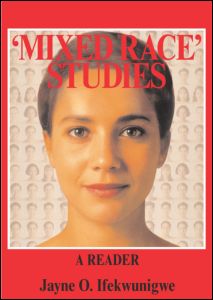
Mixed race studies is one of the fastest growing, as well as one of the most important and controversial areas in the field of race and ethnic relations. Bringing together pioneering and controversial scholarship from both the social and the biological sciences, as well as the humanities, this reader charts the evolution of debates on ‘race’ and ‘mixed race’ from the nineteenth to the twenty-first century. The book is divided into three main sections:

  • tracing the origins: miscegenation, moral degeneracy and genetics
  • mapping contemporary and foundational discourses: ‘mixed race’, identities politics, and celebration
  • debating definitions: multiraciality, census categories and critiques.

This collection adds a new dimension to the growing body of literature on the topic and provides a comprehensive history of the origins and directions of ‘mixed race’ research as an intellectual movement. For students of anthropology, race and ethnicity, it is an invaluable resource for examining the complexities and paradoxes of ‘racial’ thinking across space, time and disciplines.

Table of Contents

  • Part 1:  Tracing the Origins: Miscegenation, Moral Degeneracy, and Genetics
  • Part 2:  Mapping Contemporary and Foundational Discourses: ‘Mixed Race’, Identities Politics, and Celebration
  • Part 3:  Debating Definitions: Multiraciality, Census Categories, and Critique.  Index.
Tags: , , , ,

Spurious Issues: Race And Multiracial Identity Politics In The United States

Posted in Anthropology, Books, Census/Demographics, Media Archive, Monographs, Politics/Public Policy, United States on 2009-09-24 19:34Z by Steven

Spurious Issues: Race And Multiracial Identity Politics In The United States

Westview Press
1999-08-12
240 pages
Hardcover ISBN-10: 0813336775; ISBN-13: 978-0813336770

Rainier Spencer, Director and Professor of Afro-American Studies; Professor of Interdisciplinary Studies
University of Nevada, Las Vegas

Recent times have seen the rise of a movement lobbying for explicit recognition of multiracial identity as separate from any other racial category. Factions in this movement have petitioned the government for the addition of a federal multiracial category to the census and to other official forms. While these attempts have as yet been unsuccessful, the potential impact of such a change cannot be overstated. Rainier Spencer takes up the claims of multiracial activists, subjecting their arguments to a level of scholarly rigor they have heretofore not been required to meet. Demonstrating that the twin justifications for a federal multiracial category—accuracy and self-esteem—are inherently contradictory, Spencer presents an absorbing analysis of race, multirace, and categorization that shakes the very foundations of racial identity on all sides. Spurious Issues is a critical examination of multiracial identity politics in the United States, and of the specific issues surrounding federal racial classification. It is also a book about race generally, an extended argument that invites and challenges its readers to assume a skeptical position in regard to one of the most widely accepted but rarely analyzed components of life in the United States.

Tags: ,

`Caucasian and Thai make a good mix’

Posted in Anthropology, Articles, Asian Diaspora, Media Archive, United Kingdom on 2009-07-06 20:08Z by Steven

`Caucasian and Thai make a good mix’

European Journal of Cultural Studies
Volume 12, Number 1 (February 2009)
pages 59-78
DOI: 10.1177/1367549408098705

Jin Haritaworn, Assistant Professor in Gender, Race and Environment at the Faculty of Environmental Studies
York University, Canada

This article examines the current celebration of Eur/Asianness in the media and popular culture. It traces representations of the `mixed race’ body, from colonial discourses of degeneracy and monstrosity to capitalist discourses of commercialized exoticism and `beauty’.  It then examines how people of Thai and non-Thai parentage interviewed in Britain and Germany in 2001 and 2002 negotiated gendered and racialized readings of their bodies. Narratives of multi-racialized embodiment brim with racism, as the `valuable’ or `pathological’, `good’ or `bad mixes’, of unlike body parts grafted onto each other. This necessitates a critical re-evaluation of `hybridity’ debates, which treat biological racism as a past phenomenon that can be metaphorized for cultural processes of identification.

Read or purchase the article here.

Tags: , , ,

White but Not Quite: Tones and Overtones of Whiteness in Brazil

Posted in Anthropology, Articles, Brazil, Caribbean/Latin America, Identity Development/Psychology, Literary/Artistic Criticism, Media Archive on 2009-07-02 21:21Z by Steven

White but Not Quite: Tones and Overtones of Whiteness in Brazil

Small Axe: A Caribbean Journal of Criticism
Volume 13, Number 2 (July 2009)
pages 39-56
DOI: 10.1215/02705346-2009-005

Patricia de Santana Pinho
State Univiersity of New York, Albany

This article analyzes anecdotes, jokes, standards of beauty, color categories, and media representations of “mixed-race” individuals to assess the junctions and disjunctions of whiteness and blackness in Brazil.  While the multiple and contradictory meanings of “racial” mixture stimulates a preference for whiteness, thus reducing the access to power by those deemed black, it simultaneously fuels a rejection for “pure” forms of whiteness as witnessed in the country’s celebration of morenidade (brownness).  Not all forms of miscegenation are valued in Brazil’s myth of racial democracy, and some “types of mixture” are clearly preferred in detriment of others. I argue that anti-black racism in Brazil is expressed not only against dark-skinned individuals, but it also operates in the devaluing of physical traits “deemed black” even in those who have lighter skin complexion, thus creating “degrees of whiteness.”  One’s “measure of whiteness,” therefore, is not defined only by skin color, but requires a much wider economy of signs where, together with other bodily features, hair texture is almost as important as epidermal tone. In any given context, the definition of whiteness is also, necessarily, shaped by the contours of gender and class affiliation.

Read or purchase the article here.

Tags: , , ,