Are Mestizos Hybrids? The Conceptual Politics of Andean Identities

Posted in Anthropology, Articles, Caribbean/Latin America, Identity Development/Psychology, Social Science on 2009-12-12 00:35Z by Steven

Are Mestizos Hybrids? The Conceptual Politics of Andean Identities

Journal of Latin American Studies
Volume 37, Issue 02
May 2005
pp 259-284
DOI: 10.1017/S0022216X05009004

Marisol de la Cadena, Associate Professor of Anthropology
University of California, Davis

Through a genealogical analysis of the terms mestizo and mestizaje, this article reveals that these voices are doubly hybrid. On the one hand they house an empirical hybridity, built upon eighteenth and nineteenth century racial taxonomies and according to which ‘mestizos’ are non-indigenous individuals, the result of biological or cultural mixtures. Yet, mestizos’ genealogy starts earlier, when ‘mixture’ denoted transgression of the rule of faith, and its statutes of purity. Within this taxonomic regime mestizos could be, at the same time, indigenous. Apparently dominant, racial theories sustained by scientific knowledge mixed with, (rather than cancel) previous faith based racial taxonomies. ‘Mestizo’ thus houses a conceptual hybridity – the mixture of two classificatory regimes – which reveals subordinate alternatives for mestizo subject positions, including forms of indigeneity.

Read the entire article here.

Tags: , ,

Nagô Grandma and White Papa: Candomblé and the Creation of Afro-Brazilian Identity

Posted in Anthropology, Books, Brazil, Caribbean/Latin America, History, Identity Development/Psychology, Media Archive, Monographs, Religion, Social Science on 2009-12-04 18:12Z by Steven

Nagô Grandma and White Papa: Candomblé and the Creation of Afro-Brazilian Identity

University of North Carolina Press
September 2009
208 pages
6.125 x 9.25, 2 figs., 4 tables, notes, bibl., index
Cloth ISBN: 978-0-8078-3177-9
Paper ISBN: 978-0-8078-5975-9

Beatriz Góis Dantas, Professor Emerita of Anthropology
Universidade Federal de Sergipe in Brazil

Translated by Stephen Berg

Nagô Grandma and White Papa is a signal work in Brazilian anthropology and African diaspora studies originally published in Brazil in 1988. This edition makes Beatriz Góis Dantas’s historioethnographic study available to English-speaking audiences for the first time.

Dantas compares the formation of Yoruba (Nagô) religious traditions and ethnic identities in the Brazilian states of Sergipe and Bahia, revealing how they diverged from each other due to their different social and political contexts and needs. By tracking how markers of supposedly “pure” ethnic identity and religious practice differed radically from one place to another, Dantas shows the social construction of identity within a network of class-related demands and alliances. She demonstrates how the shape and meaning of “purity” have been affected by prolonged and complex social and cultural mixing, compromise, and struggle over time. Ethnic identity, as well as social identity in general, is formed in the crucible of political relations between social groups that purposefully mobilize and manipulate cultural markers to define their respective boundaries–a process, Dantas argues, that must be applied to understanding the experience of African-descended people in Brazil.

Tags: , ,

The Idea Of Race

Posted in Anthologies, Anthropology, Books, Brazil, History, Media Archive, Philosophy, Politics/Public Policy, Social Science on 2009-12-04 00:08Z by Steven

The Idea Of Race

Hackett Publishing Company
2000
256 pages
Cloth ISBN: 0-87220-459-6, ISBN-13: 978-0-87220-459-1
Paper ISBN: 0-87220-458-8, ISBN-13: 978-0-87220-458-4

Edited by

Robert Bernasconi, Edwin Erle Sparks Professor of Philosophy
Pennsylvania State University

Tommy L. Lott, Professor of Philosophy
San José State University

A survey of the historical development of the idea of race, this anthology offers pre-twentieth century theories about the concept of race, classic twentieth century sources reiterating and contesting ideas of race as scientific, and several philosophically relevant essays that discuss the issues presented. A general Introduction gives an overview of the readings. Headnotes introduce each selection. Includes suggested further readings.

Table of Contents
Introduction

The Classification of Races

  1. Francois Bernier, “A new division of earth, according to the different species or races of men who inhabit it”
  2. Francois-Marie Voltaire, “Of the Different Races of Men,” from The Philosophy of History
  3. Immanuel Kant, “Of the Different Human Races”
  4. Johann Gottfried von Herder, Ideas on the Philosophy of the History of Humankind
  5. Johann Friedrich Blumenbach, On the Natural Variety of Mankind
  6. G. W. F. Hegel, “Anthropology,” from The Encyclopedia of Philosophical Science

Science and Eugenics

  1. Arthur de Gobineau, The Inequality of Human Races
  2. Charles Darwin, “On the Races of Man,” from The Descent of Man
  3. Francis Galton, “Eugenics: Its Definition, Scope and Aims”

Heredity and Culture

  1. Franz Boas, “Instability of Human Types”
  2. Alain Locke, “The Concept of Race as applied to Social Culture”
  3. Ashley Montagu, “The Concept of Race in the Human Species in the Light of Genetics”

Race and Political Ideology

  1. W. E. B. Du Bois, The Conservation of Races
  2. Anthony Appiah, “The Uncompleted Argument: Du Bois and the Illusion of Race”
  3. Leopold Senghor, “What is Negritude?”

Racial Identity

  1. Linda Alcoff, “Mestizo Identity”
  2. Michael Hanchard, “Black Cinderella? Race and the Public Sphere in Brazil”
  3. Michael Omi and Howard Winant, Racial Formation in the United States.
Tags: , , , , , , , , , , , , , , , , , , ,

The Creolization Reader: Studies in Mixed Identities and Cultures

Posted in Anthologies, Anthropology, Books, Media Archive, Social Science on 2009-11-28 02:15Z by Steven

The Creolization Reader: Studies in Mixed Identities and Cultures

Routledge
2009-09-10
416 pages
Paperback ISBN: 978-0-415-49854-8
Hardback ISBN: 978-0-415-49713-8

Edited by

Robin Cohen, Professor of Development Studies and Director of the International Migration Institute
University of Oxford

Paola Toninato, Research Fellow in Sociology and Italian Studies
University of Warwick

Increasingly, ‘creolization’ is used to analyse ‘cultural complexity’, ‘cosmopolitanism’, ‘hybridity’, ‘syncretism’ and ‘mixture’, prominent and growing characteristics of the global age. The Creolization Reader captures all these meanings. Attention to the ‘creolizing world’ has enormous potential as a suggestive way of describing our complex world and the diverse societies in which we all now live. The Creolization Reader illuminates old creole societies and emerging cultures and identities in many parts of the world. Areas covered include Latin America, the Indian Ocean, the Caribbean, West, South and East Africa, the Pacific and the USA. Our authors provide an authoritative review, conspectus and critique of many aspects of creolization. This book is divided into five main sections covering the following key topics:

  • Concepts and Theories
  • The Creolized World
  • Popular Culture
  • Kindred Concepts
  • The Creolizing World

Each section begins with a brief introduction summarizing the key arguments of the contributors, while the editors provide a provocative and comprehensive introduction to the debates provoked by creolization theory. The Creolization Reader is multi-disciplinary and includes 28 readings and original contributions drawn mainly from history, sociology, development studies, anthropology and cultural studies.

Table of Contents

PART 1: CONCEPTS AND THEORIES 1. Creolité and the Process of Creolization 2. Creoles, Capitalism and Colonialism 3. Creolization and its Discontents 4. Creolization and Creativity 5. In Praise of Créolité PART 2: THE CREOLIZED WORLD 6. The Creolité Movement: Paradoxes of a French Caribbean Orthodoxy 7. Creolization and Creole Societies 8. Creolization and Globalization in Réunion 9. Ethnicity and Identity: Creoles of Colour in Louisiana 10. Creolization and Nation-Building in the Hispanic Caribbean 11. The Evolution of a Creole Identity in Cape Verde PART 3: POPULAR CULTURE 12. Calypso Reinvents Itself 13. Capoeira: The History of an Afro-Brazilian Martial Art 14. Louisiana Creole Food Culture 15. African Gods in Contemporary Brazil 16. Architectural Creolization 17. Masquerade Politics PART 4: KINDRED CONCEPTS 18. Hybridity in Cultural Theory: Encounters of a Heterogeneous Kind 19. Mestizaje in Latin America 20. Conceiving Transnationalism 21. Conceiving Cosmopolitanism 22. Syncretism and its Synonyms: Reflections on Cultural Mixture PART 5: THE CREOLIZING WORLD 23. A Creolizing South Africa? Mixing, Hybridity and Creolization 24. Sacred Subversions? Syncretic Creoles, the Indo-Caribbean, and ‘Cultures in-between’ 25. Creolization in Transnational Japan-America 26. Creolization and Nation-Building in Indonesia 27. Swahili Creolization: The Case of Dar es Salaam 28. The World in Creolization.

Tags: , ,

Situating “Race” And Racisms In Space, Time, And Theory: Critical Essays for Activists and Scholars

Posted in Anthologies, Anthropology, Books, Media Archive, Social Science on 2009-11-18 03:28Z by Steven

Situating “Race” And Racisms In Space, Time, And Theory: Critical Essays for Activists and Scholars

McGill-Queen’s University Press
2005-04-27
256 pages
6 x 9
Paper: (0773528873) 9780773528871
Cloth: (0773528865) 9780773528864

Edited by

Jo-Anne Lee, Associate Professor of Women’s Studies
University of Victoria

John Sutton Lutz, Associate Professor of History
University of Victoria
A resource for anti-racist scholars and activists.

Grounded in real life and theoretically charged, the nine essays in this interdisciplinary collection explore how race, racisms, and racialization are changing and suggest strategies for reading their emerging forms and discourses. Race has historically been defined by visible difference, but the slippery nature and malleability of racisms and racialising processes challenge scholars and activists to remain vigilant, responsive, and critical in their analyses and actions.

This collection explores the strengths and weaknesses of postmodern social theory in the struggle against racism. Recognizing diversity as a conduit for resilience, endurance, and strength, the editors have tried to encourage coalition building by bringing together historians, sociologists, cultural theorists, and literary scholars in dialogue with artists and activists. Topics considered include nation formation, racialized states, cultural racism, multiculturalism, hyphenated and mixed-race identities, media and representation, and shifting identities.

Contributors include Jeannette Armstrong, director of the En’owkin International School of Writing in Penticton, Canada; Frances Henry, professor emirita at York University; Yasmin Jiwani, assistant professor in the Department of Communication Studies at Concordia University; Paul Maylam, chair of the Department of History at Rhodes University, South Africa; Minelle Mahtani, assistant professor in the Department of Geography and Planning, and the Program in Journalism, University of Toronto; Roy Miki, professor of contemporary literature in the English Department at Simon Fraser University; Roxana Ng, professor in the Department of Adult Education, Community Development and Counselling Psychology at the Ontario Institute of Secondary Education/University of Toronto; Ali Rattansi, retired professor of sociology at City University London; Ann Stoler, distinguished professor and chair, Department of Anthropology, New School University in New York; and Carol Tator, course coordinator in the Department of Anthropology, York University.

Table of Contents

Acknowledgments
Preface

Introduction: Toward a Critical Literacy of Racisms, Anti-Racisms?
and Racialization

Jo-Anne Lee and John Lutz

Deconstructing Race? Deconstructing Racism (with Postscript 2004)
A Conversation Between Jeannette Armstrong and Roxana Ng

On Being and not Being Brown/Black-British: Racism, Class, Sexuality?
and Ethnicity in Post-Imperial Britain (with Postscript 2004: The Politics of Longing and (Un)Belonging, Fear? and Loathing)

Ali Rattansi

Mixed Metaphors: Positioning ?Mixed Race? Identity
Minelle Mahtani

Turning In, Turning Out: The Shifting Formations of ?Japanese Canadian? from Uprooting to Redress
Roy Miki

Racist Visions for the Twenty-First Century: On the Banal Force of the French Radical Right
Ann Laura Stoler

Unravelling South Africa?s Racial Order: The Historiography of Racism, Segregation? and Apartheid
Paul Maylam

A Critical Discourse Analysis of the Globe and Mail Editorials on Employment Equity
Frances Henry and Carol Tator

Orientalizing ?War Talk?: Representations of the Gendered Muslim Body Post-9/11 in The Montreal Gazette
Yasmin Jiwani

Contributors
Index

Tags: , , , , , , , , , , ,

Legalizing Identities: Becoming Black or Indian in Brazil’s Northeast

Posted in Anthropology, Books, Brazil, Caribbean/Latin America, History, Identity Development/Psychology, Law, Media Archive, Monographs, Social Science on 2009-11-17 05:40Z by Steven

Legalizing Identities: Becoming Black or Indian in Brazil’s Northeast

University of North Carolina Press
June 2009
272 pages
6.125 x 9.25, 18 illus., 2 maps, notes, bibl., index
Cloth ISBN  978-0-8078-3292-9
Paper ISBN  978-0-8078-5951-3

Jan Hoffman French, Assistant Professor of Anthropology
University of Richmond

Anthropologists widely agree that identities—even ethnic and racial ones—are socially constructed. Less understood are the processes by which social identities are conceived and developed. Legalizing Identities shows how law can successfully serve as the impetus for the transformation of cultural practices and collective identity. Through ethnographic, historical, and legal analysis of successful claims to land by two neighboring black communities in the backlands of northeastern Brazil, Jan Hoffman French demonstrates how these two communities have come to distinguish themselves from each other while revising and retelling their histories and present-day stories.

French argues that the invocation of laws by these related communities led to the emergence of two different identities: one indigenous (Xocó Indian) and the other quilombo (descendants of a fugitive African slave community). With the help of the Catholic Church, government officials, lawyers, anthropologists, and activists, each community won government recognition and land rights, and displaced elite landowners. This was accomplished even though anthropologists called upon to assess the validity of their claims recognized that their identities were “constructed.” The positive outcome of their claims demonstrates that authenticity is not a prerequisite for identity. French draws from this insight a more sweeping conclusion that, far from being evidence of inauthenticity, processes of construction form the basis of all identities and may have important consequences for social justice.

Tags: , , ,

The Coexistence of Race and Racism: Can They Become Extinct Together?

Posted in Anthropology, Books, Media Archive, Monographs, Social Science on 2009-11-16 23:04Z by Steven

The Coexistence of Race and Racism: Can They Become Extinct Together?

University Press of America
June 2005
204 pages
Paper 0-7618-3213-0 / 978-0-7618-3213-3

Janis Faye Hutchinson, Associate Professor of Anthropology
University of Houston

Race and racism are interconnected historically and in the modern world. This connection is related to changing social, political, and economic conditions that impact how we think of others and ourselves. Race and racism are also connected to biological discoveries that justify how we think of others and ourselves. The main focus of this book is the examination of these connections. It is argued that while both race and racism are social constructions, the justification for racism changed as the definition and attributes of races were modified to correspond with new developments in biology and genetics.

Whereas biological discoveries are one side of this construction, changing social situations represent the other. That is, racism also responds to changing social, political, and economic conditions that alter its justification. In addition, scientific constructions of race are impacted by social factors that serve to direct the “scientific disclosures” on human diversity. These factors form the context for the intricate relationship between race and racism.

Tags: ,

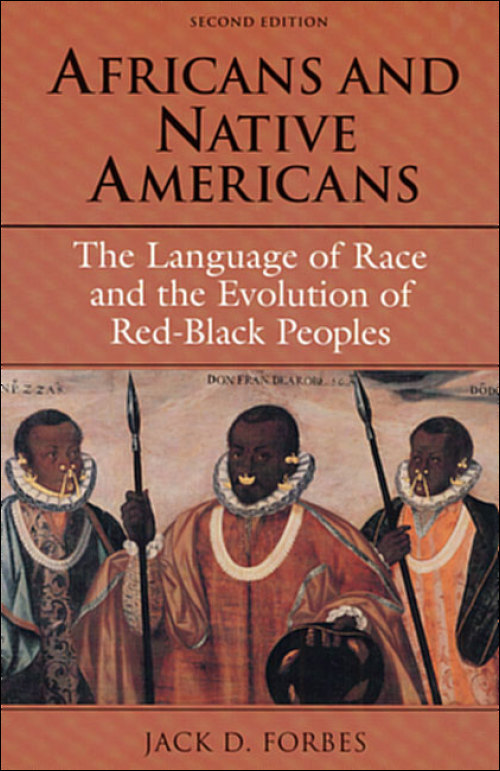
Africans and Native Americans: The Language of Race and the Evolution of Red-Black Peoples (Second Edition)

Posted in Anthropology, Books, Canada, Caribbean/Latin America, Europe, History, Media Archive, Monographs, Native Americans/First Nation, United States on 2009-11-11 18:16Z by Steven

Africans and Native Americans: The Language of Race and the Evolution of Red-Black Peoples (Second Edition)

University of Illinois Press
1993
Paper: 978-0-252-06321-3
352 pages

Jack D. Forbes, Professor Emeritus. Native American Studies and Anthropology
University of California, Davis

This volume will revise the way we look at the modern populations of Latin America and North America by providing a totally new view of the history of Native American and African American peoples throughout the hemisphere. Africans and Native Americans explores key issues relating to the evolution of racial terminology and European colonialists’ perceptions of color, analyzing the development of color classification systems and the specific evolution of key terms such as black, mulatto, and mestizo, which no longer carry their original meanings. Jack Forbes presents strong evidence that Native American and African contacts began in Europe, Africa, and the Caribbean and that Native Americans may have crossed the Atlantic long before Columbus.

Tags: , ,

Black Europe and the African Diaspora

Posted in Anthologies, Anthropology, Books, Europe, Identity Development/Psychology, Media Archive, Social Science on 2009-11-11 16:35Z by Steven

Black Europe and the African Diaspora

University of Illinois Press
2009
368 pages
6 x 9 in. 
15 black & white photographs, 1 map
Cloth: ISBN 978-0-252-03467-1
Paper: ISBN 978-0-252-07657-2

Edited by

Darlene Clark Hine, Board of Trustees Professor of African American Studies
Northwestern University

Trica Danielle Keaton, Associate Professor of African American and Diaspora Studies
the University of Minnesota, Twin Cities

Stephen Small, Associate Professor of African American Studies
University of California, Berkeley

Multifaceted analyses of the African diaspora in Europe

The presence of Blacks in a number of European societies has drawn increasing interest from scholars, policymakers, and the general public. This interdisciplinary and multi-disciplinary collection penetrates the multifaceted Black presence in Europe, and, in so doing, complicates the notions of race, belonging, desire, and identities assumed and presumed in revealing portraits of Black experiences in a European context. In focusing on contemporary intellectual currents and themes, the contributors theorize and re-imagine a range of historical and contemporary issues related to the broader questions of blackness, diaspora, hegemony, transnationalism, and “Black Europe” itself as lived and perceived realities.

Contributors are Allison Blakely, Jacqueline Nassy Brown, Tina Campt, Fred Constant, Alessandra Di Maio, Philomena Essed, Terri Francis, Barnor Hesse, Darlene Clark Hine, Dienke Hondius, Eileen Julien, Trica Danielle Keaton, Kwame Nimako, Tiffany Ruby Patterson, T. Denean Sharpley-Whiting, Stephen Small, Tyler Stovall, Alexander G. Weheliye, Gloria Wekker, and Michelle M. Wright.

Tags: , , , , , , , , , , , , , , , , , , , , , , ,

Rise and Fall of the Cosmic Race: The Cult of Mestizaje in Latin America

Posted in Anthropology, Books, Brazil, Caribbean/Latin America, History, Identity Development/Psychology, Media Archive, Monographs, Politics/Public Policy, Social Science on 2009-11-10 04:31Z by Steven

Rise and Fall of the Cosmic Race: The Cult of Mestizaje in Latin America

University of Texas Press
2004
6 x 9 in.
216 pp., 3 b&w illus.
ISBN: 978-0-292-70596-8

Marilyn Grace Miller, Assistant Professor of Spanish and Portuguese
Tulane University, New Orleans

Latin America is characterized by a uniquely rich history of cultural and racial mixtures known collectively as mestizaje. These mixtures reflect the influences of indigenous peoples from Latin America, Europeans, and Africans, and spawn a fascinating and often volatile blend of cultural practices and products. Yet no scholarly study to date has provided an articulate context for fully appreciating and exploring the profound effects of distinct local invocations of syncretism and hybridity. Rise and Fall of the Cosmic Race fills this void by charting the history of Latin America’s experience of mestizaje through the prisms of literature, the visual and performing arts, social commentary, and music.

In accessible, jargon-free prose, Marilyn Grace Miller brings to life the varied perspectives of a vast region in a tour that stretches from Mexico and the Caribbean to Brazil, Ecuador and Argentina. She explores the repercussions of mestizo identity in the United States and reveals the key moments in the story of Latin America’s cult of synthesis. Rise and Fall of the Cosmic Race examines the inextricable links between aesthetics and politics, and unravels the threads of colonialism woven throughout national narratives in which mestizos serve as primary protagonists.

Illuminating the ways in which regional engagements with mestizaje represent contentious sites of nation building and racial politics, Miller uncovers a rich and multivalent self-portrait of Latin America’s diverse populations.

Tags: , , ,