Poetry: Three Treasures by Hannah Lowe

Posted in Articles, Asian Diaspora, Autobiography, Media Archive, Poetry on 2012-09-24 02:39Z by Steven

Poetry: Three Treasures by Hannah Lowe

Freeword: a global meeting place for literature, argument and free thinking
2012-06-12

Hannah Lowe

A panelist at ‘2 Nations’, our recent event exploring national identity, Hannah Lowe is a poet of Chinese, Jamaican and English heritage. In this poem she performed for the audience that night, she explores how her background has influenced her sense of her own identity.

Three Treasures

Jamaica in the attic in a dark blue trunk,
sea-salt in the hinges. What must it look like
all that wide blue sea?

England downstairs in a rocking chair.
Nanna rocking with her playing cards,
cigs and toffee, tepid tea.

Jamaica frying chicken in the kitchen,
pig-snout in the stew-pot,
breakfast pan of saltfish, akee

China in the won-ton skin,
gold songbird on the brittle porcelain,
pink pagoda silk settee…

Read the entire poem here.
Tags: ,

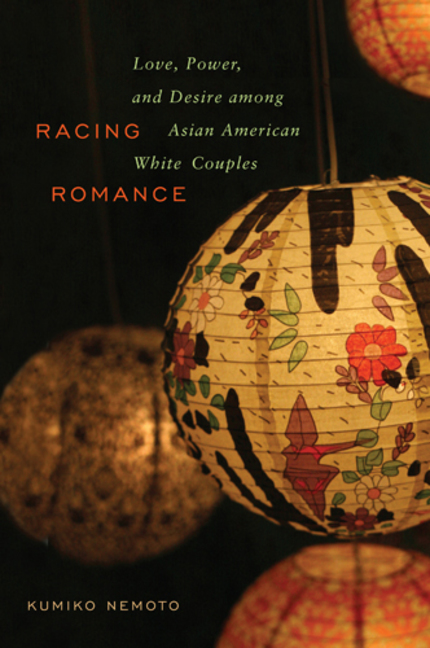
Racing Romance: Love, Power, and Desire Among Asian American/ White Couples

Posted in Asian Diaspora, Books, Media Archive, Monographs, Social Science, United States on 2012-09-23 03:06Z by Steven

Racing Romance: Love, Power, and Desire Among Asian American/ White Couples

Rutgers University Press
June 2009
208 pages
6 x 9
Paper ISBN: 978-0-8135-4533-2
Cloth ISBN: 978-0-8135-4532-5
Web PDF ISBN: 978-0-8135-4852-4

Kumiko Nemoto, Associate Professor of Sociology
Western Kentucky University

Despite being far from the norm, interracial relationships are more popular than ever. Racing Romance sheds special light on the bonds between whites and Asian Americans, an important topic that has not garnered well-deserved attention until now. Incorporating life-history narratives and interviews with those currently or previously involved with an interracial partner, Kumiko Nemoto addresses the contradictions and tensions—a result of race, class, and gender—that Asian Americans and whites experience.

Similar to black/white relationships, stereotypes have long played crucial roles in AsianAmerican/white encounters. Partners grapple with media representations of Asian women as submissive or hypersexual and Asian men are often portrayed as weak laborers or powerful martial artists. Racing Romance reveals how allegedly progressive interracial relationships remain firmly shaped by the logic of patriarchy and gender inherent to the ideal of marriage, family, and nation in America, even as this ideal is juxtaposed with discourses of multiculturalism and color blindness.

Tags: ,

Poet to discuss biracialism during UHV/ABR Fall Reading Series

Posted in Articles, Asian Diaspora, Live Events, Media Archive, Poetry, United States, Women on 2012-09-21 03:19Z by Steven

Poet to discuss biracialism during UHV/ABR Fall Reading Series

University of Houston-Victoria Newswire
Victoria, Texas
2012-09-20

Born to a Chinese mother and a Norwegian father, award-winning author Paisley Rekdal’s mixed heritage often influences her poetry and essay writing.

She will share her insights about biracialism on Sept. 27 as the second speaker in the University of Houston-Victoria/American Book Review Fall Reading Series. Rekdal also will give a reading of her poetry.

The event will begin at noon in the Alcorn Auditorium of UHV University West, 3007 N. Ben Wilson St. It is free and open to the public. Light refreshments will be served.

“Rekdal’s interesting mix of style and subject matter is a great addition to our reading series,” said Jeffrey Di Leo, ABR editor and publisher, and dean of the UHV School of Arts & Sciences. “As an Asian American, she gives a voice to a part of biracialism that is underrepresented and continues that theme to other subjects that are often overlooked.”

During the event, Rekdal plans on reading and sharing photographs from her latest book, “Intimate: An American Family Album.” The book is a hybrid photo-text memoir that combines poems, fiction and nonfiction with photography from Edward S. Curtis, a famous photographer of the American West and Native American people.

The book explores her father’s mixed-race marriage to her mother while paralleling it with stories about Curtis and his Indian guide, Alexander Upshaw. Rekdal found inspiration by looking at photographs from Curtis and imagined his life.

“It’s a memoir about my family, but it also talks about representation of mixed-race people or how they are not represented,” she said…

Read the entire article here.

Tags: , , ,

Intimate: An American Family Photo Album

Posted in Asian Diaspora, Autobiography, Books, Media Archive, Monographs, Poetry, United States, Women on 2012-09-21 03:11Z by Steven

Intimate: An American Family Photo Album

Tupelo Press
April 2012
300 pages
Paperback ISBN: 978-1-932195-96-5
Clothbound ISBN: 978-1-936797-08-0

Paisley Rekdal, Professor of English
University of Utah

Intimate is a hybrid memoir and “photo album” that blends personal essay, historical documentary, and poetry to examine the tense relationship between self, society, and familial legacy in contemporary America. Typographically innovative, Intimate creates parallel streams, narrating the stories of Rekdal’s Norwegian-American father and his mixed-race marriage, the photographer Edward S. Curtis, and Curtis’s murdered Apsaroke guide, Alexander Upshaw. The result is panoramic, a completely original literary encounter with intimacy, identity, family relations, and race.

Tags: , , ,

Living in Ambiguity with Carl Olsen

Posted in Asian Diaspora, Audio, Identity Development/Psychology, Interviews, Live Events, Media Archive, United States on 2012-09-06 01:58Z by Steven

Living in Ambiguity with Carl Olsen

Mixed Race Radio
2012-09-05, 16:00Z (12:00 EDT, 09:00 PDT)

Tiffany Rae Reid, Host

Carl Olsen
Colorado State Univeristy

Carl is a regular guest on Mixed Race Radio and self- identifies as Japanese and White. Originally Carl was going to discuss his experience being marked as white on a traffic ticket (that I got for speeding…).

Now however, I have invited Carl on to the show to discuss his thesis entitled, “Living in Ambiguity: Perceptions of Mixed Race and the Mixed Race Experience at Colorado State University.”

In addition, Carl is  conducting interviews with CSU students who self identify as having two or more races, checked the multiracial box on the admission form, and/or self-identify as mixed/multi/biracial.  Hopefully, this data will help Carl to  develop a model for creating a “Mixed Race Resource Center” of some sort, modeled after centers such as Black/African-American Cultural Centers, Asian/Pacific American Cultural Centers, etc. Carl is also serving as the advisor for SHADES of CSU, the mixed-race student organization on campus.

Carl has a perception survey to administer, and it’s one question: When you think of a mixed race/biracial/multiracial individual, what 5 words or phrases would you use to describe them?

I thought we could help him.

Play in your default player here.

Tags: , , , ,

In Michigan, most people identify me as Asian, but here in California, I’m a white guy.

Posted in Asian Diaspora, Excerpts/Quotes on 2012-09-06 01:27Z by Steven

“In Michigan, most people identify me as Asian, but here in California, I’m a white guy,” Mark-Griffin said…

Chelsea Hawkins, “Mixed But Not Divided: Multi-ethnic populations redefine racial lines,” City on a Hill Press: A Student-Run Newspaper (University of California, Santa Cruz), October 20, 2011. http://www.cityonahillpress.com/2011/10/20/mixed-but-not-divided/

Tags: ,

Romancing the Raj: Interracial Relations in Anglo-Indian Romance Novels

Posted in Articles, Asian Diaspora, Literary/Artistic Criticism, Media Archive on 2012-09-01 01:00Z by Steven

Romancing the Raj: Interracial Relations in Anglo-Indian Romance Novels

History of Intellectual Culture
Volume 4, Number 1 (2004)
ISSN 1492-7810

Hsu-Ming Teo, Senior Lecturer and Head of Modern History
Macquarie University, Sydney, Australia

This article examines Anglo-Indian romance novels written by British women during the period of the Raj. It argues that these love stories were symptomatic of British fantasies of colonial India and served as a forum to explore interracial relations as well as experimenting with the modern femininity of the New Woman. With the achievement of Indian independence in 1947, British interest in India as a locus for romance rapidly declined, thus demonstrating that these novels were never concerned with India but with British lives and British colonialism.

Read the article here in HTML or PDF format.

Tags: , ,

Q&A: Professor examines those ‘outside the color lines’ in new book

Posted in Articles, Asian Diaspora, History, Media Archive, Social Science, United States on 2012-08-31 23:56Z by Steven

Q&A: Professor examines those ‘outside the color lines’ in new book

University of Wisconsin-Madison
News
2012-10-20

Jenney Price

The history of segregation in the United States is often seen in black and white. Leslie Bow, professor of English and Asian American studies, is interested in the experiences of communities that fell outside those color lines. In her new book, Partly Colored: Asian Americans and Racial Anomaly in the Segregated South, Bow examines what segregation demanded of people who did not fall into the category of black or white — including Asians, American Indians and people of mixed race.

Wisconsin Week: What did segregation mean for people who — as you described it — stood outside the color lines? You posed the question, “Where did the Asian sit on the segregated bus?’

Leslie Bow: I think what’s most interesting to me about a project like this is that we often conflate race with African-Americans or see race as a black-white issue. When we say “multiculturalism” … we don’t think conceptually or theoretically about the challenge that poses to the way we think about racial history in the United States…

…WW: You mentioned your parents, who are Chinese-American. They attended white schools in Arkansas but didn’t socialize with and weren’t invited to the homes of their white classmates and I wondered how much their experience impacted your research interests?

LB: Definitely, because it was something that they themselves did not talk about. What I found was that they mediated that experience by creating a third level of segregation where there was limited social engagement with either whites or blacks. Their social context was wholly Chinese-American at the time. So, to me that was just the jumping off point for really an exploration of ambiguity, which is very much the bread and butter of literary studies: How you come to this process of interpreting multiple meanings within any given text…

Read the entire article here.

Tags: , ,

Purdu­e Hapa Stude­nt Assoc­iatio­n Callo­ut Sept. 17, 2012

Posted in Asian Diaspora, Campus Life, Forthcoming Media, Live Events, United States on 2012-08-30 23:00Z by Steven

Purdu­e Hapa Stude­nt Assoc­iatio­n Callo­ut Sept. 17, 2012

Purdue University
West Lafayette, Indiana
Class of 1950, Room 121
2012-09-17, 18:00-20:00 CDT (Local Time)

The term “Hapa” refers to a biracial/multiracial person with Asian and/or Pacific Islander roots. As a club, we promote both diversity and unity, and we strive to raise awareness of identity crisis amongst Hapas, as well as Asian interest on campus. With leadership and volunteering opportunities, memorable events, and fellow club members to create long lasting memories and friendships, Purdue HSA is Purdue’s newest upcoming organization. Come to our callout to learn more about what HSA is all about!

For more information, click here.

Tags: ,

Hidden Hapa

Posted in Articles, Asian Diaspora, Media Archive on 2012-08-29 21:17Z by Steven

Hidden Hapa

Stephen Murphy-Shigematsu
2012-04-06

Stephen Murphy-Shigematsu
Stanford University

“Hey, what are you doing over there with the Hapa?”

Kathy and I looked over and there were three of our Japanese American friends at another table smiling at us, one with a mischievous grin. Sandy had jokingly pointed out that I was a mixed blood amidst a group of full bloods. Kathy and I smiled back at them and returned to our conversation.
 
But Kathy suddenly surprised me by saying, “Actually, I’m kind of mixed too; my mother is from Okinawa; like an interracial marriage to Japanese.” I looked over at my friends and remembered that one of them had told me his father was Chinese. Hey, that makes three of us and only two of them!
 
I recalled this incident when I read yesterday in the New York Times that while Asian Americans still have one of the highest interracial marriage rates in the country, Asian Americans are marrying other Asian Americans more often than in recent years. The article reported that many of these couples are of different ethnicities, such as Chinese-Indian and Filipino-Vietnamese. This means that mixed Asian Americans will continue to increase, and that many of them will not be apparently ethnically mixed. Of course, these individuals exist now and the diversity among any ethnically defined subgroup of Asian Americans is far greater than assumed. Little is know about their experience, and I think they are generally not regarded as Hapa and may not consider themselves to be Hapa. But as for others, such as black Asians, who now feel excluded from Hapa circles, a space to express mixed ancestries may be appreciated. Developing these welcome spaces is a challenge facing Asian American communities…

Read the entire essay here.

Tags: