A Letter to My Father: Growing up Filipina and American

Posted in Asian Diaspora, Autobiography, Books, Identity Development/Psychology, Media Archive, Monographs, United States, Women on 2010-01-11 19:29Z by Steven

A Letter to My Father: Growing up Filipina and American

University of Oklahoma Press
2008
184 pages
5.5″ x 8.5″ x 0″
8 b&w illustrations, 2 maps
Cloth ISBN: 978-0-8061-3909-8

Helen Madamba Mossman

Going from the jungles of the wartime Philippines to the schoolyards of northwestern Oklahoma is no easy transition. For one twelve-year-old girl, it meant distance not only across the globe but also within her own family.

Born to a Filipino father and an American mother, Helen Madamba experienced terrifying circumstances at a young age. During World War II, her father, Jorge, fought as an American soldier in his native Philippines, and his family camped in jungles and slept in caves for more than two years to evade capture by the Japanese. But once the family relocated to Woodward, Oklahoma, young Helen faced a different kind of struggle.

Here Mossman tells of her efforts to repudiate her Asian roots so she could fit into American mainstream culture—and her later efforts to come to terms with her identity during the tumultuous 1960s. As she recounts her father’s wartime exploits and gains an appreciation of his life, she learns to rejoice in her biracial and multicultural heritage.

Written with the skill of a gifted storyteller and graced with photos that capture both of Helen’s worlds, A Letter to My Father is a poignant story that will resonate with anyone familiar with the struggle to reconcile past and present identities.

Tags: , , , ,

Being Māori-Chinese: Mixed Identities (Book Review)

Posted in Anthropology, Articles, Asian Diaspora, Book/Video Reviews, Media Archive, Oceania, Social Science on 2010-01-11 19:19Z by Steven

Being Māori-Chinese: Mixed Identities (Book Review)

Sites: a journal of social anthropology and cultural studies
University of Otago, New Zealand
Volume 5, Number 2 (2008)
pages 180-182

Kate Bagnall

Being Māori-Chinese: Mixed Identities, Manying Ip, Auckland University Press, Auckland, 2008, 255pp. ISBN 978-1-86940-399-7

Manying Ip makes it clear from the outset that Being Māori-Chinese: Mixed Identities is a very personal book. It begins with an explanation of her own inspiration for the project – the emergence of tantalising snippets about Māori-Chinese families that kept popping up in her wider research on New Zealand Chinese – and her own process of locating subjects and conducting interviews. Ip tells of being warned by a ‘well-meaning elder’ from Te Wānangao-Raukawa about the difficulties she would encounter in her project, due to the sensitivity of the subject matter and the reticence that Māori-Chinese as a group would have towards sharing in-depth information with her. ‘Are you sure you wish to pursue this study on Māori-Chinese relations? I don’t think people will tell you much’, he said.

The publication of Being Māori-Chinese is, then, an acknowledgement of Ip’s reputation as a researcher and community advocate. It is only through mutual trust that she has been given access to the personal stories of the seven Māori-Chinese families whose experiences make up the heart of the book.  Each chapter focuses on a particular family and presents an intimate journey into the family culture and individual identities of family members. The book is further testament to the courage and generosity of her subjects, who shared memories and thoughts on many aspects of their lives. Their generosity is particularly moving because, as Ip states, ‘those memories involve a struggle against social discrimination and, in many cases, family disapproval’…

Family stories, such as those told in Being Māori-Chinese, are at the core of the growing body of Australasian scholarship that explores mixed race lives, families and communities. Such stories counter the assumptions of previous generations that interracial encounters were either unthinkable due to race prejudice or occurred under unsavoury conditions that were detrimental to one or both parties. Ip is to be commended for encouraging the Māori-Chinese families included in the book to share their experiences, and also for carefully structuring each chapter so that her voice takes a secondary place to those of family members themselves. As she notes in her Introduction, the book explores lives that ‘have been largely overlooked in the formal historical and sociological discourse of New Zealand’. This book is an important step in inserting Māori-Chinese into the story of New Zealand’s past, present and future…

Read the entire review here.

Tags: , , , , ,

“We Have Always Been:” Mixed Race Experiences in the USA and French Polynesian (Tahitian) Contexts: 2010 Exploration Seminar in Tahiti

Posted in Asian Diaspora, Live Events, Media Archive, Social Science on 2010-01-09 02:31Z by Steven

“We Have Always Been:” Mixed Race Experiences in the USA and French Polynesian (Tahitian) Contexts: 2010 Exploration Seminar in Tahiti

University of Washington Exploration Seminars
Dates of Instruction: 2010-08-22 through 2010-09-10

Program Director: Steve Woodard and Alejandro Espania (Minority Affairs)

Ia Ora Na, friend!  Please know that this three (3) week seminar will take place in Tahiti, one of 130 main islands within the French Polynesian archipelago.   The dates for this seminar are August 22, 2010 through September 10, 2010. Participants should plan to participate in a pre-seminar, which will take place during the latter part of Spring Quarter 2010 at the University of Washington.

We invite you to join us as we traverse through, and push upon the boundaries of, the system of knowledge collectively referred to in the literature as multiracial theory.  Our expected resources include seminal and newly published texts about the mixed race experience, as well as the participants’ (and instructors’) own respective personal narratives.  Both ways of knowing will be routinely explored via purposeful dialogues, structured self-reflections, and organized large/small group and one-on-one community interactions…

For more information, click here.

Tags: , , ,

“El Destierro de los Chinos”: Popular Perspectives of Chinese-Mexican Interracial Marriage as Reflected in Poetry, Cartoon, Comedy, and Corridos

Posted in Asian Diaspora, Caribbean/Latin America, History, Literary/Artistic Criticism, Live Events, Mexico, New Media, Social Science on 2010-01-08 02:41Z by Steven

“El Destierro de los Chinos”: Popular Perspectives of Chinese-Mexican Interracial Marriage as Reflected in Poetry, Cartoon, Comedy, and Corridos

American Historical Association
124th Annual Meeting
Friday, 2010-01-10 11:20 PST (Local Time)
San Diego Marriott Hotel & Marina
Torrey 3 (Marriott)
San Diego, California

Robert Chao Romero, Assistant Professor, Chicana and Chicano Studies
University of California, Los Angeles

Drawing from poetry, cartoons, comedy, and musical recordings of the UCLA Frontera Collection, this paper examines the historical phenomenon of Chinese-Mexican intermarriage through the lense of Mexican popular culture of the early twentieth century. Popular Mexican culture portrayed Chinese cross-cultural marriages as relationships of abuse, slavery, and neglect, and rejected the offspring of such unions as sub-human, degenerative, and unworthy of full inclusion within the Mexican national community. Interracial marriage with prosperous Chinese merchants was scornfully depicted as a shameless short cut by which slothful Mexican women avoided the need to work and secured lives of material comfort. Such popular criticism of Chinese-Mexican interracial marriage, moreover, was often couched within larger discourses of revolutionary economic nationalism. Beyond presenting an historical examination of the phenomenon of Chinese-Mexican interracial marriage, as one important theoretical implication, this paper destabilizes prevalent notions of “mestizaje” within the disciplines of Latin American Studies and Latino Studies. It challenges the “white-brown” binary of traditional racial theory in Latino Studies and sounds a clarion call for further research and discussion related to the important contributions of Chinese, Japanese, African, Middle Eastern, and other overlooked ethnic immigrant groups to the Mexican and cultural melting pot.

Tags: , , , ,

Crossing Boundaries, Claiming a Homeland: The Mexican Chinese Transpacific Journey to Becoming Mexican, 1910s-1960s

Posted in Asian Diaspora, Caribbean/Latin America, History, Media Archive, Mexico, Papers/Presentations, Politics/Public Policy, Social Science on 2010-01-07 22:57Z by Steven

Crossing Boundaries, Claiming a Homeland: The Mexican Chinese Transpacific Journey to Becoming Mexican, 1910s-1960s

2009 Meeting of the Latin American Studies Association
Rio de Janeiro, Brazil
2009-06-11 through 2009-06-14

Julia María Schiavone Camacho, Assistant Professor of History
University of Texa, El Paso

On May 12, 1960, the Mexican Chinese community leader in Macau, Ramón Lay Mazo, wrote to a prominent Mexican widow, Doña Concepción Rodríguez Viuda de Aragón, in Tampico, Tamaulipas, Mexico. Seeking her continued support for the Mexican Chinese repatriation cause, he conveyed the deep, devoted love Mexican women living in China felt for their nation, Mexico. When he asked Mexican women in China whether they wanted to move to other countries, they replied, “Ni que me den un palacio allá, prefiero México, aunque vaya a vivir bajo un mesquite” (“Not even if they gave me a palace there, I prefer Mexico, even if I have to live under a mesquite”). Disheartened by the Mexican government’s disregard for them and their desperate situations, Ramón tried to convince Mexican women to consider living elsewhere. He warned them that Mexico might not be the same as it once was and that it might be more difficult to survive in the communities where they had once lived. To this the women rejoined, “Aunque vayamos a escarbar camotes amargos a la sierra, queremos México” (“Even if we have to dig for bitter sweet potatoes in the sierra, we want Mexico”). The conditions, where in the nation they might live, and how long they might have to wait were no matter. They wanted to return to the Mexican homeland they had longed for since years past…

Read the entire paper here.

Tags: , , ,

Ethnic Identity Among Mixed-Heritage People In Hawaii

Posted in Articles, Asian Diaspora, Identity Development/Psychology, Media Archive, United States on 2010-01-07 22:52Z by Steven

Ethnic Identity Among Mixed-Heritage People In Hawaii

Symbolic Interaction
Volume 14, Number 3 (Fall 1991)
Pages 261–277
DOI 10.1525/si.1991.14.3.261

Cookie White Stephan, Emeritus Professor of Sociology
New Mexico State University

In this study, intensive interviews were used to explore the identity of a sample of mixed-heritage Hawaiian college students from a variety of ethnic groups. The great majority of respondents listed at least one multiple-heritage identity (e.g., Chinese-Japanese). While cultural exposure and ethnic identity were strongly associated, cultural exposure is neither a necessary nor a sufficient condition for ethnic identity to occur. Differences in perceptions of ethnic identity between respondents with stable and situtionally changing identities were discussed. The conceptions of identity proposed by processual and structural symbolic interactionists both received some support in these data.

Read or purchase the article here.

Tags: , , ,

Crossing Boundaries, Claiming a Homeland: The Mexican Chinese Transpacific Journey to Becoming Mexican, 1930s–1960s

Posted in Articles, Asian Diaspora, Caribbean/Latin America, History, Identity Development/Psychology, Media Archive, Mexico, Politics/Public Policy, Social Science on 2010-01-07 20:17Z by Steven

Crossing Boundaries, Claiming a Homeland: The Mexican Chinese Transpacific Journey to Becoming Mexican, 1930s–1960s

Pacific Historical Review
Volume 78, Number 4 (November 2009)
pages 545–577
DOI 10.1525/phr.2009.78.4.545

Julia María Schiavone Camacho, Assistant Professor of History
University of Texa, El Paso

This article follows Mexican Chinese families from Mexico, across the Mexican-U.S. border, to China, and back to Mexico. Settling in northern Mexico in the nineteenth century, Chinese formed multiple ties with Mexicans. An anti-Chinese movement emerged during the Mexican Revolution and peaked during the Great Depression. The Mexican government deported several thousand Chinese men and their Mexican-origin families from Sonora and neighboring Sinaloa, some directly to China and others to the United States, whose immigration agents also deported the families to China. They arrived in Guangdong (Canton) Province but eventually congregated in Macau where they forged a coherent Mexican Chinese enclave. Developing a strategic Mexican nationalism, they appealed for repatriation. The Mexican Chinese “became Mexican” only after authorities compelled them to struggle for years from abroad for the inclusion of their mixed-race families in the nation. They became diasporic citizens and fashioned hybrid identities to survive in Mexico and China.

Tags: , , ,

“What are You?”: Explaining Identity as a Goal of the Multiracial Hapa Movement

Posted in Articles, Asian Diaspora, Identity Development/Psychology, New Media, Social Science, United States on 2010-01-07 18:18Z by Steven

“What are You?”: Explaining Identity as a Goal of the Multiracial Hapa Movement

Social Problems
Volume 56, Number 4 (November 2009)
Pages 722–745
DOI 10.1525/sp.2009.56.4.722

Mary Bernstein, Associate Professor of Sociology
University of Connecticut

Marcie De la Cruz
Empirical Education Inc.

This article uses the Hapa movement as a case study in order to provide a framework for understanding identity as a goal of social movements and to expand on a theoretical understanding of multiracial social movements. In contrast to current understandings of identity-based movements, this article argues that the Hapa movement seeks simultaneously to deconstruct traditional notions of (mono)racial identities and to secure recognition for a multiracial “Hapa” identity. Movements that have identity as a goal are motivated by activists’ understandings of how categories are constituted and how those categories, codes, and ways of thinking serve as axes of regulation and domination. The Hapa movement simultaneously challenges (mono)racial categories at both the institutional level through targeting the state and at the micro level through challenging the quotidian enactment of race and promulgating a Hapa identity. Activism by mixed-race individuals and organizations constitutes an important challenge to power that has significant implications for racial categorization and classification in contemporary American society.

Tags: , ,

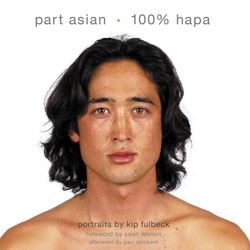
Part Asian, 100% Hapa: Portraits by Kip Fulbeck

Posted in Arts, Asian Diaspora, Books, Media Archive, Monographs on 2010-01-04 22:09Z by Steven

Part Asian, 100% Hapa: Portraits by Kip Fulbeck

Chronicle Books
February, 2006
264 pages
7 x 7 in; 125 color photographs
ISBN 0811849597
ISBN13 9780811849593

Kip Fulbeck, Professor of Performative Studies, Video
University of California, Santa Barbara

Foreword by Sean Lennon

Afterword by Paul Spickard, Professor of History
University of California, Santa Barbara

Part Asian, 100% Hapa — Originally a derogatory label derived from the Hawaiian word for half, Hapa is now being embraced as a term of pride by many people of Asian or Pacific Rim mixed-race heritage. Award-winning film producer and artist Kip Fulbeck has created a forum in word and image for Hapas to answer the question they’re nearly always asked: “What are you?” Fulbeck’s frank, head-on portraits are paired with the sitters’ own statements of identity. A work of intimacy, beauty, and powerful self-expression, Part Asian, 100% Hapa is the book Fulbeck says he wishes he had growing up. An introduction to the rest of the world and an affirmation for Hapas themselves—who now number in the millions—it offers a new perspective on a rapidly growing population.

Tags: , , , , , ,

Sexual Naturalization: Asian Americans and Miscegenation

Posted in Asian Diaspora, Books, History, Law, Literary/Artistic Criticism, Media Archive, Monographs, Social Science, United States on 2010-01-01 23:35Z by Steven

Sexual Naturalization: Asian Americans and Miscegenation

Stanford University Press
2005
224 pages
Cloth ISBN-10: 0804747288; ISBN-13: 9780804747288
Paper ISBN-10: 0804747296; ISBN-13: 9780804747295

Susan Koshy, Associate Professor of English and Asian American Studies
University of Illinois, Urbana-Champaign

Sexual Naturalization offers compelling new insights into the racialized constitution of American nationality. In the first major interdisciplinary study of Asian-white miscegenation from the late nineteenth to the end of the twentieth century, Koshy traces the shifting gender and racial hierarchies produced by antimiscegenation laws, and their role in shaping cultural norms. Not only did these laws foster the reproduction of the United States as a white nation, they were paralleled by extraterritorial privileges that facilitated the sexual access of white American men to Asian women overseas. Miscegenation laws thus turned sex acts into race acts and engendered new meanings for both.

Koshy argues that the cultural work performed by narratives of white-Asian miscegenation dramatically transformed the landscape of desire in the United States, inventing new objects and relations of desire that established a powerful hold over U.S. culture, a capture of imaginative space that was out of all proportion to the actual numbers of Asian residents.

Read an excerpt of chapter 1 here.

Table of Contents

  • Acknowledgments
  • Introduction
  • Part One: Sexual Orients and the American National Imaginary
    • Mimic Modernity: “Madame Butterfly” and the Erotics of Informal Empire
    • Eugenic Romances of American Nationhood
  • Part Two: Engendering the Hybrid Nation
    • Unincorporated Territories of Desire: Hypercorporeality and Miscegenation in Carlos Bulosan’s Writings
    • Sex Acts as Assimilation Acts: Female Power and Passing in Bharati Mukherjee’s Wife and Jasmine
  • Notes
  • Bibliography
  • Index
Tags: ,