Color Struck: Essays on Race and Ethnicity in Global Perspective

Posted in Africa, Anthologies, Anthropology, Asian Diaspora, Books, Brazil, History, Identity Development/Psychology, Media Archive, Politics/Public Policy, Religion, Slavery, Social Science on 2010-10-24 14:10Z by Steven

Color Struck: Essays on Race and Ethnicity in Global Perspective

University Press of America
April 2010
516 pages
Paper ISBN: 0-7618-5064-3 / 978-0-7618-5064-9
Electronic ISBN: 0-7618-5092-9 / 978-0-7618-5092-2

Edited by

Julius O. Adekunle, Professor of History
Monmouth University, West Long Branch, New Jersey

Hettie V. Williams, Lecturer, African American History
Department of History and Anthropology
Monmouth University, West Long Branch, New Jersey
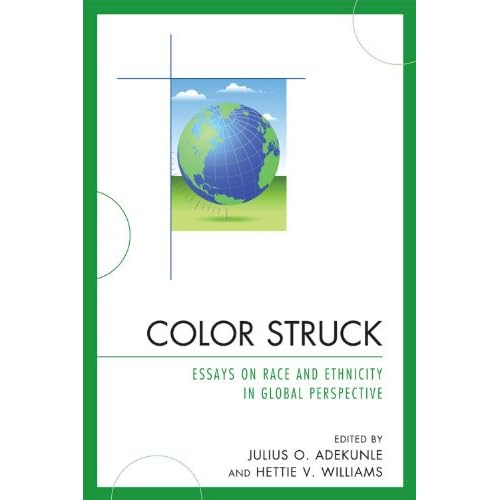
Color Struck: Essays of Race and Ethnicity in Global Perspective is a compilation of expositions on race and ethnicity, written from multiple disciplinary approaches including history, sociology, women’s studies, and anthropology. This book is organized around a topical, chronological framework and is divided into three sections, beginning with the earliest times to the contemporary world. The term “race” has nearly become synonymous with the word “ethnicity,” given the most recent findings in the study of human genetics that have led to the mapping of human DNA. Color Struck attempts to answer questions and provide scholarly insight into issues related to race and ethnicity.

Table of Contents

Preface
Acknowledgements
Introduction

Part 1: The First Complex Societies to Modern Times

1. Race, Science, and Human Origins in Africa
Julius O. Adekunle

2. Race and the Rise of the Swahili Culture
Julius O. Adekunle

3. ‘Caste’-[ing] Gender: Caste and Patriarchy in Ancient Hindu Jurisprudence
Indira Jalli

4. Comparative Race and Slavery in Islam, Judaism, and Christianity: Texts, Practices, and Current Implications
Magid Shihade

5. The Dark Craven Jew: Race and Religion in Medieval Europe
James M. Thomas

6. Growth of the Atlantic Slave Trade: Racial Slavery in the New World
Kwaku Osei Tutu

7. The Yellow Lady: Mulatto Women in the Suriname Plantocracy
Hilde Neus

Part 2: Race and Mixed Race in the Americas

8. Critical Mixed Race Studies: New Approaches to Resistance and Social Justice
Andrew Jolivétte

9. Militant Multiraciality: Rejecting Race and Rejecting the Conveniences of Complicity
Rainier Spencer

10. Whiteness Reconstructed: Multiracial Identity as a Category of “New White”
Kerry Ann Rockquemore and David L. Brunsma

11. Conversations in Black and White: The Limitations of Binary Thinking About Race in America
Johanna E. Foster

12. The Necessity of a Multiracial Category in a Race-Conscious Society
Francis Wardle

13. Mixed Race Terminologies in the Americas: Globalizing the Creole in the Twenty First Century
DeMond S. Miller, Jason D. Rivera, and Joel C. Telin

14. Examining the Regional and Multigenerational Context of Creole and American Indian Identity
Andrew Jolivétte

15. Race, Class, and Power: The Politics of Multiraciality in Brazil
G. Reginald Daniel and Gary L. Haddow

16. All Mixed Up: A New Racial Commonsense in Global Perspective
G. Reginald Daniel and Gary L. Haddow

Part 3: Race, Ethnicity, and Conflict in Contemporary Societies

17. Black No More: African Americans and the ‘New’ Race Science
Hettie V. Williams

18. Contesting Identities of Color: African Female Immigrants in the Americas
Philomina Okeke-Ihejirika

19. Burdened Intersections: Black Women and Race, Gender, and Class
Marsha J. Tyson Darling

20. Ethnic Conflicts in the Middle East: A Comparative Analysis of Communal Violence within the Matrix of the Colonial Legacy, Globalization, and Global Stability
Magid Shihade

21. Ethnic Identity in China: The Politics of Cultural Difference
Dru C. Gladney

22. Shangri-la has Forsaken Us: China’s Ethnic Minorities, Identity, and Government Repression
Reza Hasmath

23. The Russian/Chechen Conflict and It’s Consequences
Mariana Tepfenhart

Contributors
Index

Tags: , , , , , , , , , , , , , , , , , , , , , , , , , , , , , , , ,

Dr. Sue-Je Gage to be Featured Guest on Mixed Chicks Chat

Posted in Asian Diaspora, Audio, Interviews, Live Events, Media Archive, United States, Women on 2010-10-21 00:39Z by Steven

Dr. Sue-Je Gage to be Featured Guest on Mixed Chicks Chat

Mixed Chicks Chat (The only live weekly show about being racially and culturally mixed. Also, founders of the Mixed Roots Film & Literary Festival) Hosted by Fanshen Cox and Heidi W. Durrow
Website: TalkShoe™ (Keywords: Mixed Chicks)
Episode: #178 – Dr. Sue-Je Gage
When: Thursday, 2010-11-04, 21:00Z (17:00 EDT, 16:00 CDT, 14:00 PDT)

Sue-Je Gage, Assistant Professor of Anthropology
Ithaca University


Dr Gage’s specific research focuses on citizenship, identity, blood, gender and transnationalism by examining the identities of Amerasians in South Korea. It explores how Amerasians as local, national and global citizens identify themselves and strategically use their identities to maneuver within Korean society and the globalizing world.

Download or listen to the podcast here.

Selected Bibliography:

Tags: , , , ,

The Japanese in multiracial Peru, 1899-1942

Posted in Asian Diaspora, Caribbean/Latin America, Dissertations, History, Media Archive on 2010-10-19 17:40Z by Steven

The Japanese in multiracial Peru, 1899-1942

University of California, San Diego
November 2009
335 pages
Publication Number: AAT 3355652

Stephanie Carol Moore

This study analyzes the integration of the Japanese into the politics of race and nation in Peru during the period from 1899 to 1942. The first generation of Japanese immigrants arrived in Peru at the apex of debates on national racial identity and popular challenges to the white oligarchy’s exclusive hold on national political and economic power. This dissertation examines how not only elites, but also working- and middle-class movements advocated the exclusion of the Japanese as a way of staking their claims on the nation. In this study, I argue that Peru’s marginalization of the Japanese sprang from racist structures developed in the colonial and liberal republican eras as well as from global eugenic ideologies and discourses of “yellow peril” that had penetrated Peru. The Japanese were seen through Orientalist eyes, conceptualized and homogenized as a race that acted as a single organism and that would bring only detriment to the Peruvian racial “whitening” project. Eugenics conflated women with their reproduction, leading “racial science” advocates to portray Japanese women in Peru as the nation’s ultimate danger and accuse them of attempting to conquer Peru “through their wombs.”

The Japanese men and women who settled in Peru, however, were also actors in their Peruvian communities. Many Japanese laborers, largely Okinawan, were participants in rural labor movements in Peru. Policymakers, hacienda owners, and local power holders, however, undermined class-based challenges to their authority by demonizing the Japanese as a cultural, racial, and political threat to the Peruvian nation. In stepping out of their rung on the racial hierarchy, the Japanese shop keepers also provoked resentment both among their fellow Peruvian business owners and elements within the urban labor movement. The deeper the Japanese Peruvians sank their roots into Peru, the more shrill became the accusations that they were “inassimilable.” Finally, opportunistic politicians played upon the Peruvian elites’ deepest fears by accusing the Japanese immigrants of joining with Peru’s indigenous people to launch a race war.

Table of Contents

  • Signature Page
  • Table of Contents
  • List of Figures
  • Lis of Tables
  • Map
  • Acknowledgements
  • Vita
  • Abstract
  • Introduction
  • Chapter One: The Historical and Hemispheric Context of Japanese Immigration to Peru: Independence to 1920s
  • Chapter Two: Japanese Workers on Peru’s Sugar Plantations, 1890-1923
  • Chapter Three: Conflict and Collaboration: Yanaconas in the Chancay Valley
  • Chapter Four: The Butcher, The Baker, and the Hatmaker: Working Class Protests against the Japanese Limeños
  • Chapter Five: Race, Economic Protection, and Yellow Peril: Local Anti-Asian Campaigns and National Policy
  • Chapter Six: Peru’s “Racial Destiny”: Citizenship, Reproduction, and Yellow Peril
  • Epilogue
  • Conclusion
  • References

List of Fugures

  • Figure 5.1: Anti-Asia cartoons
  • Figure 5.2: “The Asian Metamorphosis”
  • Figure 5.3: Business License of Y. Nishimura, Tailor, Lima
  • Figure 6.1: Mundo Gráfico Cartoon

List of Tables

  • Table 4.1: Selected Professions of Peruvians and Foreigners (Lima 1908)
  • Table 4.2: 1940 Investigation of Japanese Bakeries, Lima
  • Table 6.1: Births to Japanese Women in Lima

Order the dissertation here.

Tags: , , ,

Between Race; Beyond Race: The Experience of Self-Identification of Indian-White Biracial Young Adults and the factors Affecting their Choices of Identity

Posted in Articles, Asian Diaspora, Identity Development/Psychology, Media Archive, South Africa on 2010-10-18 21:28Z by Steven

Between Race; Beyond Race: The Experience of Self-Identification of Indian-White Biracial Young Adults and the factors Affecting their Choices of Identity

PINS (Psychology in Society)
Issue 34 (2006)
pages 1-16

Dennis Francis, Dean of Education
University of The Free State, South Africa

This study, based on my doctoral research, is an exploration of how nine Indian-White biracial young adults interpret their social reality, especially with regard to their understanding and experience of racial identity. I chose life histories as a method in line with my view of social identity as a resource that people draw on in constructing personal narratives, which provide meaning and a sense of continuity to their lives. As a life history researcher I started with the assumption that by asking the participants to tell me stories of their lives I would gain access to how biracial young adults interpret their social world and what they believe about themselves. All of the primary research took place within the Durban area. In giving an account of their identities, the nine biracial young adults in my study described their life worlds as the sum of many parts, which included but was not limited to their racial identity. With regards to racial identity, the participants chose a variety of ways to name themselves. Four self-identified as Indian, one chose not to place himself into a racial category, and four named themselves as Indian and White or mixed race. None of the nine Indian-White biracial young adults in my study named themselves as White, and none identified themselves as Coloured. The participants named a combination of factors as influencing how they identified – at times these were not without inconsistencies and contradictions. While some factors were more salient than others, I argue that no single factor that influences identity can be looked at in isolation or as assumed to be more important from any other. In their account of the various factors that contributed to their understanding of racial identity, none of the participants identified their assigned racial classification as having a direct influence on their choice of racial identity.

Read the entire article here.

Tags: , , ,

“What is black, white and yellow all over?”: An analysis of the racial experiences of people of Asian/white and Asian/black heritage

Posted in Asian Diaspora, Dissertations, Identity Development/Psychology, Media Archive, Social Science, United States on 2010-10-13 21:53Z by Steven

“What is black, white and yellow all over?”: An analysis of the racial experiences of people of Asian/white and Asian/black heritage

University of Southern California
May 2007
208 pages

Bruce Calvin Hoskins

Dissertation Presented to the Faculty of the Graduate School of the University of Southern California In Partial Fulfillment of the Requirements for the Degree Doctor of Philosophy (Sociology)

It has been argued that the increase of people of multiracial heritage in our society represents the fulfillment of the assimilation process. People of Asian/white and Asian/black heritage have been singled out in multiple works as posing a direct challenge to how race is understood in the United States and that this group’s assertion of their multiracial identity will ultimately lead to a raceless society (Williams-Leon and Nakashima 2001; Root 1996; Hollinger 1995; Root 1992). Therefore, this research uses in-depth interviews of thirty-two (32) people of Asian/white and Asian/black heritage and six (6) sets of interracial Asian and white and Asian and black parents to critically analyze to what degree their lived experiences are consistent with a society that has assimilated people of different racial categories.

In order to determine levels of assimilation for these groups, this research will use a racial formations framework to examine how racial categories are constructed through “racial logic” and how race is given meaning within the lives of multiracial people and through parents of multiracial children. This will be done by showing situations where society will ascribe a race onto a person of multiracial heritage, how the person of multiracial heritage will use their “biology” to support or refute these claims, and how that same multiracial person might develop a racial identity that may or may not be consistent with how they look or their actual racial heritage.

Demonstrating how race is socially constructed will reveal how being mixed with white is fundamentally different than being mixed with black. This will be shown by demonstrating that Asian/white people have more identity options than Asian/black people, how families socially enforce to their children which races are considered acceptable marriage partners, and how society uses a universal anti-black context to discriminate against people of Asian/black heritage.

Table of Contents

  • Dedication
  • Abstract
  • Chapter 1: Introduction
  • Chapter 2
    • Literature Review
    • Chapter Endnotes
  • Chapter 3
    • Methodology
    • Chapter Endnotes
  • Chapter 4: “What Are You?”
    • How Multiracial People Construct an Internal Racial Identity
    • Chapter Endnotes
  • Chapter 5: “What are you?” Part II
    • The creation of external and expressed racial identity
  • Chapter 6: “Can’t We All Just Get Along?”
    • The External Context of Racial Identity Formation
  • Chapter 7: All in the Family
    • Learning Racial Hierarchy from the Ones You Love
    • Chapter Endnotes
  • Chapter 8: Conclusions
    • From the Beginning to the End then Back to the Beginning
  • Bibliography
  • Appendices
    • Appendix A: Questions for Multiracial Person
    • Appendix B: Questions for Interracial Parents

Read the entire dissertation here.

Tags: , , ,

The Chinese Mestizos and the Formation of the Filipino Nationality

Posted in Articles, Asian Diaspora, History, Media Archive, Social Science on 2010-10-13 05:11Z by Steven

The Chinese Mestizos and the Formation of the Filipino Nationality

Archipel
Volume 32, 1986
pages 141-162
DOI: 10.3406/arch.1986.2316

Antonio S. Tan

The recorded history of the Philippines would be incomplete as a basis for understanding contemporary society unless it takes into account the Chinese mestizos’ contributions to our development as a nation.  The Chinese mestizos were an important element of Philippine society in the 19th century.  They played a significant role in the formation of the middle class, in the agitation for reforms, in the 1898 revolution and the formation of what is now known as the Filipino nationality.  In contemporary times their role in nation-building continues.

Read the entire article here.

Tags: , , ,

The Chinese Mestizo in Philippine History

Posted in Articles, Asian Diaspora, History, Media Archive on 2010-10-13 02:15Z by Steven

The Chinese Mestizo in Philippine History

The Journal of Southeast Asian History
Volume 5, Number 1 (March 1964)
pages 62-100
DOI: 10.1017/S0217781100002222

Edgar Wickberg (1927-2008), Professor Emeritus of History
University of British Columbia

Our knowledge is still insufficient to allow us to assess the overall significance of the mestizo in Philippine history. But on the basis of what we now know we can make some generalizations and some hypotheses for future study. It is clear, in the first place, that the activities I have described are those of Chinese mestizos – not Spanish mestizos. While the Chinese mestizo population in the Philippines exceeded 200,000 by the late nineteenth century, the Spanish mestizo population was probably never more than 35,000. Furthermore, those who commented at all on the Spanish mestizo noted that he was interested in military matters or the “practical arts” – never in commerce. The aptitudes and attitudes of the Chinese mestizo were in sharp contrast to this.

Secondly, the Chinese mestizo rose to prominence between 1741 and 1898, primarily as a landholder and a middleman wholesaler of local produce and foreign imports, although there were also mestizos in the professions. The rise of the mestizos implies the existence of social change during the Spanish period, a condition that has been ignored or implicitly denied by many who have written about the Philippines. It needs to be emphasized that the mestizo impact was greatest in Central Luzon, Cebu, and Iloilo. We cannot as yet generalize about other areas.

Third, the renewal of Chinese immigration to the Philippines resulted in diversion of mestizo energies away from commerce, so that the mestizos lost their change to become a native middle class, a position then taken over by the Chinese.

Fourth, the Chinese mestizos in the Philippines possessed a unique combination of cultural characteristics. Lovers of ostentation, ardent devotees of Spanish Catholicism – they seemed almost more Spanish than the Spanish, more Catholic than the Catholics. Yet with those characteristics they combined a financial acumen that seemed out of place. Rejecters of their Chinese heritage, they were not completely at home with their indio heritage. The nearest approximation to them was the urbanized, heavily-hispanized indio. Only when hispanization had reached a high level in the nineteenth century urban areas could the mestizo find a basis of rapport with the indio. Thus, during the late nineteenth century, because of cultural, economic, and social changes, the mestizos increasingly identified themselves with the indios. in a new kind of “Filipino” cultural and national consensus.

Those are my conclusions. Here are some hypotheses, which I hope will stimulate further study:

  1. That today’s Filipino elite is made up mostly of the descendants of indios and mestizos who rose to prominence on the basis of commercial agriculture in the lattetf part of the Spanish period. That in some respects the latter part of the Spanish period was a time of greater social change, in terms of the formation of contemporary Philippine society, than the period since 1898 has been.
  2. That in the process of social change late in the Spanish period it was the mestizo, as a marginal element, not closely tied to a village or town, who acted as a kind of catalytic agent. In this would be included the penetration of money economy into parts of the Philippines. There were areas where the only persons with money were the provincial governors and the mestizos.
  3. That the Chinese mestizo was an active agent of hispanization and the leading force in creating a Filipino culture characteristic now of Manila and the larger towns.
  4. That much of the background explanation of the Philippine Revolution may be found by investigating the relationships between landowning religious orders, mestizo inquilinos, and indio kasamahan laborers.

It is my hope that these hypotheses may stimulate investigation into this important topic which can tell us so much about economic, social, and cultural change during- the Spanish period of Philippine history.

Read the entire article here.

Tags: , , ,

We Are a People: Narrative and Multiplicity in Constructing Ethnic Identity

Posted in Anthologies, Anthropology, Asian Diaspora, Books, Brazil, Identity Development/Psychology, Media Archive, Social Science on 2010-10-05 01:54Z by Steven

We Are a People: Narrative and Multiplicity in Constructing Ethnic Identity

Temple University Press
January 2000
304 pages
7×10
5 tables 5 figures
Paper EAN: 978-1-56639-723-0; ISBN: 1-56639-723-5

edited by Paul Spickard, Professor of History
University of California, Santa Barbara

and W. Jeffrey Burroughs, Dean of Math and Sciences and Professor of Psychology
Brigham Young University, Hawaii

As the twentieth century closes, ethnicity stands out as a powerful force for binding people together in a sense of shared origins and worldview. But this emphasis on a people’s uniqueness can also develop into a distorted rationale for insularity, inter-ethnic animosity, or, as we have seen in this century, armed conflict. Ethnic identity clearly holds very real consequences for individuals and peoples, yet there is not much agreement on what exactly it is or how it is formed.

The growing recognition that ethnicity is not fixed and inherent, but elastic and constructed, fuels the essays in this collection. Regarding identity as a dynamic, on-going, formative and transformative process, We Are a People considers narrative—the creation and maintenance of a common story—as the keystone in building a sense of peoplehood. Myths of origin, triumph over adversity, migration, and so forth, chart a group’s history, while continual additions to the larger narrative stress moving into the future as a people.

Still, there is more to our stories as individuals and groups. Most of us are aware that we take on different roles and project different aspects of ourselves depending on the situation. Some individuals who have inherited multiple group affiliations from their families view themselves not as this or that but all at once. So too with ethnic groups. The so-called hyphenated Americans are not the only people in the world to recognize or embrace their plurality. This relatively recent acknowledgment of multiplicity has potentially wide implications, destabilizing the limited (and limiting) categories inscribed in, for example, public policy and discourse on race relations.

We Are a People is a path-breaking volume, boldly illustrating how ethnic identity works in the real world.

Table of Contents

Acknowledgments
1. We are a People – Paul Spickard and W. Jeffrey Burroughs

Part I: The Indeterminacy of Ethnic Categories: The Problem and A Solution
2. Multiple Ethnicities and Identity Choices in the United States – Mary C. Waters
3. That’s the Story of Our Life – Stephen Cornell

Part II: Construction of Ethnic Narratives: Migrant Ethnicities
4. Black Immigrants in the United States – Violet M. Johnson
5. The Children of Samoan Migrants in New Zealand – Cluny Macpherson and La’avasa Macpherson

Part III: Ethnicities of Dominated Indigenous Peoples
6. Narrating to the Center of Power in the Marshall Islands – Phillip H. McArthur
7. Discovered Identities and American-Indian Supratribalism – Stephen Cornell
8. Racialist Responses to Black Athletic Achievement – Patrick B. Miller
9. I’m Not a Chileno! Rapa Nui Identity – Max E. Stanton and Andrés Edmunds P.

Part IV: Emerging Multiethnic Narratives
10. Multiracial Identity in Brazil and the U.S. – G. Reginald Daniel
11. Mixed Laughter – Darby Li Po Price
12. Punjabi Mexican American Experiences of Multiethnicity –  Darby Li Po Price

Part V: Theoretical Reflections
13. Rethinking Racial Identity Development – Maria P. P. Root
14. The Continuing Significance of Race – Lori Pierce
15. What Are the Functions of Ethnic Identity? – Cookie White Stephan and Walter G. Stephan
16. Ethnicity, Multiplicity, and Narrative – W. Jeffrey Burroughs and Paul Spickard

Read an excerpt of chapter 1 here.

Tags: , , , , , , , , , , , , , , , , , , , , , ,

Essayist and Poet Paisley Rekdal to Read From Works at Ithaca College

Posted in Asian Diaspora, Media Archive, United States, Women on 2010-10-03 02:28Z by Steven

Essayist and Poet Paisley Rekdal to Read From Works at Ithaca College

Ithaca College
Clark Lounge, Egbert Hall
2010-10-05, 19:30 (Local Time)

ITHACA, NY — Essayist and poet Paisley Rekdal will give a free public reading from her works on Tuesday, Oct. 5, at Ithaca College. Her presentation, part of the Distinguished Visiting Writers Series, will be held at 7:30 p.m. in Clark Lounge, Egbert Hall.

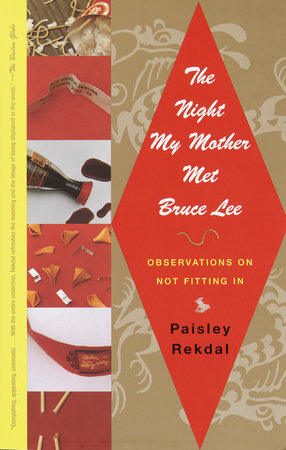
The daughter of a Chinese-American mother and an American father of Norwegian heritage, Rekdal is the author of “The Night My Mother Met Bruce Lee,” a collection of personal essays in which she confronts the difficulty of negotiating her biracial identity. She has also published three collections of poetry and will have a hybrid photo-text memoir that combines poems, nonfiction and fiction with photography, coming out from Tupelo Press in 2011.

Rekdal currently teaches at the University of Utah. She has been honored for her writing with a Village Voice Writers on the Verge Award, a Pushcart Prize, National Endowment for the Arts and Fulbright fellowships, the University of Georgia Press’s Contemporary Poetry Series Award and the Laurence Goldstein Poetry Prize from Michigan Quarterly Review.

For more information, click here.

Tags: ,

The Night My Mother Met Bruce Lee: Observations on Not Fitting In

Posted in Asian Diaspora, Autobiography, Biography, Books, Identity Development/Psychology, Media Archive, Monographs, Women on 2010-10-03 02:27Z by Steven

The Night My Mother Met Bruce Lee: Observations on Not Fitting In

Vintage an Imprint of Random House
2000
224 pages
Paperback ISBN: 978-0-375-70855-8 (0-375-70855-3)
E-Book ISBN: 978-0-307-42908-7 (0-307-42908-3)

Paisley Rekdal, Professor of English and Asian Studies
University of Utah

When you come from a mixed race background as Paisley Rekdal does — her mother is Chinese American and her father is Norwegian– thorny issues of identity politics, and interracial desire are never far from the surface. Here in this hypnotic blend of personal essay and travelogue, Rekdal journeys throughout Asia to explore her place in a world where one’s “appearance is the deciding factor of one’s ethnicity.”

In her soul-searching voyage, she teaches English in South Korea where her native colleagues call her a “hermaphrodite,” and is dismissed by her host family in Japan as an American despite her assertion of being half-Chinese. A visit to Taipei with her mother, who doesn’t know the dialect, leads to the bitter realization that they are only tourists, which makes her further question her identity. Written with remarkable insight and clarity, Rekdal a poet whose fierce lyricism is apparent on every page, demonstrates that the shifting frames of identity can be as tricky as they are exhilarating.

Tags: