British-Asian cinema: the sequel

Posted in Articles, Asian Diaspora, Identity Development/Psychology, Literary/Artistic Criticism, Religion, United States on 2011-05-26 22:09Z by Steven

British-Asian cinema: the sequel

The Guardian
2011-02-17

Sarfraz Manzoor


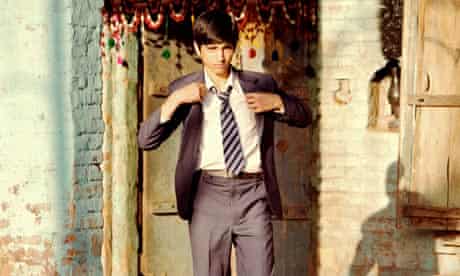
Aqib Khan in West Is West.

Twelve years on from the hugely acclaimed East Is East comes its sequel, West Is West. Sarfraz Manzoor examines the new directions British-Asian film-makers are taking

Twelve years on from the hugely acclaimed East Is East comes its sequel, West Is West. Sarfraz Manzoor examines the new directions British-Asian film-makers are taking

Ayub Khan-Din was in his first year at drama school in Salford when his mother was diagnosed with Alzheimer’s disease. Khan-Din, the mixed-race son of a Pakistani Muslim father and a white Catholic mother, found that each time he came home, another slab of his mother’s memory had disappeared. The past, with all its stories, was slipping into the void, and Khan-Din became determined to try to preserve his parents’ history and his own experience of growing up.

Although he was studying to be an actor, Khan-Din started writing. At the time, Asians were rarely glimpsed on screen in the UK unless they were being beaten up by racist skinheads, running corner shops or fleeing arranged marriages. Khan-Din wanted to tell a different story—about growing up with a Pakistani father who had married an English woman, but who wanted his boys to marry Pakistani girls. The play Khan-Din wrote, East Is East, was performed on stage, then released to great acclaim as a film in 1999. Now, 12 years on, comes the release of West Is West, Khan-Din’s long-awaited sequel…

…Like Khan-Din and Monica Ali—whose novel Brick Lane would later be adapted for the screen—Kureishi grew up in a mixed-race family. The particular conflicts inherent in such a background, and the subsequent struggles for identity, were not shared by those such as Chadha and Syal, whose parents were both Asian. My Beautiful Laundrette was not only a personal work but also, Kureishi suggests, the product of an emerging curiosity of mainstream Britain about Asian society. “Around the mid-80s, people in film and publishing realised that Britain was changing,” he says. “I was lucky because I had this great opportunity to write about something that no one else had written about.” The freshness of this material to a wider audience meant many of the films that have come out of the British-Asian subgenre—including Prasad’s My Son the Fanatic, based on another Kureishi short story—operate not only as fictional works but also as quasi-documentaries, revealing a hitherto unknown world. The frisson of familiarity felt by Asian audiences on seeing families like theirs was coupled by the shock of the new that white audiences experienced…

Read the entire article here.

Tags: , ,

INDIGO – Laura Kina & Shelly Jyoti

Posted in Arts, Asian Diaspora, Media Archive, United States, Women on 2011-05-13 03:36Z by Steven

INDIGO – Laura Kina & Shelly Jyoti

Diana Lowenstein Fine Arts
2043 North Miami Avenue
Miami, Florida 33127
2011-05-14 through 2011-06-30

Opening Reception
2011-05-14, 14:00-21:00 EDT (Local Time)

Laura Kina, Associate Professor Art, Media and Design and Director Asian American Studies
DePaul University

Shelly Jyoti, Visual Artist, Fashion Designer, Poet, Researcher and Independent Curator

In the 19th century, Bengal was the world’s biggest producer of indigo but today, the deep blue color of indigo is synthetically created in a lab and is associated in the West with blue jeans more than its torrid colonial past. But indigo holds a sustained presence in the post-colonial identity of India. Employing fair trade embroidery artisans from women’s collectives in India and executing their works in indigo blue, Jyoti and Kina’s works draw upon India’s history, narratives of immigration and transnational economic interchanges. The artists decided to collaborate in 2008-2009, considering their mutual interest in textile history, pattern & decoration. They began by thinking about the intersections of their own ethnic and national positions in relation to fabrics. For this exhibition in particular, Jyoti’s Indigo Narratives utilize traditional embroidery and embellishments along with heritage symbols belonging to traveling ethnic communities who settled in coastal Gujarat while Kina’s Devon Avenue Sampler series focuses on a contemporary Desi/Jewish community in Chicago.  This exhibition includes new works in mediums such as hand-embroidery on khadi, acrylic on fabric, hand-stenciled Sanskrit calligraphy and textile embroidery on canvas.

For more information, click here.

Tags: , , , , ,

Breaking the Black-White Binary

Posted in Articles, Asian Diaspora, History, Identity Development/Psychology, Interviews, Media Archive, Politics/Public Policy, Social Science, United States on 2011-05-11 04:11Z by Steven

Breaking the Black-White Binary

Fathom: the source for online learning
Columbia University
2002

Gary Okihiro, Professor of International and Public Affairs
Columbia University

Where do Asians fall in the American construct of race? According to Gary Okihiro, the director of Columbia University’s Center for Race and Ethnicity, the position of Asians has had to be invented and reinvented over the past two centuries to fit into a binary, black-white national racial definition

Gary Okihiro: In the US, the racial formation is a binary of black and white. In fact, there is actually mainly black. White is frequently not seen as a racial category; it is simply the normative. Blackness is race. And when today we deploy the term “minority,” for example, we mean basically African-Americans. I think binaries are simpleminded ways of categorizing not just people but also things, objects other than oneself. Binaries provide a kind of coherence. They allow for a simple and straightforward explanation of who one is and who one is not. And so this binary of who one is, which is whiteness, and who one is not, which is blackness, in this case affords a kind of self-definition and also a privilege that authorizes one to define the other.

Now, Asians and Latinos and other racialized minorities who do not fit into that black-white binary pose a problem for that kind of racialized thinking. The binary itself, by the way, is very functional. Obviously it is an invention, first of all. Who is white, for example, is an invention, and the category “white” is an elastic one. It includes different peoples at different times; for example, at some point Irish people were not included within the category “white” within the United States. Similarly, the category “black” is an invented category and is also an elastic one…

Read the entire interview here.

Tags: ,

Multiracial Identity Development: Understanding Choice of Racial Identity in Asian-White College Students

Posted in Articles, Asian Diaspora, Campus Life, Identity Development/Psychology, Media Archive, United States on 2011-05-07 16:23Z by Steven

Multiracial Identity Development: Understanding Choice of Racial Identity in Asian-White College Students

Journal of the Indiana University Student Personnel Association
2011
pages 38-45

Ashley Viager
Higher Education and Student Affairs Program
Indiana University

Asian-White individuals will have greater representation in higher education in coming years, and student affairs professionals must learn how these students make meaning of their racial identities in order to best serve the needs of this group. Analyzing Poston’s (1990) and Root’s (2003) theories of multiracial identity development, this paper examines the experiences unique to this population to demonstrate that Asian-White individuals have the ability to choose from multiple racial identity outcomes.

In 2000, the United States government conducted a census in which multiracial individuals could self-identify with more than one racial category. Multiracial individuals are those whose parents are of two or more different and distinct federally recognized racial groups (Chapman-Huls, 2009). Previously, multiracial individuals had not been formally recognized in the United States. Instead, multiracial individuals who had one White parent were primarily classified according to their parent of color (Zack, 2001). This system of racial classification, also known as “hypodescent,” originated in the eighteenth century as a way to “maintain White racial purity and to deny mixed race people access to privilege,” (Renn, 2004, p. 4) and reinforced rigid categories of race. The 2000 census formally challenged these previous notions of essentialist racial categories by recognizing those who blurred the boundaries.

One of the main purposes in the revision of the census was to reflect the growing prevalence of interracial marriage in American society (Perlmann & Waters, 2002). The multiracial population is one of the fastest growing minority groups in the United States (Shih & Sanchez, 2009), and by the year 2050, one in five Americans could self-identify as multiracial (Farley, 2001). Of any racial minority group in the United States, Asians, both native and U.S. born, register one of the highest rates of marriages outside their race, and marriages to Whites are the most prevalent (Lee & Bean, 2004; Qian, 1997). This growing trend means the population of young mixed race Asian Americans, specifically those who claim Asian and White descent, will increase (Min, 2006). As a result, Asian-White individuals will have significantly greater representation in higher education in the coming years. Because the Asian-White student population is growing, student affairs professionals must learn how these students make meaning of their racial identities. While few studies have explored the racial identity formation specific to Asian-White individuals (Khanna, 2004), current research on multiracial identity development can help student affairs professionals understand the Asian-White experience.

Acceptance or rejection from a racial group can significantly impact how a multiracial student chooses to identify. Multiracial identity theories rely on the notion that individuals “must make choices about their racial identification, navigate validation or invalidation around their choice, and resolve their in-between status while traveling pathways shaped by acceptance and/or denial” (Rockquemore & Laszloffy, 2005). Multiracial students often feel caught between their racial components, unable to fully identify with White students or with monoracial students of color (Renn, 1998). It is important to note, however, that multiracial students experience varying levels of dissonance based on factors that impact the way they identify, and current multiracial identity development models are too general to be applied to any one specific multiracial subpopulation. Asian-White individuals share similar experiences that make their process of racial identity development different from any other multiracial group, thus necessitating a theory that outlines the Asian-White racial identity developmental process. This paper will examine Poston’s (1990) and Root’s (2003) multiracial identity development theories to provide an overview of how various factors influence the racial identity outcomes of multiracial individuals. These theories will then be integrated with current literature regarding the experiences of Asian and Asian- White groups in American society to provide an understanding of the fluidity in racial identity choice for Asian-White individuals…

Read the entire article here.

Tags: , ,

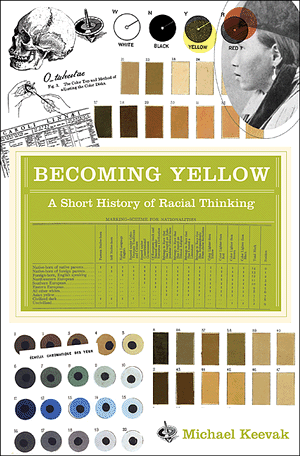
Becoming Yellow: A Short History of Racial Thinking

Posted in Asian Diaspora, Books, History, Media Archive, Monographs on 2011-05-05 02:08Z by Steven

Becoming Yellow: A Short History of Racial Thinking

Princeton University Press
2011
248 pages
6 x 9 | 7 color illus. 16 halftones
Cloth ISBN: 978-0-691-14031-5

Michael Keevak, Professor in the Department of Foreign Languages
National Taiwan University

In their earliest encounters with Asia, Europeans almost uniformly characterized the people of China and Japan as white. This was a means of describing their wealth and sophistication, their willingness to trade with the West, and their presumed capacity to become Christianized. But by the end of the seventeenth century the category of whiteness was reserved for Europeans only. When and how did Asians become “yellow” in the Western imagination? Looking at the history of racial thinking, Becoming Yellow explores the notion of yellowness and shows that this label originated not in early travel texts or objective descriptions, but in the eighteenth- and nineteenth-century scientific discourses on race.

From the walls of an ancient Egyptian tomb, which depicted people of varying skin tones including yellow, to the phrase “yellow peril” at the beginning of the twentieth century in Europe and America, Michael Keevak follows the development of perceptions about race and human difference. He indicates that the conceptual relationship between East Asians and yellow skin did not begin in Chinese culture or Western readings of East Asian cultural symbols, but in anthropological and medical records that described variations in skin color. Eighteenth-century taxonomers such as Carl Linnaeus, as well as Victorian scientists and early anthropologists, assigned colors to all racial groups, and once East Asians were lumped with members of the Mongolian race, they began to be considered yellow.

Demonstrating how a racial distinction took root in Europe and traveled internationally, Becoming Yellow weaves together multiple narratives to tell the complex history of a problematic term.

Read the introduction here.

Tags: ,

Secret Asian Woman

Posted in Asian Diaspora, Audio, Autobiography, Identity Development/Psychology, Media Archive, United States, Women on 2011-05-04 04:56Z by Steven

Secret Asian Woman

Stage and Studio
with Dmae Roberts
2011-03-03

Independent Producer Dmae Roberts presents Secret Asian Woman, a half-hour personal exploration of identity and Mixed Race. Through her personal story, Dmae charts four decades of a search by multiracial peoples for a name. The politics of calling out racism has changed through the years as has identification. In this half-hour documentary, Dmae talks with other Mixed Race Asian women with identities not easily recognized and addresses with humor the complexities involved in even discussing race.

Secret Asian Woman was produced by Dmae Roberts, with editorial consultation by Catherine Stifter and damali ayo. Original music by Clark Salisbury. Additional music by Teresa Enrico and Portland Taiko. Interviews with Velina Hasu Houston, Rainjita Yang Geesler, Julie Thi Underhill and Patti Duncan. Funded by the Regional Arts and Culture Council Individual Artist program. You can learn more by going to Dmae Roberts’ website.

To listen to the broadcast, click here.

Tags: ,

Playful ambiguities: racial and literary hybridity in the novels of Brian Castro

Posted in Asian Diaspora, Dissertations, Literary/Artistic Criticism, Media Archive, Oceania on 2011-04-28 01:55Z by Steven

Playful ambiguities: racial and literary hybridity in the novels of Brian Castro

University of Melbourne
Université Toulouse-le Mirail
2010

Marilyne Brun

PhD thesis, Arts – School of Culture and Communication, The University of Melbourne and Université Toulouse-le Mirail.

This thesis studies eight of the nine novels of Brian Castro, a contemporary Australian writer born in Hong Kong in 1950, and focuses on the theme of hybridity in his work. Starting with the observation that many of Castro’s characters are mixed-race, the thesis reflects on his suggestion, in his critical essays, that hybridity is deployed at a literary level in his fiction. It seeks to answer three major questions: how is racial hybridity represented in the novels? Why does Castro use a form of literary hybridity in his fiction? And what connections can be established between racial and literary hybridity in his work? The present study argues that hybridity is a useful concept which can be productively applied to literary studies and is particularly appropriate to discuss Castro’s novels. It focuses on two aspects of his literary practice: his use of hybridity as a literary device and his ambiguous representation of the mixed-race body. It argues that racial and literary hybridity are uniquely complementary in the novels and that Castro’s playful resort to hybridity represents a form of resistance to literary canons, racial categorisation and national politics. In this sense, the thesis not only extends the study of Brian Castro’s novels, it also brings new insights to hybridity theory, thus contributing to postcolonial, literary and critical race studies.

Tags: , , ,

Darkening Tiger Woods: How post-scandal Tiger Woods lost his whiteness and became Blasian

Posted in Asian Diaspora, Live Events, Media Archive, Social Work, United States on 2011-04-22 03:32Z by Steven

Darkening Tiger Woods: How post-scandal Tiger Woods lost his whiteness and became Blasian

Asian American Cultural Center Lounge
1210 W. Nevada Street
Urbana, Illinois
2011-04-25, 14:00 CDT (Local Time)

Myra Washington, Assistant Professor of Communication & Journalism
University of New Mexico

The rhetoric around Tiger Woods, after his extramarital affairs became public, demonstrates the complexities in which Blackness and Asianness were deployed to shame, emasculate, understand, praise, pity, and mock him. Via text, Woods himself shifts his identity from Cablinasian (on Oprah) to Blasian, which media organizations used in part used to frame his behavior. His self-identification brought Blasians under scrutiny, which resulted in moves to protect the Blasian brand. Myra Washington is a PhD candidate in the Institute of Communications Research. Her dissertation explores Black/Asian (Blasian) multiracial identity and its representations through analyzing mediated constructions of Blasian celebrities specifically Kimora Lee Simmons, Hines Ward, and post-cheating scandal Tiger Woods. Using the increase in recognition of multiracial celebrities who identify as Black and Asian and the popularity of these celebrities specifically, Washington’s project interrogates if and how their visibility and success allows for other similarly mixed up [?? actual wording in announcement] mixed-race people to claim visibility for themselves. Washington received the 2010 Jeffrey S. Tanaka Asian American Studies Grant for graduate students.

For more information, click here.

Tags: ,

Deconstructing the Visual: The Diasporic Hybridity of Asian and Eurasian Female Images

Posted in Articles, Asian Diaspora, Literary/Artistic Criticism, Media Archive, Oceania, Women on 2011-04-19 22:13Z by Steven

Deconstructing the Visual: The Diasporic Hybridity of Asian and Eurasian Female Images

Intersections: Gender, History and Culture in the Asian Context
Australian National University
Issue 8, October 2002
45 paragraphs
ISSN 1440 9151

Julie Matthews, Associate Professor and Director of Research Faculty of Arts and Social Sciences
University of the Sunshine Coast, Queensland, Australia

Introduction

Being long accustomed to the absence of images resembling myself in magazines and on TV, I find the few images I do encounter quite fascinating. Commenting on the absence of media images and representations of Asian women, Catherine Padmore notes that pale-skinned, wide-eyed Eurasian features are more likely to appear than Asian faces. As she arguesof the three hundred images appearing on the cover of the Australian publication Cleo since its inception in 1972, ‘under ten did not fit the Caucasian stereotype of wide-eyes, pale skin, and (surprisingly often) blonde hair’. My analysis of Asian and Eurasian female images is interested in the small but growing number of stylish young Eurasian and Asian fashion models appearing in Australian magazines and catalogues and Asian-female images associated with finance. The latter category links Asian women to commerce, computing and technology in a globally interconnected world. Interestingly, these images rarely feature Eurasian women.

The presence of Eurasian images in fashion representations and their absence from finance representations draw attention to the historical origins, cultural trajectories and ambivalence of meaning associated with ‘raced’ and sexed representations. Although the inclusion of Asian and Eurasian women may be intended to offset their previous absence and secure a wider multicultural appeal, they inadvertently replay processes of racialisation and sexualization. This is because they incite desires for, and identifications with, White/Western/Anglo identities authorised by essentialist and quasi-biological discourses of racialisation and sexualization.

The situation is further complicated by the diasporic hybridity of Asian and Eurasian female images. Distinguishing fashion from finance images highlights the ways these are worked out through various forms of colonialism, patriarchy, orientalism and commodification. Fashion representations commodify traditional stereotypes of Asian women and hyper-feminise Asian and Eurasian women. They model desirable ideals of youthful sexualised femininity and offer a rebuke to those who fail to meet these standards in a White/Western/Anglo-dominated global market. Finance representations take their cue from contemporary social and economic conditions where Asian ‘Tiger’ economies have come to stand for development potential and high-tech economic success under global capitalism. In these images Eurasian women are absent because Asian women more effectively represent the desirable ideals of commerce and information technology and ‘gently’ rebuke those who fail to succeed under these terms and conditions.

This paper is organised into two sections. The first section analyses Asian and Eurasian images and the latter section uses insights from this analysis to challenge current cultural studies understandings of hybridity and diaspora. This paper is not intended to provide a comprehensive semiotic analysis of media representations. Rather, it undertakes a deconstructive analysis of various images I have recently encountered. Deconstruction challenges the apparent and obvious ‘facts’ of a representation or image. It acknowledges that representations and readings are an effect of standpoint, belief and value, and support multiple and often contradictory understandings. A deconstructive analysis of visual representations highlights the interaction of images with one another as well as accentuating associations that operate beyond the text and beyond the intentions of image producers. The deconstruction of visual representations undertaken here focuses on shared and dissimilar trajectories of mobility and hybridity and the fissures and breaks in authoritative and universalising explanations and theories. Visual images work a terrain of identity and identification that defy the demarcation of primary structural or systemic forms of subordination and clear-cut lines of resistance desired by Floya Anthias. They thereby enable us to trace the contours of new forms of subjugation and struggle.

The second section of this paper explores conventional cultural studies’ understandings of diaspora and hybridity though a gender analysis which highlights the interconnected significance of economic, political, historical and contemporary conditions. My analysis of Asian and Eurasian images highlights ambivalent processes of collaboration and contestation that are an effect of diasporic hybridity and the commodification of ‘racialised’ and sexualised images. This focus illuminates how representations, intended to offset the absence of minority women in the media and thus achieve inclusion or wider multicultural appeal, may have unintended effects. New representations may be politically generative and challenge established orders but they may also incite desires for, and identifications with, White/Western/Anglo identities authorised by essentialist and quasi-biological discourses—they risk inadvertently replaying traditional processes of racialisation and sexualisation.

I use the term ‘Eurasian’ to refer to images evoking Anglo, European and Asian ‘racial’ and cultural iconography. Unlike the term ‘Asian’, which has ‘racial’ and cultural connotations, the term ‘Eurasian’ is mainly used as a ‘racial’ category to denote people of mixed European and Asian descent. I extend the category here to encompass ‘racial’ and cultural connotations including: a) those of identifiably ‘mixed race’ heritage; b) the transposition of ‘Asian’ signs and symbols into predominantly Anglo-European settings; and c) the transposition of ‘Anglo-European’ signs and symbols into ‘Asian’ settings. A focus on Eurasian and Asian female images in these terms illuminates the diasporic hybridity of visual forms. I argue that diaspora theory need not contain itself to accounts of dislocation, relocation and disembodied longings for exilic roots, but may facilitate new understandings of the role of images, signs and symbols in the achievement of collaboration and contestation…

Read the entire article here.
Tags: ,

Golden shadows on a white land: An exploration of the lives of white women who partnered Chinese men and their children in southern Australia, 1855-1915

Posted in Asian Diaspora, Dissertations, History, Media Archive, Oceania, Women on 2011-04-10 02:57Z by Steven

Golden shadows on a white land: An exploration of the lives of white women who partnered Chinese men and their children in southern Australia, 1855-1915

University of Sydney
November 2006
364 pages

Kate Bagnall

A thesis submitted in fulfilment of the requirements for the degree of Doctor of Philosophy

This thesis explores the experiences of white women who partnered Chinese men and their children in southern Australia during the late nineteenth and early twentieth centuries. It has been based on a wide range of sources, including newspapers, government reports, birth and marriage records, personal reminiscences and family lore, and highlights the contradictory images and representations of Chinese-European couples and their families which exist in those sources. It reveals that in spite of the hostility towards intimate interracial relationships so strongly expressed in discourse, hundreds of white women and Chinese men in colonial Australia came together for reasons of love, companionship, security, sexual fulfilment and the formation of family. They lived, worked and loved in and between two very different communities and cultures, each of which could be disapproving and critical of their crossing of racial boundaries. As part of this exploration of lives across and between cultures, the thesis further considers those families who spent time in Hong Kong and China. The lives of these couples and their Anglo-Chinese families are largely missing from the history of the Chinese in Australia and of migration and colonial race relations more generally. They are historical subjects whose experiences have remained in the shadows and on the margins. This thesis aims to throw light on those shadows, contributing to our knowledge not only of interactions between individual Chinese men and white women, but also of the way mixed race couples and their children interacted with their extended families and communities in Australia and China. This thesis demonstrates that their lives were complex negotiations across race, culture and geography which challenged strict racial and social categorisation.

Introduction: Shadows

Remembering Anglo-Chinese families

During the second half of the nineteenth century, hundreds of white women formed intimate relationships with Chinese men in New South Wales and Victoria. These relationships took place in Sydney, Melbourne and the bush, in towns, mining camps, and on rural properties. Some were fleeting encounters, others enduring and stable, but from both were bomj children whose faces reflected the differing heritage of their parents. These women, their Chinese partners and their Anglo-Chinese children fanned, mined, and ran stores and other businesses. Some were rich and lived in grand homes and owned large amounts of property, some only barely managed to scrape together an existence. Some load long, happy and prosperous lives together, while others faced tragedy, violence and poverty. Until recently, little lias been known about them. They are historical subjects whose lives have remained in the shadows and on the margins.

This thesis aims to throw light on those shadows by presenting the first in-depth study of intimate relationships between white women and Chinese men in the southern colonies of Australia, and of the families they formed together. Its particular focus is the colony of New South Wales (NSW), between the gold-rush year’s of the 1850s and the early years of the twentieth century. It explores the experiences of these mixed race families, in both southern Australia and southern China, from a variety of perspectives, examining representation and discourse as well as lived experience, across time and place. Beginning in the southern colonies of Australia in the 1850s, it travels through city and bush, into family homes and through public discourse, to finish in China in the early decades of the twentieth century. This thesis is significant for the contribution it makes in both redressing the neglect of interracial relationships in the history of the Chinese in Australia and in contributing to a reassessment of colonial race relations.

This thesis uses the tension between representation and discourse and lived experience, the discrepancies between ‘prescription and practice’,1 to complicate and extend our understanding of interracial intimate relationships and mixed race families in Australia in the nineteenth and early twentieth century. It reveals that in spite of the hostility so strongly expressed in discourse, white women and Chinese men came together for reasons of love, comfort, security, sexual fulfilment and the formation of family. By approaching the subject from a variety of perspectives and through a range of sources (archives, fiction, family lore, the press), it demonstrates that there was no one typical experience of intimate relationships across racial boundaries. The lives of my subjects were as varied as the places they lived and the communities they mixed with, and as individual as their own characters and pasts. Their experiences were particular” and individual and demonstrate personal negotiations of marriages and relationships and their place in families, communities and cultures.

The metaphor of the shadow in the title of this thesis represents two tilings. It suggests the way in which stories of the lives of white women, their Chinese partners and their children are a set of interconnected and intersecting plots which weave and blend and twist together, just as shadows shift and change. The idea of the shadow also suggests something not quite seen, something ephemeral, something that is there but not there, so it also represents the hidden presence of mixed race couples and Anglo-Chinese ancestors within Australian families today and within the history of the Chinese in Australia. As will be discussed further in this Introduction, their experiences have for a long time been hinted at, glossed over, and pushed aside. This thesis is an attempt to follow the traces of their existence and to draw together scraps of evidence to form a clearer picture of their lives.

By foregrounding the experiences of mixed race couples and families within both the white and Chinese communities in Australia and China, this thesis aims to challenge the ideas of difference and the boundaries imagined around the Chinese and white populations of the Australian colonies, ideas which have been carried through from nineteenth-century sources to the secondary literature. By suggesting the significance and frequency of intimate relationships between white women and Chinese men, this study seeks to demonstrate that racial categories were inherently permeable and unstable and that interactions between the white and Chinese populations in Australia’s southern colonies were more complex than has often been assumed…

Read the dissertation here.

Tags: , ,