Filipinos in Nueva España: Filipino-Mexican Relations, Mestizaje, and Identity in Colonial and Contemporary Mexico

Posted in Articles, Asian Diaspora, Caribbean/Latin America, History, Media Archive, Mexico on 2011-11-22 22:52Z by Steven

Filipinos in Nueva España: Filipino-Mexican Relations, Mestizaje, and Identity in Colonial and Contemporary Mexico

Journal of Asian American Studies
Volume 14, Number 3 (October 2011)
pages 389-416

Rudy P. Guevarra, Jr., Assistant Professor, Asian Pacific American Studies, School of Social Transformation, College of Liberal Arts and Sciences
Arizona State University

This essay examines how the Manila-Acapulco galleon era (1565-1815) under Spanish colonialism forged the early mestizaje between Filipino Indio men and Mexican Indian and mixed race women, which produced children who became the first multiethnic Mexican-Filipinos in Nueva España (Mexico). This story is juxtaposed with current migrations of Filipinos to Mexico via the vacation cruise liners, which share a story of contemporary mixing between Filipinos and Mexicans. By acknowledging both their identities and looking to the past, these modern day multiethnic Mexipinos and Filipinos connect to a long historical web of interconnectedness which underpins the mestizaje that began in the sixteenth century.

Read or purchase the article here.

Tags: , , , , , ,

Racial Alterity in the Mestizo Nation

Posted in Articles, Asian Diaspora, Caribbean/Latin America, History, Media Archive, Mexico on 2011-11-22 21:42Z by Steven

Racial Alterity in the Mestizo Nation

Journal of Asian American Studies
Volume 14, Number 3 (October 2011)
pages 331-359

Jason Oliver Chang, Assistant Professor of History and Asian American Studies
University of Connecticut

The eviction of Chinese cotton farmers from Mexicali, Baja California serves as a focal point to explore the racial boundaries of dominant discourses of Mexican national identity. By examining the politics of agrarian reform, the article illustrates how the racial alterity of Chinese immigrants to national ideals served to consolidate diverse Mexican peoples as liberal mestizo racial subjects. Racial alterity is further explored by tracing the lives of Mexican women who married Chinese men and their multi-ethnic children. Anti-Chinese politics and conscription of mestizo subjects were central themes in the Mexicanization of Baja California.

Read or purchase the article here.

Tags: , , , , ,

Negotiating Mixed Race: Projection, Nostalgia, and the Rejection of Japanese-Brazilian Biracial Children

Posted in Articles, Asian Diaspora, Brazil, Caribbean/Latin America, History, Identity Development/Psychology, Media Archive, Social Science on 2011-11-22 19:20Z by Steven

Negotiating Mixed Race: Projection, Nostalgia, and the Rejection of Japanese-Brazilian Biracial Children

Journal of Asian American Studies
Volume 14, Number 3 (October 2011)
pages 361-388

Zelideth María Rivas, Professor of Chinese and Japanese
Grinnell College, Grinnell, Iowa

Since their arrival in Brazil in 1908, the presence of Japanese immigrants has shaken Brazilian conceptions of race. Narratives of interracial marriages and biracial children in 1930s medical documents and short stories demonstrate the incorporation of the Japanese into Brazil and their subsequent marginalization within the Japanese community. This article compares and contrasts the shifting depictions of biracial Japanese-Brazilian children in Brazil by Brazilians and first generation Japanese immigrants in order to understand how their presence challenges and “negotiates” national identity. The process of othering and marginalizing biracial children upsets the hegemonic understandings of racial categorization in Brazil.

Read or purchase the article here.

Tags: , , , ,

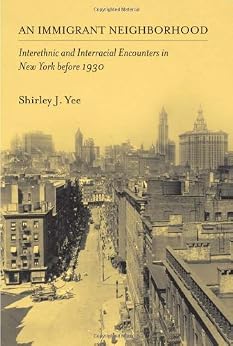
An Immigrant Neighborhood: Interethnic and Interracial Encounters in New York before 1930

Posted in Asian Diaspora, Books, History, Media Archive, Monographs, Social Science, United States on 2011-11-18 22:14Z by Steven

An Immigrant Neighborhood: Interethnic and Interracial Encounters in New York before 1930

Temple University Press
December 2011
256 pages
5.5 x 8.25
1 map, 6 halftones
Paper ISBN: 978-1-59213-128-0
Cloth ISBN: 978-1-59213-127-3
E-Book ISBN: 978-1-59213-129-7

Shirley Yee, Associate Professor of Women Studies; Adjunct Associate Professor of History; Adjunct Associate Professor of American Ethnic Studies
University of Washington

How the crowded neighborhoods of New York’s Lower East Side gave rise to cross-racial and cross ethnic bonds before 1930

Examining race and ethnic relations through an intersectional lens, Shirley J. Yee’s An Immigrant Neighborhood investigates the ways that race, class, and gender together shaped concepts of integration and assimilation as well as concepts of whiteness and citizenship in lower Manhattan during the late nineteenth and early twentieth centuries.

In contrast to accounts of insulated neighborhoods and ethnic enclaves, Yee’s study unearths the story of working-class urban dwellers of various ethnic groups—Chinese, Jews, Italians, and Irish—routinely interacting in social and economic settings.

Recounting the lived experiences in these neighborhoods, Yee’s numerous, fascinating anecdotes—such as the story of an Irishman who served for many years as the only funeral director for Chinese residents—detail friendships, business relationships, and sexual relationships that vividly counter the prevailing idea that ethnic groups mixed only in ways that were marked by violence and hostility.

Contents

  • Acknowledgements
  • Introduction
  • 1. Forming Households, Families, and Communities
  • 2. Building Commercial Relations
  • 3. Sustaining Life and Caring for the Dead
  • 4. Mixing with the Sinners: The Anti-vice Movement
  • 5. On (Un)Common Ground: Religious Politics in Settlements and Missions
  • Conclusion
  • Notes
  • Bibliography
  • Index

From the Introduction:

In the winter of 1877, a group of mourners gathered in a dimly lit funeral parlor on Pearl Street in lower Manhattan to pay their last respects to Ah Fung (sometimes referred to as Ah Lung), a Chinese man who had been brutally murdered in his Lower East Side apartment. He had died of “ghastly wounds” at Bellevue Hospital after living for eighty hours with his brain exposed. Both Irish and Chinese people attended the funeral, including Mrs. Ah Fung, a woman of Irish ancestry. The New York World described the mixed gathering as “something unprecedented . . . [that gave] a good idea of the cosmopolitan character of the city” Given the well-publicized history of anti-Chinese hostility among the Irish working class, it is not surprising that the editors viewed the Ah Fung funeral as an anomaly.

The details of Ah Fung’s life are murky. The World described him as a laundry worker, while the New York Times reported that he had eked out a living making cigars and cigarettes with a Chinese man, Tung Ha, also known as “Peter Johnson,” and his white wife, Theresa. The three lived at 17 Forsyth Street, located in an ethnically mixed neighborhood across from the future site of the Manhattan Bridge. For unknown reasons, the household had not included Ah Fung’s wife; the two apparently had been living apart for several months before the attack.

Like other working-class immigrant communities, the Chinese called on their local mutual aid societies to help cover the funeral costs. Members of the Ene E. Jong, a Chinese burial society, raised $200 for the funeral and burial expenses. But the dead man’s friends and relatives had to look outside the Chinese community for an undertaker, for it would not be until the 1930s that the Chinese could hire a licensed Chinese funeral director. They hired William H. Kennedy, who placed Ah Fung’s coffin in his carriage house “amidst numerous hacks, coffins of several sorts, and a dreary looking hearse.” The forty-five-year-old Irish immigrant was a former carpenter and stable and livery keeper known for having “buried all the Chinese that [had] died in the down-town settlement for a number of years past.” Readers of the World caught a glimpse of Chinese customs from Kennedy, who provided a lengthy description of Chinese funeral and burial rituals, information he had acquired after many years of serving the local Chinese community. He also provided details of the Ah Fung funeral, noting that Mrs. Ah Fung, whom he described as “bright and intelligent,” was apparently unmoved by her husband’s violent death. In the undertaker’s view, the young woman was “not in the least crushed by affliction, for having left a tidy sum to his widow, she [was] not left in poverty by the demise of her husband.” Kennedy’s perception that Mrs. Ah Fung was not aggrieved but satisfied at her newly acquired financial state reinscribed popular racial stereotypes of the time—that she could never have entered the marriage out of love, but only for economic gain.

The newspaper reports of Ah Fung’s murder and the funeral that followed were no different from other tales of interracial love, sex, and violence that had become standard fodder in an increasingly sensationalist press by the late nineteenth century. But once we sift through the lurid details of the crime and the “colorful” descriptions Kennedy provides, a layer of interracial/interethnic social and economic relations that operated beneath the radar of popular depictions of urban life begins to surface. Ah Fung’s community in 1877 consisted of both Chinese and non-Chinese people who in various ways provided friendship, kinship ties, social services, and financial as well as emotional support.

Ah Fung’s situation was not unusual. Interrracial/interethnic relations were a common feature of daily life among working-class New Yorkers even as the ethnic composition of working-class neighborhoods in lower Manhattan changed over time. Nearly fifty years after Ah Fung’s funeral, a few blocks north of Forsyth Street, Johanna Hurley sat with Ching Yeng and her four-year-old daughter, Lung Som Moy, as Ching’s husband, Lung Lin, lay dying. Hurley, a widowed German immigrant, lived in the same apartment building and had summoned the ambulance. The building on Division Street, where Hurley’s and Ching’s families resided, housed an ethnically mixed population of old and new immigrants, the latter being mostly Russian and Polish Jews who worked in the city’s garment factories, ran small shops, or peddled wares in the densely populated neighborhoods of lower Manhattan. Moy’s father worked as a store manager several blocks over on Pell Street in the area popularly known as “Chinatown.”…

…The language and politics of difference have undergone significant changes over the past two centuries, encoded in the categories “nationality,” “race,” “ethnicity,” “gender,” “culture,” and “class.” Such terms can denote group identities as well as official designations for enumeration and the development of public policy. Popular, legal and social-science definitions of race and ethnicity have been fluid and often inconsistent. In 1911, the Immigration Commission, headed by William P. Dillingham, departed from the practice of classifying people according to country of origin, opting instead to categorize people according to race. The commission defined race broadly rather than adopting the accepted notion that five distinct races existed—Caucasian, Mongolian, African, Malay, and Indian—which, its report argued, confined itself to only physical characteristics and color. According to the report, widening the definition of race to include what social scientists of the time would have referred to as “culture” was, the commission believed, more statistically accurate and practical in its effort to identify diverse groups coming from particular countries of origin. Thus, the commission retained the desire to classify, coming up with forty categories that it believed more accurately represented the identity of immigrant groups.

The terminology of race remained inconsistent in “objective” government documents, as well as in the courts. The social construction of race as an official classification shaped the ways in which government documents, such as the census, have categorized immigrants and their descendants into specific “racial” groups and reported their country of origin, or nationality. Even though federal census reports added more detail in terms of the numbers of categories, race remained an ambiguous category. Once classified as simply “colored” along with African Americans, the Chinese, for example, were classified as “Ch” for Chinese by 1890, but their children could be classified as either “Chinese” or “white,” especially if they had been born of marriages between Chinese and women of European ancestry. People of African descent were categorized alternatively as “colored,” “Negro,” “Black,” or “mulatto.” Such inconsistencies reflected the continued confusion among census takers about what race “really” was. At the root of the race problem were shifting meanings of whiteness.

Between the late nineteenth century and the 1930s, popular understandings of “race” had undergone important changes. As the nation moved steadily toward the narrow “one-drop” rule that signified “blackness,” the meaning of “whiteness” expanded to include the Irish and, later, all Europeans of Caucasian ancestry. By 1920, concerns about how to define “white” and, hence, “non-white” made its way into the U.S. Census guidelines. For the first time, the introduction to the census articulated the notion of racial purity as a way to resolve the problem of classifying mixed-race people and provided guidelines for census takers (who, as it turned out, used their own discretion when classifying people anyway). While previous census reports had simply declared “whiteness” to mean people of European ancestry, in the 1920 guidelines, the government added the terms “purity” and “blood” to further specify the meanings of “white,” “non-white,” and mixed-white: “The term ‘white’ as used in the census reports refers to persons understood to be pureblooded whites. A person of mixed blood is classified according to the nonwhite racial strain or, if the nonwhite blood itself is mixed, according to his racial status as adjudged by the community in which he resides.”…
Tags: , ,

One Big Hapa Family

Posted in Asian Diaspora, Canada, Family/Parenting, Identity Development/Psychology, Media Archive, Social Science, United States, Videos on 2011-11-14 01:32Z by Steven

One Big Hapa Family

KCTS 9 Television
Real NW
Seattle, Washington
Monday, 2011-11-14, 22:00 PST

After a family reunion, Japanese-Canadian filmmaker, Jeff Chiba Stearns embarks on a journey of self-discovery to find out why everyone in his Japanese-Canadian family married interracially after his grandparents’ generation.

Using a mix of live action and animation, “One Big Hapa Family,” explores why almost 100 percent of Japanese-Canadians—more than any other ethnic group—marry interracially and how their mixed children perceive their unique multiracial identities.

The stories of our generations of a Japanese-Canadian family to come to life through animation by some of Canada’s brightest independent animators, including Louise Johnson, Ben Meinhardt, Todd Ramsay, Kunal Sen, Jonathan Ng, and the filmmaker himself.

“One Big Hapa Family” makes us question: Is interracial mixing the end of multiculturalism as we know it?

 For more information, click here.

Tags: ,

The Stain of White: Liaisons, Memories, and White Men as Relatives

Posted in Articles, Asian Diaspora, Family/Parenting, History, Media Archive, Social Science on 2011-11-12 01:17Z by Steven

The Stain of White: Liaisons, Memories, and White Men as Relatives

Men and Masculinities
Volume 9, Number 2 (October 2006)
pages 131-151
DOI: 10.1177/1097184X06287764

Janaki Abraham, Assistant Professor Women Studies
Jawaharlal Neru University

During British colonial rule some matrilineal Thiyya women in North Kerala, India, had liaisons with British men. While the response of the caste (here, a Backward caste) to these liaisons shifted over time, in the late nineteenth and early twentieth century many women who had liaisons and their families were excommunicated. A “white connection” became a stain and kinship with the white man was denied or shrouded. This article looks at the ways in which both the liaisons and the denial of the white man as father or relative were located within practices of matrilineal kinship. Furthermore, this article seeks to understand how these liaisons are remembered today and how the presence of the white man as a relative is layered over by processes of forgetting and remembering.

Read or purchase the article here.

Tags: , ,

History and the (Un)making of Identifications in Literary Representations of Anglo-Indians and Goan Catholics

Posted in Asian Diaspora, Dissertations, History, Literary/Artistic Criticism, Media Archive, Religion on 2011-10-26 01:38Z by Steven

History and the (Un)making of Identifications in Literary Representations of Anglo-Indians and Goan Catholics

University of British Columbia
September 2000
465 pages

Marian Josephine Gracias

A THESIS SUBMITTED IN PARTIAL FULFILMENT OF THE REQUIREMENTS FOR THE DEGREE OF DOCTOR OF PHILOSOPHY in THE FACULTY OF GRADUATE STUDIES (Department of English)

This dissertation examines selected literature by and about Anglo-Indians (Eurasians) and Goan Catholics from India and the Indian diaspora, focusing on its preoccupation with the history of these communities as a site of contested identifications. Especially polemical are perceptions (due to communalist stereotypes or internalisation) of Anglo Indians and Goan Catholics as mimic or intermediary communities who ended up capitulating to British and/or Portuguese colonialist structures respectively. Larger issues for both communities in India and in the diaspora also involve questions of racial or cultural hybridity, and the slippage between religion and culture, particularly the linking of conversion to Christianity with colonisation, Westernisation, denationalisation, and non-Indianness.

I argue for a more layered understanding of the concepts of mimicry, hybridity, and resistance in relation to identifications from these communities. By choosing literature set in times of national crisis and historical change (in India, and in East Africa for the Goan diaspora), I have been attentive to the varying ways in which literary characters and narrators confront, project, or elide contradictions of proximity and difference in the production of racial, cultural, and national identity. The main literary texts in the discussion of Anglo- Indian identifications include John Masters’ “Bhowani Junction”, Manorama Mathai’s “Mulligatawny Soup”, Stephen Alter’s “Neglected Lives” and Allan Sealy’s “The Trotter-Nama”. In these texts, I have examined how the narrative opens up or circumscribes the agency and racial identifications of Anglo-Indian characters. As well, I make some references to Rudyard Kipling’s “Kim” and selected work by Ruskin Bond. The central literary texts in the discussion of Goan Catholic and diasporic identifications include Lambert Mascarenhas’ “Sorrowing Lies My Land”, Kiran Nagarkar’s “Ravan and Eddie”, João da Veiga Coutinho’s “A Kind of Absence: Life in the Shadow of History”, selected writing by damian lopes, and Peter Nazareth’s “In a Brown Mantle” and “The General is Up”. I also dwell in some detail on selected short stories by Lino Leitão, and Violet Dias Lannoy’s “Pears from the Willow Tree”. I examine the role of Anglo-Indian and Goan Catholic women literary characters, making the case that, for the most part, it is male characters who are given political and narrative complexity in terms of negotiating colonialism and nationalism, and that women characters, when central, are imaged as mediating grounds to advance or block access to male characters who are competing over nationalist and colonialist discourses about race and sexuality. An exception is the poetry of Eunice de Souza where there is critical reflection on the position of Goan Catholic women.

Where relevant, I draw from particular areas of cultural studies, postcolonial and feminist theories (including those dealing with psychoanalysis), and writings about Indian history and nationalism. Writings from these areas offer pertinent insights on ambivalence in the production of subjectivity, and on the construction of Indianness in relation to arguments on colonialism, gender, caste, class, secularism, and the religious right (especially the discourses of Hindutva). While the identifications and identity of Anglo-Indians and Goan Catholics appear in the genre of history, these communities are largely absent or peripheral in the area of literary analysis, cultural studies, and postcolonial theory pertaining to India. Therefore, I hope that a study of these communities will contribute to the discussion of religious and multiracial identifications that is increasingly relevant to the field of postcolonial and cultural studies.

Table of Contents

  • Abstract
  • Acknowledgements
  • Prologue: Copy Cat Copy Cat?
  • Chapter 1: “A Certain Way of Being There”
    • 1.1 Introduction
    • 1.2 Proximity and Distance: Colonialism and the Construction of Mimic Subjectivity
    • 1.3 Forms of Mimic Subjectivity and the Question of Subversion
    • 1.4 Nationalism, Colonialism, and the Construction of Indianness
  • Chapter 2: Negotiating Classifications: Writing an Anglo-Indian History
    • 2.1 Introducing Mixed Race Classifications
    • 2.2 Anglo-Indians and the Discourse of Mixed Races under British Colonialism
    • 2.3 Scientific Racialism and Other Discourses of Mixed Races
    • 2.4 Conclusion: (Dis)placing Anglo-Indian Classifications and Affiliation
  • Chapter 3: (By) Passing Stereotypes of Anglo-Indian Identifications in Literature
    • 3.1 Literary Antecedents: Representations of Mixed Race People
    • 3.2 “Species Loyally”: Anglo-Indian Identifications in John Masters’ Bhowani Junction
    • 3.3 Between Homes: Manorama Mathai’s Mulligatawny Soup
    • 3.4 Escaping from History: Stephen Alter’s Neglected Lives
    • 3.5 Interracial Relationships in Bhowani Junction, Mulligatawny Soup and Neglected Lives: Possibilities and Closures
  • Chapter 4: Beyond Doom and Gloom: Allan Sealy’s The Trotter-Nama
    • 4.1 Introduction: Alternatives to Stereotypes of Anglo-Indian Identifications
    • 4.2 Contending with “The Grey Man’s Burden”: Allan Sealy’s The Trotter-Nama
  • Chapter 5: Writing Identity in Goan History
    • 5.1 Claims in the Writing of Goan History.
    • 5.2 Early History of the Portuguese in India and Goa
    • 5.3 Mixing Trade, Religion, and Race
    • 5.4 Conversion to Christianity and the Practice of Religion Under British and Portuguese Colonialism
    • 5.5 Caste, Conversion, and National Identity in Portuguese Goa and British India
    • 5.6 Placing the Politics of Resistance to Portuguese Rule
    • 5.7 Claiming Goa: Liberation or Invasion?.
    • 5.8 The Impact of Language and Migration in the Construction of Goan Identity Today
    • 5.9 Colonial and Caste Effects in Locating Conversion to Christianity Within Communal and Secular Debates in Contemporary India
  • Chapter 6: Identifications in Crisis: Goan Catholics in Literature
    • 6.1 The Question of Goan Identity
    • 6.2 Writing Against Colonialism: Lambert Mascarenhas’ Sorrowing Lies My Land, Lino Leitão’s “The Miracle” and “Armando Rodrigues”
    • 6.3 The Crisis of Leadership: Violet Dias Lannoy’s Pears from the Willow Tree and Lambert Mascarenhas’ A Greater Tragedy
    • 6.4 Interrogating Gender: The Poetry of Eunice de Souza
    • 6.5 Hindus and Catholics: Where Parallel Worlds of Difference Meet in the Horizon of Kiran Nagarkar’s Ravan and Eddie
  • Chapter 7: “The Intimate Outsider”: History and Location in Literature from the Goan Catholic Diaspora
    • 7.1 Introductory Issues in Writing Diaspora
    • 7.2 The Search for a Theory of Goan History: João da Veiga Coutinho’s A Kind of Absence: Life in the Shadow of History.
    • 7.3 East African Goan Catholics: Narrating the Third That Walks Between Black and White in Peter Nazareth’s In a Brown Mantle and The General Is Up
    • 7.4 Intermediary Positions and Peter Nazareth’s Narrators
    • 7.5 Navigating Historical Legacies in damian lopes’ Writing
  • Chapter 8: Epilogue: The Politics of Engagement
  • Works Cited

Read the entire dissertation here.

Tags: , , , , , , , , , , , , , , , ,

Barack Obama in Hawai’i and Indonesia: The Making of a Global President

Posted in Asian Diaspora, Barack Obama, Biography, Books, Identity Development/Psychology, Media Archive, Monographs, United States on 2011-10-24 18:46Z by Steven

Barack Obama in Hawai’i and Indonesia: The Making of a Global President

ABC-CLIO Praeger
September 2011
276 pages
6 1/8 x 9 1/4
Hardcover ISBN: 978-0-313-38533-9
Electronic ISBN: 978-0-313-38534-6

Dinesh Sharma, Senior Fellow
Institute for International and Cross-Cultural Research
St. Francis College, New York

Distinguishing itself from the mass of political biographies of Barack Obama, this first interdisciplinary study of Obama’s Indonesian and Hawai’ian years examines their effect on his adult character, political identity, and global world-view.

Barack Obama is the first American president born and raised in Hawai’i, the most diverse state in the Union, and the first American president to have spent a significant part of his childhood in a Muslim-majority nation, namely, Indonesia. What effect did these—and other early experiences—have on the man who is now, arguably, the world’s most popular political leader?

The first 18 years of President Obama’s life, from his birth in 1961 to his departure for college in 1979, were spent in Hawai’i and Indonesia. These years fundamentally shaped the traits for which the adult Obama is noted—his protean identity, his nuanced appreciation of multiple views of the same object, his cosmopolitan breadth of view, and his self-rooted “outpost” patriotism. Barack Obama in Hawai’i and Indonesia: The Making of a Global President is the first study to examine, in fascinating detail, how his early years impacted this unique leader.

Existing biographies of President Obama are primarily political treatments. Here, cross-cultural psychologist and marketing consultant Dinesh Sharma explores the connections between Obama’s early upbringing and his adult views of civil society, secular Islam, and globalization. The book draws on the author’s on-the-ground research and extensive first-hand interviews in Jakarta; Honolulu; New York; Washington, DC; and Chicago to evaluate the multicultural inputs to Obama’s character and the ways in which they prepared him to meet the challenges of world leadership in the 21st century.

Features

  • Foreword
  • Photographs
  • Timelines
  • Figures
  • Appendices

Highlights

  • Offers the first systematic study of Barack Obama’s Indonesian and Hawai’ian years and their effect on his adult character and political identity
  • Shows how Obama’s early experiences fostered a repertoire of social and psychological skills ideally suited to dealing with the complex cultural and geopolitical issues that confront 21st-century America
  • Provides new keys to understanding Obama by looking at the varied cultural and religious influences that shaped his attitudes, beliefs, and hybrid cultural identity
  • Examines Ann Dunham’s doctoral dissertation, based on her social anthropological fieldwork in Indonesia, for clues to the perceptual prisms she inculcated in her son, Barack Obama
Tags: , , , ,

Clench: What are You Fighting For?

Posted in Asian Diaspora, Media Archive, Social Science, Social Work, United Kingdom, Videos, Women on 2011-10-23 02:46Z by Steven

Clench: What are You Fighting For?

Commissioned By: Runnymede Trust-UK’s Leading Race Equality Think Tank
2011
Written and directed by Riffat Ahmed
Produced by Shane Davey, Courtney Edwards, Riffat Ahmed and Fabien Soazandry of Davey Inc
Running Time: 00:15:39

Starring: Hussina Raja as Ash
With: Kevin Morris, Jeff Caffrey, Afreen Mhar, Allan Hopwood, and Danny Randall

Made as part of the Runnymede Trust’s Generation 3.0 project, which looks at how racism can be ended in a generation, this short film tells the story of Ash, a mixed-race girl from Old Trafford, Manchester.

On a youth referral scheme, we see Ash travel to the iconic Salford Lads Club where she takes up boxing as a way of dealing with her troubled past. By portraying Ash’s experience of the sport, the film highlights how the boxing ring can be a neutral space where race and neighbourhood politics are left outside.

The film looks at not only Ash’s own experience of racism, but also the preconceptions she holds about other people and places.

Clench demonsrates how boxing can become the ultimate visual tool for communication between generations, highlighting that every person has a story to tell regardless of how they look.

Music: Sam Baws
Director of Photography: Jake Scott
Sound Design: Ashley Charles
Editor: Vid Price

Supporting Cast: Ezzo DeVaugn, Billy Wain, Kane Hannaway, Charell Anerville, Philip Mulher, Adam Crosby, Sam Walker, Rico Stewart, Dan McCan, Anna Baatz, and Patrick O’Brien

Gaffer: Gwyn Hemmings
Focus Puller: Matt French
Second AC/DIT: Jan Koblanski Bowyer
Sound Recordist: Shaun Hocking
Make up: Sophie Mechlowitz and Leah Tesciuba
Red Camera: HH Films Manchester
Anamorphic Lenses: Nick Gordon Smith
Lighting: Arri Manchester
Colourist: Martin Southworth @ Nice Biscuits

Shot on location in Manchester, England

Tags: , , , , , , , , , , , , , , , ,

Mixed But Not Divided: Multi-ethnic populations redefine racial lines

Posted in Articles, Asian Diaspora, Census/Demographics, Media Archive, Politics/Public Policy, United States on 2011-10-22 17:05Z by Steven

Mixed But Not Divided: Multi-ethnic populations redefine racial lines

City on a Hill Press: A Student-Run Newspaper
University of California, Santa Cruz
2011-10-20

Chelsea Hawkins

When I was six or seven years old, I would spend my Saturday afternoons at the local Korean Baptist Church. A pink textbook opened in front of me, oversized hangul lightly sketched on sheets of paper. I kept my eyes turned downward behind a veil of straight brown hair as I avoided speaking. My face would become red and hot with embarrassment, as the guttural sounds got caught in my throat and I fumbled over words — the syllables swirled around in my mouth, only to be spit out awkwardly, a jumble of sounds always a little off.

Korean school was a short-lived experience — I hated going because even though I wasn’t sure what it was, I knew I was different. I looked different. I was shy and out of place. I hated my limited Korean and I hated feeling like an outsider. I spent more afternoons hiding in the secret places of a little garden than talking to my peers.

I am — like 4.2 million Americans — multiracial. My mother is Native American and white; my father, Korean and white. If my parents had followed the life paths their families had in mind, I would not be here. A product of teen parents, I stumbled through life and grew up with them. And when they came into the picture, my two younger brothers joined our little family.

Among American children, the multiracial population has increased almost 50 percent to 4.2 million people since 2000, according to The New York Times. The 2000 census report was the first time that Americans had the option to select more than one race — and reports flooded in, indicating the number of mixed race people in the United States…

…Mark-Griffin, who is a native of Michigan and former UCSC student, had an experience unique compared to a multiracial Californian: He was one of the only Asian-American students in his school.

While Mark-Griffin said he doesn’t want to portray Michigan or the Midwest as a racist area, he did emphasize that it wasn’t nearly as diverse as California. But as a result of the differences in culture between California and Michigan, Mark-Griffin has seen the way people’s perceptions can change with communities.

“In Michigan, most people identify me as Asian, but here in California, I’m a white guy,” Mark-Griffin said…

Read the entire article here.

Tags: , , , ,