Professor’s Bookshelf: Amy Cynthia Tang

Posted in Articles, Asian Diaspora, Campus Life, Media Archive, Passing, United States, Women on 2012-04-26 02:57Z by Steven

Professor’s Bookshelf: Amy Cynthia Tang

The Wesleyan Argus
Middletown, Connecticut
2012-04-19

Miriam Olenick, Staff Writer

Assistant Professor Amy Cynthia Tang, of the American Studies and English departments, specializes in Asian-American and African-American literature—most recently, she has been reading satirical Asian-American plays. Professor Tang sat down with The Argus to discuss her favorite authors, her plans for future classes, and her manuscript.

The Argus: What’s on your bookshelf?

Amy Cynthia Tang: So almost everything on these shelves is either a work of American literature or a critical or theoretical text about American literature, mainly Asian-American and African-American. I have some sections on cultural studies, critical race theory, and narrative theory. I have the books for the courses I’m teaching this term—Trauma in Asian American Literature, and Racial Passing in American Literature. And I have a small section devoted to art history.

A: Do you have anything you’re reading just for fun, not related to classes?

ACT: Right now I’m finishing up this collection of plays by Young Jean Lee called “Songs of the Dragons Flying to Heaven.” It’s a satirical take on what people expect an Asian-American identity play to be about. She’s an experimental playwright, so the characters are non-realist, and she uses stereotypes to engage received ideas of Asian-American identity and push back against them. I was just thinking that it’s sort of related to Theresa Cha’s Dictee—which we’re reading for Trauma—since they’re both by Korean-American women writers, and they’re both very experimental and non-realist. So Lee’s book is both work and pleasure, I guess.

Also I commute from New Haven, so I listen to books on tape—that really is fun. I just finished Jonathan Safran Foer’sExtremely Loud and Incredibly Close.” I got interested in Foer because I have a thesis student who wrote on “Everything is Illuminated.” And now I’m ready to start Ralph Ellison’s posthumously published, unfinished novel, “Juneteenth.” I’ve been meaning to read it for a long time, and finally broke down and said well, there’s the audio book. And bizarrely, I just started looking at it, and it turns out it’s a passing narrative, and I’m teaching a class on racial passing, so there will be some resonances there…

Read the entire article here.
Tags: , , , , , ,

Multi-ethnic Koreans find help with assimilation through MACK Foundation

Posted in Articles, Asian Diaspora, Identity Development/Psychology, New Media, Social Science on 2012-04-26 01:31Z by Steven

Multi-ethnic Koreans find help with assimilation through MACK Foundation

The Korea Times
2012-04-25

A “typical Korean” probably wouldn’t call Yang Chan-wook a typical Korean, but he wants to be seen that way. The 37-year-old is a multi-ethnic Korean, part Korean from his mother’s side and part African-American from his father’s side. And he’s working towards better understanding of multi-ethnic Koreans in Korean society with his foundation, the Movement for the Advancement of the Cultural-Diversity of Koreans, also known as MACK.

The MACK Foundation president was born in Korea, but moved around between the U.S., Germany and Korea when he was young. Yang says he really started to come to terms with his dual ethnicities after his parents divorced.

“It was around 10 or 11 when I started to identify myself with the different cultural aspects of my own life that either contradicted or fit into the environment that I was in,” says Yang. Until that point, Yang continues, “my ethnicity wasn’t really on my mind until I moved to my father’s side of the family in an all African-American community.” It was there in Chicago where Yang says that his dual-ethnicities were actually being pointed out to him and he had to start thinking about what that meant.

After that, Yang decided to dedicate his life towards helping others with similar backgrounds. He moved back to Korea in 2003. It was here in 2009 where he took the reins of MACK.

“We’re different from other multi-cultural foundations because we’re focused on Koreans accepting the diversity of its own people,” says Yang…

Shin Hei-soo, a U.N. Committee on Economic, Social and Cultural Rights expert, says that Korea still has many issues accepting a multi-ethnic as well as a multi-cultural society. It’s because “Koreans have long historical roots of the family tree,” Shin explains. In her hometown area in Gyeonggi Province, where they can count back to 11 generations of the family name Shin, she says even Koreans with a different last name than Shin are still treated as outsiders.

Rural and older generations might have a more conservative view about accepting mixed-race Koreans into society, says Lee Kyu-jae, a recent Hanyang University graduate. “In my opinion, mixed-race Koreans are also our citizens so we shouldn’t consider them as foreign or someone who is different.” The 26-year-old continues, “because Korea is a single-race nation, most Koreans cannot help having a sense of difference about them. So, they sometimes suffer from hardship due to this unique Korean perspective.”…

Read the entire article here.

Tags: , , , , , , ,

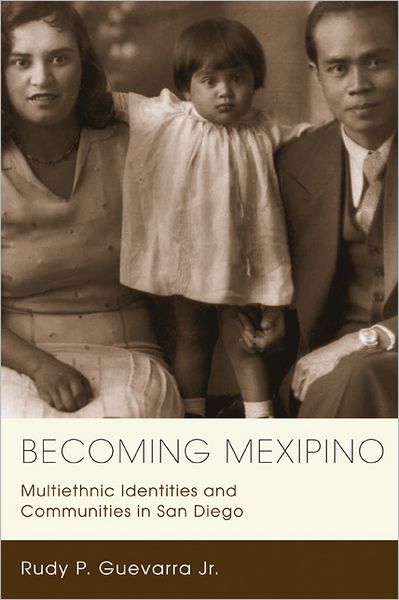
Becoming Mexipino: Multiethnic Identities and Communities in San Diego

Posted in Anthropology, Asian Diaspora, Books, History, Identity Development/Psychology, Latino Studies, Media Archive, Monographs, United States on 2012-04-24 12:19Z by Steven

Becoming Mexipino: Multiethnic Identities and Communities in San Diego

Rutgers University Press
June 2012
256 pages
Hardcover ISBN-13: 9780813552835, ISBN: 0813552834
Paperback ISBN-13: 9780813552842, ISBN: 0813552842

Rudy P. Guevarra, Jr., Associate Professor, Asian Pacific American Studies, School of Social Transformation, College of Liberal Arts and Sciences
Arizona State University, Tempe

Becoming Mexipino is a social-historical interpretation of two ethnic groups, one Mexican, the other Filipino, whose paths led both groups to San Diego, California. Rudy Guevarra traces the earliest interactions of both groups with Spanish colonialism to illustrate how these historical ties and cultural bonds laid the foundation for what would become close interethnic relationships and communities in twentieth-century San Diego as well as in other locales throughout California and the Pacific West Coast.

Through racially restrictive covenants and other forms of discrimination, both groups, regardless of their differences, were confined to segregated living spaces along with African Americans, other Asian groups, and a few European immigrant clusters. Within these urban multiracial spaces, Mexicans and Filipinos coalesced to build a world of their own through family and kin networks, shared cultural practices, social organizations, and music and other forms of entertainment. They occupied the same living spaces, attended the same Catholic churches, and worked together creating labor cultures that reinforced their ties, often fostering marriages. Mexipino children, living simultaneously in two cultures, have forged a new identity for themselves.  Their lives are the lens through which these two communities are examined, revealing the ways in which Mexicans and Filipinos interacted over generations to produce this distinct and instructive multiethnic experience. Using archival sources, oral histories, newspapers, and personal collections and photographs, Guevarra defines the niche that this particular group carved out for itself.

Tags: , , , , , ,

Identity of Biracial College Students

Posted in Asian Diaspora, Campus Life, Dissertations, Identity Development/Psychology, Media Archive, United States on 2012-04-16 02:36Z by Steven

Identity of Biracial College Students

San Jose State University
May 1999
77 pages

MyTra Fitzpatrick

A Thesis Presented to The Faculty of the Department of Child Development San Jose State University In Partial Fulfillment of the Requirements for the Degree Master of Arts

This thesis examined the identity of biracial college students and the relationship between parenting styles (authoritative, authoritarian, and permissive) and biracial identity development. Biracial subjects were defined as individuals having parents who were from two different ethnic/racial groups. Of the total of 104 subjects, 65 students were classified into one of three mixed-groups categories according to the two ethiucities of their parents: Asian/Euro-American, Asian/Latino, and Latino/Euro-American. Results showed that students identified strongly with one or both ethnicities, and that strong bicultural identity was associated with positive self-esteem. The majority of parents utilized authoritative parenting styles, regardless of their ethnic mix. While authoritative parents were more likely to have offspring who exhibited higher levels of bicultural identity and self-esteem, these results were not statistically significant. These findings are consistent with the parenting styles literature and with studies showing positive identity for biracial students.

Table of Contents

  • List of Tables
  • Chapter 1: Introduction to the Problem
    • Interracial Marriages
    • Definition of Biracial Individuals
    • Statement of the Problem and Purpose of this Study
  • Chapter 2: Review of the Literature
    • Research on Biracial Individuals
    • Identity Development: Definitions and Theories
    • Identity Development of Ethnic Minority Individuals
    • Identity Development of Biracial Individuals
    • Parenting Styles and the Relationship to Biracial Adolescents’ Social and Emotional Development
      • Baumrind’s Four Dimensions of Parental Behavior
      • Baumrind’s Three Parenting Style Typologies
      • Ethnic Differences in Parenting Styles
  • Chapter 3: Methodology
    • Participants
    • Materials
    • Procedure
  • Chapter 4: Results
  • Chapter 5: Discussion and Conclusions
  • References
  • Appendix A

List of Tables

  1. Who Students Live With by Ethnicity of Parents
  2. Percent of Students who Identified with Their Mom vs. Their Dad
  3. Identity Strength for Group 1 by Ethnicity of Parents
  4. Identity Strength for Group 2 by Ethnicity of Parents
  5. Bicultural Identity from Low to High by Ethnicity of Parents
  6. Mean Scores for Identity Items by Primary Identity Group
  7. Reasons Student Select for Identifying with Primary Ethnic Identity Group
  8. Mean Score of Self-Esteem by Primary Ethnic Identity
  9. Mean Score of Self-Esteem by Bicultural Identity
  10. Mean Score of Self-Esteem by Ethnicity of Parents
  11. Parenting Styles by Ethnic Mix-Groups of Parents
  12. Percent of Parents Using Each Parenting Styles by Bicultural Identity of Child.
  13. Mean Self-Esteem Scores by Parenting Styles

Read the entire thesis here.

Tags: ,

Eurasian Women as Tawa’if Singers and Recording Artists: Entertainment and Identity-making in Colonial India

Posted in Articles, Asian Diaspora, History, Literary/Artistic Criticism, Media Archive, Women on 2012-04-13 01:13Z by Steven

Eurasian Women as Tawa’if Singers and Recording Artists: Entertainment and Identity-making in Colonial India

African and Asian Studies
Volume 8, Issue 3 (2009)
pages 268-287
DOI: 10.1163/156921009X458118

Shweta Sachdeva Jha, Assistant Professor of English
Miranda House, University College for Women, University of Delhi

Scholarship on Eurasians has often addressed issues of migration, collective identity and debates around home. Women performers however do not find themselves discussed in these histories of Eurasian peoples in India. This paper aims to account for individual agency in shaping one’s identity within the meta-narratives of collective identity of migrant peoples. I focus on two Eurasian women entertainers in the colonial cities of Benares and Calcutta who chose to forget their mixed-race past to fashion successful careers using new identities as tawa’if singers and actors in the late nineteenth and early twentieth centuries. This, I shall argue, was possible within the wider context of emergent colonial modernities in colonial India. By choosing micro-level case histories of these celebrity entertainers, I want to argue for including popular culture as an arena of identity-making within histories of migration and gender. To engage with popular culture, I shall extend our perception of historical ‘archive’ to include a varied set of materials such as biographical anecdotes, discographies, songbooks, and address the fields of poetry, music and history. Through this project I hope to rethink ideas of gender, culture and agency within wider debates of migration and identity-making.

Tags: , , ,

The Effect of a Biracial identity Development Program on Feelings of Alienation in Biracial Children

Posted in Asian Diaspora, Dissertations, Identity Development/Psychology, Media Archive on 2012-04-10 01:52Z by Steven

The Effect of a Biracial identity Development Program on Feelings of Alienation in Biracial Children

University of San Francisco
December 2004
94 pages
Publication Number: AAT 3156115
ISBN: 9780496168002

Robin E. Schulte

A Dissertation Presented to The Faculty of the School of Education Counseling Psychology Department In Partial Fulfillment of the Requirement for the Degree Doctor of Psychology

Research on biracial individuals has primarily been done on Black/White mixed individuals. This study examines the effects of a biracial identity development program on feelings of alienation for Asian/Caucasian and Latino/Caucasian children. A single-subject research design was conducted on three female participants, two of Asian/Caucasian descent and the third of Latino/Caucasian descent. The purpose of the research was to demonstrate whether a biracial identity development program would prevent a cultural identity crisis from forming. This was accomplished by measuring the participant’s levels of alienation. The program utilized concepts from social learning theory and incorporated various activities which included, role-modeling, the Kinetic Family Drawing, bibliotherapy, and family meetings. The social environment and cultural factors such as the race of peers, relatives, communities, and friends were examined. Results indicated that the program was not as effective as previously hypothesized. However, results also showed that this may have been due to the way the program outcome was measured.

TABLE OF CONTENTS

  • CHAPTER ONE: Introduction
    • Statement of the Problem
    • Procedures
    • Definitions
    • Implications of the Study
    • Significance of the Study
  • CHAPTER TWO: REVIEW OF THE LITERATURE
    • Intermarried Couples
    • Biracial Offspring
      • A Model of Ethnic Identity Development
      • Physical Appearance
    • Counseling Interracial Families and their Children
      • Principles of Working with Interracial Couples
      • Implications for Counselors Working with Biracial Child
    • Biracial Research
      • Biracial Identity Development
    • Therapy and Biracial Identity Development
    • Social Learning Theory
    • Alienation
    • Conclusion
  • CHAPTER THREE: METHOD
    • Restatement of the Major Research Question
    • Research Design
    • Participants
    • Protection of Human Subjects
    • Procedures
    • Treatment
      • Week 1
      • Week 2
      • Week 3
      • Week 4
      • Week 5
    • Instrumentation
      • Structured Interview:
      • The MEIM
    • Reliability
      • Structured Interview:
      • The Multigroup Ethnic Identity Measure
    • Validity:
    • Data Collection
      • Structured Interview
      • Revised Version of the MEIM:
      • Alienation Log
    • Data Analysis
      • Structured Interview
      • Revised Version of the MEIM
      • Alienation Log
  • CHAPTER FOUR: RESULTS
    • Alienation Scores
      • Participant 1
      • Participant 2
      • Participant 3
    • Revised MEIM Scores
    • Social Validation Observations
      • Participant 1
        • Week 1-Baseline
        • Week 2
        • Week 3
        • Week 4
        • Week 5
        • Feedback Session
      • Participant 2
        • Week 1-Baseline
        • Week 2
        • Week 3
        • Week 4
        • Week 5
        • Feedback Session
      • Participant 3
        • Week 1-Baseline
        • Week 2
        • Week 3
        • Week 4
        • Week 5
        • Feedback Session
    • Summary
  • SECTION FIVE: DISCUSSION
    • Limitations of the Study
      • Internal Validity
    • Recommendations
    • Implications for Practice
    • Conclusion
  • APPENDICES
  • REFERENCES

Purchase the dissertation here.

Tags: , ,

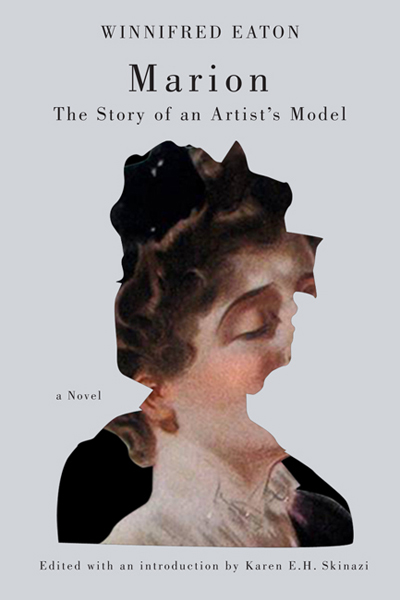
Marion: The Story of an Artist’s Model

Posted in Asian Diaspora, Books, Canada, Media Archive, Novels, Passing, Women on 2012-04-04 02:10Z by Steven

Marion: The Story of an Artist’s Model

McGill-Queen’s University Press
2012-03-19
410 pages
21 b&w photos
6 x 9
Paper (077353962X) 9780773539624

Winnifred Eaton (1875-1954)

Introduction by:

Karen E. H. Skinazi, Lecturer
Princeton Writing Program
Princeton University

The daughter of an English merchant father and Chinese mother, Winnifred Eaton (1875-1954) was a wildly popular fiction writer in her time. Born in Montreal, Eaton lived in Jamaica and several places in the United States before settling in Alberta. Her books, many of them published under the Japanese pseudonym Onoto Watanna, encompass the experiences of marginalized women in Canada, Jamaica, the United States, and a romantic, imagined Japan. Marion: The Story of an Artist’s Model is Eaton’s only book that explicitly deals with being “foreign” in Canada.

The novel follows the life of “half-foreign” Marion Ascough—a character based on Eaton’s own sister—while never identifying her “foreignness.” Escaping the unrelenting racial discrimination her family endures in Quebec, Marion follows her dream of being an artist by moving to New York, where she becomes “Canadian” instead of ethnic – a more palatable foreignness. Having successfully stripped herself of her ethnicity, Marion continues to experience discrimination and objectification as a woman, failing as an artist and becoming an artist’s model. Karen Skinazi’s introduction to Eaton’s fascinating narrative draws attention to the fact that although the novel uses many of the conventions of the “race secret” story, this time the secret is never revealed.

This new edition of Marion: The Story of An Artist’s Model brings back into print a compelling and sophisticated treasure of Asian Canadian/American fiction that offers a rare perspective on ethnicity, gender, and identity.

Tags: , , , ,

Association for Asian American Studies 2012 Annual Conference

Posted in Asian Diaspora, Forthcoming Media, History, Identity Development/Psychology, Live Events, Social Science, United States on 2012-04-03 19:58Z by Steven

Association for Asian American Studies 2012 Annual Conference

Capitol Hilton Hotel
1001 16th Street, NW
Washington, D.C.
2012-04-11 through 2012-04-14

Selected Sessions from Tentative Schedule

Thursday, April 12: 13:15-14:45 (South American A) Exposing Truths: Re-Centering Filipina/o American Subjectivities
Chair: Dawn Bohulano Mabalon, San Francisco State University

“Passing It On: Mixed Filipina/o American PEP Teachers Facilitating Growth in Students and Self”
Teresa Hodges, San Francisco State University

Friday, April 13: 15:00 – 16:30 EDT  (Statler B) Multiracial Asian/Americans: War and the Mixed Race Experience
Chair: Sue-Je Gage, Ithaca College

“Different Kinds of Occupation: Mixed Race People in Occupied Post-War Japan and Okinawa”
Lily Anne Yumi Welty, University of California, Santa Barbara

“When Half is Whole”
Stephen Murphy-Shigematsu, Stanford University

“Kiku and Isamu: Japanese Representations of Biracial Children in Post-war Japan”
Zelideth M. Rivas, Grinnell College

“Politics and Policing of Difference: Asian America and ‘Amerasians’”
Sue-Je Gage, Ithaca College

 
Friday, April 13: 15:00-16:30 EDT (California) Performing History, Expanding Race: Afro-Asian and Arab-Asian Hip Hop, Film and Spoken Word
Chair: Vanita Reddy, Texas A&M
Discussant: Junaid Rana, University of Illinois at Urbana-Champaign

“Afro-Asian Diasporic Intimacies: Mira Nair’s Mississippi Masala and Shailja Patel’s Migritude”
Vanita Reddy, Texas A&M

“Performing the Political: Kundiman’s 9/11 Poetry Project”
Anantha Sudhakar, University of Illinois at Urbana-Champaign

“Afro-Asian Aesthetics in Early Hip Hop Culture and Performance: Martin Wong’s Graffiti and Berry Gordy’s The Last Dragon”
Shante Paradigm Smalls, Davidson College

Saturday, April 14: 14:45-16:15 EDT (Statler B) Theorizing Asian Americans: Race, Ethnicity, and Nation
Chair: Lisa Mar, University of Maryland

“Genetic Citizens: Multiracial Asian Americans and the Limits of Nation”
LeiLani Nishime, University of Washington

For more information, click here.

For Asian-American Couples, a Tie That Binds

Posted in Articles, Asian Diaspora, New Media, Social Science, United States on 2012-04-01 22:42Z by Steven

For Asian-American Couples, a Tie That Binds

The New York Times
2012-03-30

Rachel L. Swarns

WHEN she was a philosophy student at Harvard College eight years ago, Liane Young never thought twice about all the interracial couples who flitted across campus, arm and arm, hand in hand. Most of her Asian friends had white boyfriends or girlfriends. In her social circles, it was simply the way of the world.

But today, the majority of Ms. Young’s Asian-American friends on Facebook have Asian-American husbands or wives. And Ms. Young, a Boston-born granddaughter of Chinese immigrants, is married to a Harvard medical student who loves skiing and the Pittsburgh Steelers and just happens to have been born in Fujian Province in China.

Ms. Young said she hadn’t been searching for a boyfriend with an Asian background. They met by chance at a nightclub in Boston, and she is delighted by how completely right it feels. They have taken lessons together in Cantonese (which she speaks) and Mandarin (which he speaks), and they hope to pass along those languages when they have children someday.

“We want Chinese culture to be a part of our lives and our kids’ lives,” said Ms. Young, 29, an assistant professor of psychology at Boston College who married Xin Gao, 27, last year. “It’s another part of our marriage that we’re excited to tackle together.”

Interracial marriage rates are at an all-time high in the United States, with the percentage of couples exchanging vows across the color line more than doubling over the last 30 years. But Asian-Americans are bucking that trend, increasingly choosing their soul mates from among their own expanding community…

Read the entire article here.

Tags: , , , , , ,

Half and Half

Posted in Articles, Asian Diaspora, Campus Life, Identity Development/Psychology, Media Archive, United States on 2012-03-28 23:11Z by Steven

Half and Half

The Cornell Daily Sun
Ithaca, New York
2012-03-28

Rebecca Lee

Just about the only thing I am looking forward to about graduation is finally being able to meet all of my best friends’ parents.  In high school, we knew our friends’ parents almost as well as our own, calling them by their first names, even dropping a playful “Mom” now and then.   Au contraire, we go through college barely having met the creators of the people with whom we share everything, from our rooms to our nights to our secrets.  Meeting a friend’s parents is an “aha” moment in which you are almost in awe of the physical representation of genetics in front of you.

Ah, genetics.  It’s where I get my mom’s smile and idealism, my dad’s olive skin and innate quietude.  It’s why I can both wear a “Kiss Me I’m Irish” shirt on St. Patrick’s Day and send out Chinese New Year cards when my family misses the traditional holiday season.  It’s why some people think I’m adopted.  It’s why I proudly refer to myself as a halfie.

In all honesty, my Chinese dad grew up in Great Neck and I am not even that good at using chopsticks.   But even though I am thoroughly Americanized, I still feel close to my distinct Chinese heritage.  For one, I am perceptibly Asian, whereas the other half of my genes are a little more, well, recessive. I even spent the first seven years of my life in Chinatown, at a public kindergarten where I was the only kid who didn’t know how to speak Chinese. But I have to wonder whether I would feel as close a connection to my Asian heritage if my last name wasn’t Lee, if my hair wasn’t naturally dark and stick straight, if I didn’t grow up knowing my Chinese grandparents…

…When people say that they only want to be with someone of their same race or religion, I take it as somewhat of a personal offense, since my own mixed-race existence was in such clear defiance of those beliefs.  I used to think it was closed minded of my Catholic friends to only follow up on Catholic advances.  I used to think it was cruel and unusual for my Indian friends to have to only date other Indians.   I used to see it as a kind of discrimination, even.  I used to protest, caught up by a combination of romantic whimsy and defensiveness — Give everyone a fair chance! You can’t help who you fall in love with! People are people!

And it’s true, people are people, but people are also products of their cultures and beliefs.  Is it really discrimination to prefer to be with people who share those things with you?…

Read the entire article here.

Tags: , ,