Children of the banished dragon

Posted in Articles, Asian Diaspora, History, Media Archive, United Kingdom on 2012-05-18 19:24Z by Steven

Children of the banished dragon

The Daily Post
Liverpool, England
2006-01-23

Lew Baxter

Lew Baxter reports on a shameful episode after World War II when Chinese sailors who had risked their lives for Britain were deported back to China, many leaving behind distraught British wives and children.

Even 60 years later, tears and trauma trail in the wake of a callous official decision to forcibly repatriate hundreds of Chinese seamen who helped crew the British merchant fleets on the dangerous Atlantic wartime convoys ensuring the country’s vital lifeline.

Hundreds of other Chinese sailors lost their lives in those bitterly cold waters.

As a result of Home Office policy of the time, families were broken up and many of the British-born wives and children left behind became destitute, some women even thought of suicide as a way out of their misery. Others remarried and tried to forget the past. Many believed their husbands had deserted them and, for years, explained away their embarrassment by claiming they had drowned at sea.

The truth is much harsher and more brutal.

From October 1945 to July 1946, hundreds of Chinese sailors were rounded up, largely in Liverpool—quite a few at night by crack squads of police led by Special Branch—and repatriated. In reality, almost 5,000 were sent back to China under specially altered directives that affected their landing rights.

Their children—at least 450—were told little of their fathers, or that they were dead or had left, others were adopted by strangers who knew nothing of their background. Their early lives were cloaked in mystery and confusion.

Today the story of these perfidious and shabby deeds has been unearthed by the tenacity of a small number of these lost children of the Chinese dragons.

A memo locked away for decades in the Public Record Office in Kew—amongst a fascinating archive that reveals the shocking depth and extent of the iniquity—dated November 9 1945 reads: “I am directed by the Secretary of State to say that, with the ending of the war against Japan, deportation to China is likely to become possible before long and the Ministry of Transport will shortly be making available transport for the repatriation of Chinese now in this country.”

Many of the men had settled in Britain after “doing their duty” and had married local girls, particularly in Liverpool. There were hundreds of Eurasian children from these relationships and most of these sailors from Shanghai, Ningbo, Hong Kong and even Singapore assumed they had a right to remain in the country they had defended…

…It was the same mission that drove Yvonne Foley, who first learned of the facts after the BBC documentary and she became determined to trace her own background.

“My interest was stirred by that programme and I met Keith. We agreed to help each other. He gave me the names of others and there are now about nine of us. We have called ourselves the Dragons of the Pool,” says Yvonne, who has actually lived in Hong Kong and visited China many times. In many ways, the “dragons” are now a family forged out of a shared heartache.

In the wake of these post war deportations came awful distress and even attempted suicides amongst broken, distraught families: women who had no idea where their men had gone, some believing they had deserted them while generations of children never knew their fathers or their true bloodlines. Official records show that more than 230 married Chinese sailors were given no choice or chance to say goodbye to loved ones…
Read the entire article here or here.

Tags: , , , ,

Eurasians: The First British Born Chinese?

Posted in Articles, Asian Diaspora, History, Media Archive, United Kingdom on 2012-05-18 18:04Z by Steven

Eurasians: The First British Born Chinese?

DimSum: The British Chinese community website
2007-06-30

Yvonne Foley

I am a Eurasian.  I am the daughter of an English mother and a Shanghai father.  In traditional Chinese culture, having a Chinese father, I am regarded as being Chinese.

I am part of a community that has been around for over 100 years.  We pre-date by many decades what many people seem to think is the point at which Britains’ Chinese community came into being.  The 1950s, when people from Hong Kong’s New Territories started to come to the UK.

Our fathers’ origins

Chinese men started to settle down in Britain in the last years of the nineteenth century. Right from the start they seemed to have few problems in getting partners amongst the working class girls of the cities in which they settled. Not very surprising when up to World War Two and even beyond it marriage for a young woman could mean violence and the most desperate poverty.  John Chinaman, as he was called at the time, was clean, sober, hard working and a good father. And, of course, more often than not he was quite a handsome man!

But where did these men come from?  For many, the answer they gave to any official who asked was ‘Hong Kong’. But that tells us little.  A Chinese seaman had to take an English language test – unless he was from Hong Kong.  So there were few who were prepared to say that they were not from Hong Kong unless they had confidence in their English language skills!  Where they were actually from ranged from Hainan Island to Fukien and Tientsin.  But since Shanghai was by far the most important commercial city in China and its major port, it seems that many were recruited there and in the nearby city of Ningbo

Read the entire article here. For more information about Liverpool’s early Chinese Community, see http://www.halfandhalf.org.uk

Tags: , ,

In Mixed Company: Multiracial academics, advocates and artists gather for Hapa Japan Conference

Posted in Articles, Asian Diaspora, Identity Development/Psychology, Media Archive, United States on 2012-05-15 21:37Z by Steven

In Mixed Company: Multiracial academics, advocates and artists gather for Hapa Japan Conference

Nichi Bei: A mixed plate of Japanese American News & Culture
2011-05-26

Alec Yoshio MacDonald, Nichi Bei Weekly Contributor

As a graduate student in UCLA’s psychology department during the late 1970s, Christine Iijima Hall absorbed scathing criticism about her dissertation. Fellow academics dismissed her project as “a ridiculous piece of research,” she said, and newspapers declined to publicize her need for study participants based on the belief that she was covering a “stupid topic.” Few people, apparently, saw any worth in exploring the identity formation of individuals from mixed black and Japanese backgrounds.
 
Coming from such a background herself, Hall remained undeterred in pursuing the subject. In part, she was motivated to counteract existing literature that painted a disturbing portrait of those like her—in essence, that “we were insane, that there was something wrong with us, we never knew what we wanted, and we killed ourselves.” The studies that yielded these alarming conclusions were flawed, she explained, because they tended to focus on institutionalized patients instead of average folks. By delving into the everyday mixed race experience, she knew she could reveal a more compelling story deserving of attention.
 
In her effort to reframe an issue so widely ignored and narrowly interpreted, Hall ended up producing one of the pioneering works of an emerging discipline. At that time “‘multiracial’ was not a word yet,” she recalled, but thanks in no small measure to her perseverance, the field of multiracial studies exists today.

Scholars in the field recently had the chance to reflect on the past, present and future of their discipline when they came together April 8 and 9 for the Hapa Japan Conference. Held primarily on the campus of UC Berkeley and hosted by the university’s Center for Japanese Studies, it showcased a range of both foundational and current projects concerning multiraciality. As Hall pointed out while revisiting her dissertation for a session called “A Changing Japanese-American Community,” the conference also served as “a reunion for many of us who have done mixed race research.”…

Read the entire article here.

Tags: , , , , , , , , , , , , , ,

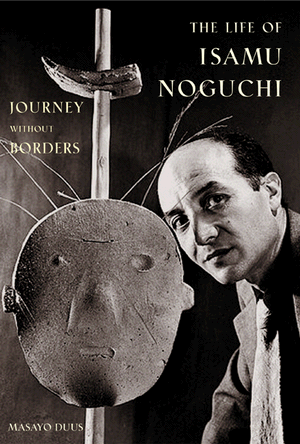
The Life of Isamu Noguchi: Journey without Borders

Posted in Arts, Asian Diaspora, Biography, Books, Media Archive, Monographs on 2012-05-15 17:48Z by Steven

The Life of Isamu Noguchi: Journey without Borders

Princeton University Press
2004
440 pages
6 x 9
36 halftones
Paper ISBN: 9780691127828

Masayo Duus
Translated by Peter Duus

  • 2005 Non-fiction Finalist for the Kiriyama Prize, Pacific Rim Voices
  • One of Choice’s Outstanding Academic Titles for 2005

Isamu Noguchi, born in Los Angeles as the illegitimate son of an American mother and a Japanese poet father, was one of the most prolific yet enigmatic figures in the history of twentieth-century American art. Throughout his life, Noguchi (1904-1988) grappled with the ambiguity of his identity as an artist caught up in two cultures.

His personal struggles—as well as his many personal triumphs—are vividly chronicled in The Life of Isamu Noguchi, the first full-length biography of this remarkable artist. Published in connection with the centennial of the artist’s birth, the book draws on Noguchi’s letters, his reminiscences, and interviews with his friends and colleagues to cast new light on his youth, his creativity, and his relationships.

During his sixty-year career, there was hardly a genre that Noguchi failed to explore. He produced more than 2,500 works of sculpture, designed furniture, lamps, and stage sets, created dramatic public gardens all over the world, and pioneered the development of environmental art. After studying in Paris, where he befriended Alexander Calder and worked as an assistant to Constantin Brancusi, he became an ardent advocate for abstract sculpture.

Noguchi’s private life was no less passionate than his artistic career. The book describes his romances with many women, among them the dancer Ruth Page, the painter Frida Kahlo, and the writer Anaïs Nin.

Despite his fame, Noguchi always felt himself an outsider. “With my double nationality and my double upbringing, where was my home?” he once wrote. “Where were my affections? Where my identity?” Never entirely comfortable in the New York art world, he inevitably returned to his father’s homeland, where he had spent a troubled childhood. This prize-winning biography, first published in Japanese, traces Isamu Noguchi’s lifelong journey across these artistic and cultural borders in search of his personal identity.

Table of Contents

  • Prologue
  • Chapter One: Yone and Leonie
  • Chapter Two: His Mother’s Child
  • Chapter Three: All-American Boy
  • Chapter Four: Journey of Self-Discovery
  • Chapter Five: Becoming a Nisei
  • Chapter Six: The Song of a Small
  • Chapter Seven: Honeymoon with Japan
  • Chapter Eight: The World of Dreams
  • Chapter Nine: The Universe in a Garden
  • Chapter Ten: Encounter with a Stonecutter
  • Chapter Eleven: Farewell to s Dreamer
  • Epilogue
  • Notes
  • Bibliography
  • Acknowledgments
  • Index
  • Photgraphy Credits
Tags: , , ,

Honors 301: Mixed Race Art and Identity

Posted in Arts, Asian Diaspora, Course Offerings, Literary/Artistic Criticism, United States on 2012-05-15 17:06Z by Steven

Honors 301: Mixed Race Art and Identity

DePaul University, Chicago, Illinois
Autumn Quarter 2011-2012

Laura Kina, Associate Professor Art, Media, & Design

Mixed Race Art & Identity will focus on contemporary art and popular culture to critically examine images of miscegenation and mixed race and post-ethnoracial identity constructs. Students will learn about the history and emergence of the multiracial movement in the United States from the 1967 Loving v. Virginia Supreme Court Case, which overturned our nation’s last anti-miscegenation law; to the emergence of the multiracial movement in the 1990s leading up to the 2000 U.S. Census, which for the first time allowed multiracial individuals to self-identify as more than one race; to the ways in which discussions of race have unfolded following the 2008 election of President Obama and the results of the 2010 Census.  Through the vehicle of art and cultural studies, students will reflect upon our present moment and the increasingly ethnically ambiguous generation that is coming of age. This seminar course is designed to be interactive and will include: class discussions, leading or co-leading a reading, online reflection posts on readings, viewing films, art lectures, a visiting artist talk, a mid-term paper, and a final creative group curatorial project.

Course Books/Readings and Research Resources

Required Text Books (Available through the University Bookstore and on reserve at the LPC library. We will read select chapters from these two books.)

Required E-reserve and/or Online Readings (Available through library.depaul.edu or through the course blackboard site, Mixedheritagecenter.org (MHC), or online.)

Research and selections from original artist interviews with contemporary artists from the forthcoming book “War Baby/ Love Child: Mixed Race Asian American Art” edited by Laura Kina and Wei Ming Dariotis (University of Washington Press, 2013) and related exhibition co-curated by Kina and Dariotis (DePaul University Art Museum April 26 – June 30, 2013, Chicago, IL and Wing Luke Museum of the Asian Pacific American Experience August 9, 2013 – January 19, 2014, Seattle, WA. ) The artists covered include: Mequita Ahuja, Albert Chong, Serene Ford, Kip Fulbeck, Stuart Gaffney, Louie Gong, Jane Jin Kaisen, Lori Kay, Li-lan, Richard Lou, Laurel Nakadate, Samia Mirza, Chris Naka, Gina Osterloh, Adrienne Pao, Cristina Lei Rodriguez, Amanda Ross-Ho, Debra Yepa-Pappan, and Jenifer Wofford.

Film, Video, TV, and Radio

Supplemental E-reserve and Reserve Readings are also available through the LPC Library

Tags: ,

Setting Assumptions Aside: Exploring Identity Development in Interracial Intercultural Individuals Growing up in Japan

Posted in Asian Diaspora, Dissertations, Identity Development/Psychology, Media Archive on 2012-05-04 01:47Z by Steven

Setting Assumptions Aside: Exploring Identity Development in Interracial Intercultural Individuals Growing up in Japan

University of Toronto
2001
280 pages

Penny Sue Kinnear

A thesis submitted in conformity with the requirements for the degree of Master of Arts Department of Curriculum, Teaching and Learning Ontario Institute for Studies in Education of the University of Toronto

This research attempts to understand the experience of interracial/intercultural individuals growing up in Japan. Their experiences do not fit current minority identity development models. Much of the tension in their experience appears to be between the individual’s own experience and the stereotypica1 experience he or she is supposed to undergo as a mixed individual. Identity was not a question of either/or, but took shape from dialogues that reflected a complex relationship between community, individual, language, and culture. One factor determining the tenor of the dialogue is its grounding in commonalities or in differences. The experience was profoundly different for individuals who attended international schools or Japanese schools. The difficulty that the international school attendees articulated, in contrast to those attending Japanese schools, appears as a clash of boundaries, not values. This is reflected particularly where “Japaneseness” fits in the hierarchy and the degree of rigidity or permeability of those boundaries.

Read the entire dissertation here.

Tags: , , , ,

Social Construction of Ethnicity Versus Personal Experience: The Case of Afro-Amerasians

Posted in Articles, Asian Diaspora, Identity Development/Psychology, Media Archive, United States on 2012-04-28 20:56Z by Steven

Social Construction of Ethnicity Versus Personal Experience: The Case of Afro-Amerasians

Journal of Comparative Family Studies
Volume 29, Issue 2 (Summer 1998)
pages 255-267

Teresa Kay Williams

Michael C. Thornton, Professor of Afro-American Studies
University of Wisconsin, Madison

The article focuses on the existence of ethnic group differences in the U.S. and how the subgroup of Black Americans, Afro-Amerasians, situate themselves in an environment that attempts to place them within established racial boundaries. Afro-Amerasians are estranged between two forces: the contrasting push of society to identify them as only Black, and the pull of their own personal and unique experience. However, instead of succumbing to these forces, these groups developed a different kind of Black identity which incorporates other parts of their heritage. They choose to situate themselves on the traditional boundaries of racial groups rather than deny important parts of who they are; thus, they choose to be marginal. They grew up in environment where they had ample opportunity to develop. These people tried to make sense of their experiences as radicalized peoples. Their struggles with personal and social accepts of identity provide sociological insight into understanding the complexities and contradictions of race and their ever-changing meanings and applications.

There are two significant contributors to ethnicity or racial group identity: a thread of historical experience that is shared by each member of the collectivity, and a sense of potency/strength inherent in the group (see Phinney, 1990). In social science research, racial identity, ostensibly feelings toward the group, is rarely examined with explicit measures of group feelings. Usually, a racial label is correlated to psychosocial development of group members. In this regard, racial group membership – and not actual experience – is normally featured.

 Thus, race is often used as a proxy for experience and attitudes, a practice embedded in premises of social science literature (Wilkinson, 1984). Deterministic views of race ignore important variations in how subgroups of Blacks relate to the larger group and to one another. Perhaps no experience better exposes the contradictions regarding how we view race in America than that of racially mixed individuals and, in particular, those with African heritage (Bonacich, 1991; King and DaCosta, 1995; Root, 1992).

Although a rare occurrence, interracial ties draw much attention because they encapsulate unresolved feelings and attitudes about race (Thomton and Wason, 1995). In a society racially stratified, where races are seen to be distinct, racial mixing has always been considered problematic (Spickard, 1992). Interracial populations muddy the dualistic view of race (i.e., that each of us is one or another race) and epitomize the inadequacies of this ideology; they lead us to question basic assumptions of how racial life is organized. In this article, we elaborate on this point by examining what would normally be considered a subgroup of Black Americans. We explore how Afro-Amerasians situate themselves in an environment that attempts to place them within established racial boundaries.

LITERATURE REVIEW

Black Group Identity

Work on Black group identity is not easy to characterize, in part because of relatively limited research on this issue, especially that which examines ethnic group differences (Porter and Washington, 1993). Typically, analysis highlights the influence of social class on identity (e.g., Landry, 1987; Farley, 1984). Some inquiry suggests that class is only a part of the puzzle. Broman et al. (1988) reveal that older, less-educated respondents in urban areas and highly-educated Blacks living outside the West were most likely to feel close to other Blacks. Gurin et al. (1989) show that identity, defined as common fate and as more Black than American, was not simply related to class. Males and those of upper-class status were more likely to feel a common fate with Blacks. Younger Blacks and those who did not work full-time were also more likely to feel more Black than American.

Usually, these studies implicitly assume that group identity is a globally positive (or negative) feeling toward a homogeneous racial referent (Allen et al., 1989). This view fails to recognize that subgroups of Blacks have attitudes about various groups within the racial category (e.g., poor versus middle-class Blacks). It is also common, within this perspective, to treat Blacks as having assimilated and thus not see identity as an alternate cultural experience (Porter and Washington, 1993). These assumptions result in an approach that rarely sees group attitudes as an admixture of positive and negative feelings. This approach does not allow for the possibility that group attitudes may involve an affinity with some aspects of subgroups within the racial category, even while coupled with attempts to disassociate from others (McAdoo, 1985; Jackson et al., 1988; Cross, 1991).

However, an ambiguity toward the racial group might be expected for minorities who contend with negative images of their group permeating society. Some emerging works identify several reference groups within the overarching racial category. Allen et al. (1989) describe identity as containing two important referents: masses (non-mainstream) and elites (mainstream). They suggest that within the racial category is an array of boundaries and identities prioritized in a variety of ways. For example, case studies show that native Black Americans distance themselves from Black Haitians (Stafford, 1985).

Multiracial Identity

Blacks will have different views of Blackness depending on where they are positioned in the social hierarchy. The position we consider here is mixed racial heritage. Historically, this category was simple. Mixed race referred to Black-White offspring who were part of a two-tiered system: Whites and Blacks, with racially mixed people viewed as improved versions of Blacks. Changes in the racial composition of the United States have been the catalyst of emerging work accenting race relations as inclusive …

Tags: , , , ,

Not Quite/ Just the Same/ Different: the Construction of Identity in Vietnamese War Orphans Adopted by White Parents

Posted in Asian Diaspora, Dissertations, Identity Development/Psychology, Media Archive, Oceania on 2012-04-27 00:46Z by Steven

Not Quite/ Just the Same/ Different: the Construction of Identity in Vietnamese War Orphans Adopted by White Parents

University of Technology, Sydney, Australia
2003
180 pages

Indigo Williams

Master of Arts by Thesis Faculty of Humanities and Social Sciences

Global diasporas caused by wars carry many streams of people—in the 1970s one of these streams contained orphans from Vietnam delivered to white parents in the West. On arrival, the social expectation was that these children would blend seamlessly into the culture of their adoptive parents. Now some adoptees, as adults, reflect on their lives as ‘Asian’ or racially ‘Other’ children in white societies, charting the critical points in their maturation. This thesis interrogates their life histories to explore the role of birth-culture in the self-definition of people removed from that culture at birth or in childhood. Thirteen adult adopted Vietnamese participants were interviewed. These interviews provided qualitative data on issues of racial and cultural identity. These data were developed and analysed, using a framework drawn from symbolic interactionism and cultural studies, in order to reveal the interpersonal dynamics in which people were involved, and the broader cultural relations that sustained them.

The findings reveal that in early childhood the adopted Vietnamese identity process was shaped by a series of identifications with, and affirmations of, sharing their adoptive parents racial and cultural identity. Such identifications were then challenged once the adoptees entered society and were seen by others as different. The participants’ attempts to locate a secure sense of self and identity within the world they are placed in are disturbed by numerous uncertainties surrounding racial and cultural difference. One of the most crucial uncertainties is the adopted Vietnamese knowledge about their cultural background. While most felt they lacked positive knowledge about Vietnam and racial diversity, their sense of identity was unsettled by experiences with racism and negative cultural stereotypes throughout their late childhood to adolescence.

As their recognition and acceptance of their difference develops in adulthood, they experience a degree of empowerment due to their being able to access more knowledge about their cultural background and a greater appreciation of racial diversity. Many participants have formed closer ties with other people born in Vietnam, most notably other adoptees; most returned to visit Vietnam. The thesis concludes that those adoptees who were able to develop an understanding of the Vietnamese and other backgrounds to their complex identities, tended to be more integrated as adults than those who either rejected or were unable to come to terms with their Vietnamese ancestry.

Read the entire thesis here.

Tags:

Children of the Vietnam War

Posted in Articles, Asian Diaspora, History, Identity Development/Psychology, Media Archive, Politics/Public Policy, Social Science, United States on 2012-04-26 21:08Z by Steven

Children of the Vietnam War

Smithsonian Magazine
June 2009

David Lamb

Born overseas to Vietnamese mothers and U.S. servicemen, Amerasians brought hard-won resilience to their lives in America

They grew up as the leftovers of an unpopular war, straddling two worlds but belonging to neither. Most never knew their fathers. Many were abandoned by their mothers at the gates of orphanages. Some were discarded in garbage cans. Schoolmates taunted and pummeled them and mocked the features that gave them the face of the enemy—round blue eyes and light skin, or dark skin and tight curly hair if their soldier-dads were African-Americans. Their destiny was to become waifs and beggars, living in the streets and parks of South Vietnam’s cities, sustained by a single dream: to get to America and find their fathers.
 
But neither America nor Vietnam wanted the kids known as Amerasians and commonly dismissed by the Vietnamese as “children of the dust”—as insignificant as a speck to be brushed aside. “The care and welfare of these unfortunate children…has never been and is not now considered an area of government responsibility,” the U.S. Defense Department said in a 1970 statement. “Our society does not need these bad elements,” the Vietnamese director of social welfare in Ho Chi Minh City (formerly Saigon) said a decade later. As adults, some Amerasians would say that they felt cursed from the start. When, in early April 1975, Saigon was falling to Communist troops from the north and rumors spread that southerners associated with the United States might be massacred, President Gerald Ford announced plans to evacuate 2,000 orphans, many of them Amerasians. Operation Babylift’s first official flight crashed in the rice paddies outside Saigon, killing 144 people, most of them children. South Vietnamese soldiers and civilians gathered at the site, some to help, others to loot the dead. Despite the crash, the evacuation program continued another three weeks.

“I remember that flight, the one that crashed,” says Nguyen Thi Phuong Thuy. “I was about 6, and I’d been playing in the trash near the orphanage. I remember holding the nun’s hand and crying when we heard. It was like we were all born under a dark star.” She paused to dab at her eyes with tissue. Thuy, whom I met on a trip to Vietnam in March 2008, said she had never tried to locate her parents because she had no idea where to start. She recalls her adoptive Vietnamese parents arguing about her, the husband shouting, “Why did you have to get an Amerasian?” She was soon sent off to live with another family…

Read the entire article here.

Tags: , ,

Multicultural children’s baseball team founded

Posted in Articles, Asian Diaspora, Media Archive on 2012-04-26 21:00Z by Steven

Multicultural children’s baseball team founded

The Korea Times
2012-04-20

Kim Bo-eun

Former baseball player Heo Koo-youn, 61, will found a baseball team for children of interracial families in Korea, Monday.

The team will be called Heo Koo-youn Rainbow Little.

The initiation ceremony will be held at the National Baseball Center in Goyang, north of Seoul.
 
The junior team will be comprised of about 20 children from interracial and underprivileged families residing in Goyang…

…“The team is designed to help resolve the problems troubling interracial families through sports,” Heo said in a phone interview with The Korea Times Friday…

Read the entire article here.

Tags: , , , , , , ,