White mother given mixed race sperm in IVF loses compensation claim

Posted in Articles, Health/Medicine/Genetics, Law, Media Archive, United Kingdom on 2010-10-17 02:34Z by Steven

White mother given mixed race sperm in IVF loses compensation claim

British Medical Journal
Volume 341, Number 5806
2010-10-15
DOI: 10.1136/bmj.c5806

Clare Dyer

Two children in Northern Ireland whose white mother was mistakenly impregnated with sperm from South Africa labelled “Caucasian (Cape Coloured)” during in vitro fertilisation have failed in a compensation claim at the High Court in Belfast.

The children’s mother, who brought the case on their behalf, claimed that their quality of life was adversely affected because they looked markedly different from their parents and had quite different skin colour from each other. She said that they were subject to “abusive and derogatory comment and hurtful name calling from other children, causing emotional upset.”…

Read or purchase the article here.

[Note from Steven F. Riley]

Admittedly from a cursory glance, this article is perhaps the kind that belongs on the front page of  a supermarket tabloid.  However, the plaintiff’s claim of “abusive and derogatory comment and hurtful name calling from other children, causing emotional upset.” because of “differently looking” children does seem to merit some kind of thoughtful and intelligent commentary.

Needless to say, millions of families with “differently looking” children by the way of “correctly labeled” sperm and egg rendezvous—or by adoption—face the prospect “abuse and derogatory” comments every day.  Thus a successful claim might have laid down a very, very interesting precedent.

Tags: , ,

Multiethnic Multiracial Experience (Ethnic Studies 199)

Posted in Course Offerings, History, Identity Development/Psychology, Law, United States on 2010-10-07 01:46Z by Steven

Multiethnic Multiracial Experience (Ethnic Studies 199)

University of Oregon
Winter 2010

Anselmo Villanueva, Ph.D.

This course will focus on the multiracial multiethnic experience in the United States, with particular emphasis on the Northwest. This course will provide students with a framework to understand this experience. The course will cover the history and background of the mixed race experience, anti-miscegenation laws and practices, research, identity models, resources, and case studies. The topic of trans-racial adoption will also be included in this course.

Traditionally, the multiracial experience has been defined as literally “Black” and “White” – people, relationships, and marriages that have been between White and African American people. This course will also include the experiences of multiple relationships and people, such as Asian and Latino, Black and Asian, and so on. Multiethnic relationships will also be included, such as Chinese and Korean.

Students will develop a broad understanding of the multiracial multiethnic experience. In the process, students will also have the opportunity to examine their own culture, ethnic identity, and background. Students will also examine attitudes and beliefs related to the mixed race experience.

For more information, click here.

Tags: , ,

“A Mongrel Breed of Citizens”: Animus Against Multiracial People

Posted in Excerpts/Quotes, History, Law, Social Science, United States on 2010-09-18 04:48Z by Steven

…One might argue that discrimination against multiracial people is merely a subset—perhaps even a milder one—of discrimination against monoracial individuals. In other words, a person who is identified as partially Black might be subject to the same kind of animus as one who is identified as fully Black. This Part aims to disprove that notion and demonstrate that animus against people identified as multiracial is a unique phenomenon.

I readily acknowledge some overlap between what we might call monoracial and multiracial animus: a racist who dislikes people who she views as Asian might well dislike an individual whom she identifies as part-Asian for some of the same reasons. But viewing someone as part-Asian also lends itself to unique forms of animus not directed at those perceived as monoracial. A mixed-race person may be viewed as polluted, defective, confusing or confused, passing, threatening, or—in our diversity-obsessed society—as opportunistic, gaining an advantage by identifying with a group in which he is at best a partial member. These negative associations may be distinguished from those directed at people perceived as monoracial.

I use history, sociology, and jurisprudence to buttress my claim that animus against multiracial people is a unique form of animus that is distinguishable from animus directed at any monoracial group. In the process, I hope to demonstrate that animus against racially mixed individuals is anything but benign or mild.

Other scholars have attempted to illuminate the reason underlying the persistent discomfort with racial mixing and racial mixedness. My own view is that different groups’ discomfort with mixing is so heterogeneous that any theory attempting to explain animus toward multiracial people will by necessity be quite complicated. While I believe that development of such a theory is an important project, it is one I do not address in this Article. Instead, I focus on demonstrating that racism directed at people who are viewed as multiracial is a real phenomenon that may result in tangible negative consequences to the lives of the people thus identified…

Nancy Leong, “Judicial Erasure of Mixed-Race Discrimination,” American University Law Review, Volume 59, Number 3 (2010): 483-484.

Tags:

Righteous Fathers, Vulnerable Old Men and Degraded Creatures: Southern Justices on Miscegenation in the Antebellum Will Contest

Posted in History, Law, Media Archive, Slavery, United States, Women on 2010-09-14 22:20Z by Steven

Righteous Fathers, Vulnerable Old Men and Degraded Creatures: Southern Justices on Miscegenation in the Antebellum Will Contest

Tulsa Law Review
Volume 40 (2005)
pages 699-

Bernie D. Jones, Associate Professor of Law
Suffolk University

Although scholars have long addressed the role of legislators and local elites in policing the color line between black and white, antebellum jurists hearing will contests also played a special role, different from the roles they played in miscegenation prosecutions, but just as effective, nonetheless. State court justices, who heard cases involving bequests to the putative slave children of slaveholding elite men, exercised their power to police by deciding when the color line had been breached. In those cases, miscegenation between white men and slave women or free women of color was not the problem, however. Instead, the color line was breached in those cases when white men recognized and accorded slave women and their mixed-race children status through manumission and property. Official recognition by white relatives meant access to whiteness. Black personal freedom, combined with access to money and land, were threats to the social order of slavery and white supremacy. Free blacks were deemed uncontrollable and arrogant, particularly when they had money. They were perceived as a bad influence upon the bonded. In the eyes of many jurists, wealthy free black status was to be denied at all costs, for the benefit of the white social order, and the white relatives or creditors seeking to establish their claim to the decedent’s estate.

In this article, I explore the attitudes of antebellum jurists towards slavery, miscegenation, and the transfer of property from elite white men to black slave women, free women of color, and their mixed-race children, as found in antebellum will contests. This article is a historical study, in which I do a case-by-case analysis and categorization of the language used by state high court justices of the South in describing the white men who left wills that gave property to black women and their children. Although these cases have been studied by historians and legal scholars in other contexts, reading these cases for the purpose of discovering judicial narratives on miscegenation has not been the focus on inquiry. As a result, scholarship on the full flavor of judicial responses to slavery is missing.

Read the entire article here.

Tags: , ,

The Veils of the Law: Race and Sexuality in Nella Larsen’s Passing

Posted in Articles, Law, Literary/Artistic Criticism, Media Archive, United States on 2010-09-12 02:29Z by Steven

The Veils of the Law: Race and Sexuality in Nella Larsen’s Passing

College Literature
Volume 22, Number 3 (October 1995)
Race and Politics: The Experience of African-American Literature
pages 50-67

Corinne E. Blackmer, Associate Professor of English
Southern Connecticut State University

When Nella Larsen, then a prominent young writer of the Harlem Renaissance, published her second and final novel, Passing, in 1929, the Supreme Court’s “separate but equal” interpretation of the equal protection clause of the Fourteenth Amendment in Plessy v. Ferguson (1896) had been law for over thirty years. Plessy turned on the issue of the constitutionality of so-called Jim Crow laws, which mandated racially-segregated facilities for whites and “coloreds” throughout the South. Homer Plessy, a resident of Louisiana who described himself as “seventh-eights Caucasian and one-eighth African blood” (1138), was forcibly rejected, after he refused to leave voluntarily, from the first-class, whites-only section of a railroad car in his home state. Declaring that “the mixture of colored blood was not discernible in him, and that he was entitled to every recognition, right, privilege, and immunity secured to the citizens of the United States of the white race,” Plessy argued that the Louisiana law violated his constitutional rights of habeas corpus, equal protection, and due process. The Supreme Court denied the validity of this reasoning on several counts, among them that various state laws forbade interracial marriage on the grounds, as the State of Virginia later argued unsuccessfully before the Court in Loving v. Virginia (1967), that “Almighty God created the races white, black, yellow, malay and red, and he placed them on separate continents … The fact that he separated the races shows that he did not intend for the races to mix.” Second, in an egregious instance of conceptual blurring of categories of persons that implied, without submitting the proposition toloical scrutiny, that white males were intrinsically more ‘adult’ and ‘able’ than non-whites or women, the Court argued that most states had established “segregated” schools “for children of different ages, sexes and colors, and … for poor and neglected children” (Plessy 114). The Court avoided responsibility for promoting institutional racism and established the constitutionality of de jure segregation by stating that “the assumption that the enforced separation of the two races stamps the colored race with a badge of inferiority … is not by reason of anything found in the act, but solely because the colored race chooses to put the construction upon it” (1143). They made an invidious distinction between the cultural and political rights of whites and ‘coloreds’ on the basis of the intrinsic “reasonableness” of long-established cultural practices. Writing for a majority of seven, Justice Henry Brown allowed that while the officers, empowered to judge racial identity by outward appearances might conceivably err in their judgment, the “object of the [Fourteenth] amendment was undoubtedly to enforce the absolute equality of the two races before the law, but in the nature of things it could not have been intended to abolish distinctions based upon color, or to enforce social, as distinguished from political, equality, or a commingling of the two races upon terms unsatisfactory to either” (1140).

In the fifty-eight years between Plessy and the Court’s landmark decision in Brown v. Board of Education of Topeka, Kansas (1954), which declared separate public facilities based on race inherently unequal,” many African-American authors pursued an actively critical engagement with the convoluted and contradictory terms of racial identity and identification set forth in Plessy. On the one hand, African-American letters faced the onerous burden of proving the cultural worth of black culture to an often doubting, condescending, and largely white audience. On the other hand, the legal decision and the Social Darwinism underlying it provided an unwelcome opportunity to thematize the willful ignorance and blindness informing racial segregation by exploring how racial stigmas were not founded in the “natural” superiority or inferiority of the races but rather constructed through historical prejudices and arbitrary (often illusory) social distinctions. Moreover, since Plessy not only denied the long if publicly unacknowledged history of interracial sexual unions (which had produced, among others, Homer Plessy as subject) but also strengthened existing miscegenation statutes by forbidding the social commingling of the races, narrative treatments of interracial sexual unions featuring characters who “passed” racially became an ideal vehicle through which to explore the inevitable intersection of racism (and, in some cases, sexism) with sexual taboos.

Seen in the light of the legal and cultural assumptions informing its production, Larsen’s Passing, the curious plot of which has thus far eluded satisfactory analysis, becomes a searching exploration and critique of the aesthetic, narrative, and ideological incoherences that confronted Larsen as an urbane African-American woman author who eschewed racial separatism and nineteenth-century racial uplift, rhetoric – which might in part explain why she abandoned her promising literary career after writing this novel.(5) Indeed, Passing, a relatively late example of this topos of American writing, represents both an original reconfiguration of and commentary on more conventional plots of racial “passing,” which typically center on a psychologically and culturally divided “tragic mulatto” figure, in such novels as James Weldon Johnson’s The Autobiography of an Ex-Colored Man and Jessie Fauset’s Plum Bun, among others. While these novels offer trenchant critiques of institutional racism, they also emphasize the heavy personal costs of crossing over the color line” and thus in some measure reinforce the consequences of racial division in an equally separatist “national” literature. Passing, in contrast, stresses the interpretive anxieties and sexual paranoias that make convention-bound people reluctant to allow others the freedom to travel freely throughout the many worlds, identities, and sexualities of American society. Larsen’s novel not only explores a legally fraudulent inter racial union in the marriage between Clare Kendry and John Bellew, but also subtly delineates the intraracial sexual attraction of Irene Redfield for Clare, while the former projects her taboo desires for Clare onto her husband Brian. Ironically, Brian Redfield, who the text implies might be homosexual, evinces no sexual interest in women, but Irene nonetheless begins to suspect that Brian and Clare are conducting an illicit, clandestine affair. Since the term “passing” carries the connotation of being accepted for something one is not, the title of the novel serves as a metaphor for a wide range of deceptive appearances and practices that encompass sexual as well as racial “passing.” Focussed principally on the operation of chance and accident as well as the epistemological crises of unknowability that result from self-silencing and self-repression, Larsen’s novel ostensibly passes” for a conventional narrative of racial “passing.” …

Read the entire article here.

Tags: , , , ,

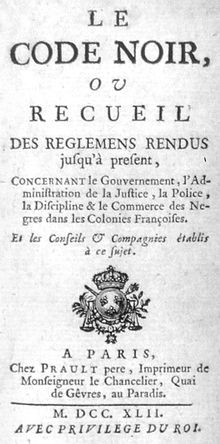
Code Noir (The Black Code)

Posted in Definitions, History, Law, Slavery on 2010-09-11 04:25Z by Steven

The Code Noir (French language: The Black Code) was a decree passed by France’s King Louis XIV in 1685. The Code Noir defined the conditions of slavery in the French colonial empire, restricted the activities of free Negroes, forbade the exercise of any religion other than Roman Catholicism, and ordered all Jews out of France’s colonies. The code has been described by Tyler Stovall as “one of the most extensive official documents on race, slavery, and freedom ever drawn up in Europe.”

…2 of the 60 articles, the document specified that:

  • married free men will be fined for having children with their slave concubines, as will the slave concubine’s master. If the man himself is the master of the slave concubine, the slave and child will be removed from his ownership. If the man was not married, he should then be married to the slave concubine thus freeing her and the child from slavery (art. 9)
  • children between a male slave and a female free woman are free; children between a female slave and a free man are slaves (art. 13)

Read all 60 articles (in French) here.

Wikipedia

Tags:

Plessy v. Ferguson

Posted in Definitions, Law, United States on 2010-09-11 03:53Z by Steven

Plessy v. Ferguson, 163 U.S. 537 (1896), is a landmark United States Supreme Court decision in the jurisprudence of the United States, upholding the constitutionality of state laws requiring racial segregation in private businesses (particularly railroads), under the doctrine of “separate but equal”.

Wikipedia

Comments by Steven F. Riley:

The Plessy decision is significant in that it not only gave constitutional legitimacy to Jim Crow segregation, it also effectively codifed the so-called “one-drop rule” which designated anyone with any known quantity of African ancestry—no mater how small—as black.   Homer Plessy, (of one-eighth African ancestry) was by all appearances  “visibly white” and in fact had to announce his appearance on the railroad car in which he was traveling.

Tags:

AMST130 SC-Multiracial People and Relations in U.S. History

Posted in Barack Obama, Course Offerings, History, Law, Media Archive, Social Science, United States on 2010-09-03 17:45Z by Steven

AMST130 SC-Multiracial People and Relations in U.S. History

Scripps College, Claremont, California
2013

Matthew Delmont, Assistant Professor of American Studies

This class will explore the conditions and consequences for crossing racial boundaries in the U.S. We will take a multidisciplinary approach, exploring historical, literary, and ethnographic writings along with several feature and documentary film treatments of the subject. We will examine: Relations among Native Americans, whites, and blacks in the colonial era and nineteenth century; the legal formation of race through miscegena­tion cases; the regulation and representation of multiracial themes in film; the concept of mestizaje; contemporary debates surrounding the Mixed-race/Multiracial movement; and the racial identity of the 44th President of the United States, Barack Obama.

Tags: ,

Plessy as “Passing”: Judicial Responses to Ambiguously Raced Bodies in Plessy v. Ferguson

Posted in Articles, History, Law, Media Archive, Passing, United States on 2010-09-03 17:34Z by Steven

Plessy as “Passing”: Judicial Responses to Ambiguously Raced Bodies in Plessy v. Ferguson

Law & Society Review
Volume 39, Issue 3 (September 2005)
pages 563–600
DOI: 10.1111/j.1540-5893.2005.00234.x

Mark Golub, Assistant Professor of Politics & International Relations
Scripps College, Claremont, California

The Supreme Court’s decision in Plessy v. Ferguson (1896) is infamous for its doctrine of “separate but equal,” which gave constitutional legitimacy to Jim Crow segregation laws. What is less-known about the case is that the appellant Homer Plessy was, by all appearances, a white man. In the language of the Court, his “one-eighth African blood” was “not discernible in him.” This article analyzes Plessy as a story of racial “passing.” The existence of growing interracial populations in the nineteenth century created difficulties for legislation designed to enforce the separation of the races. Courts were increasingly called upon to determine the racial identity of particular individuals. Seen as a judicial response to racial ambiguity, Plessy demonstrates the law’s role not only in the treatment of racial groups, but also in the construction and maintenance of racial categories.

Read or purchase the article here.

Tags: , , ,

City of Amalgamation: Race, Marriage, Class and Color in Boston, 1890-1930

Posted in Dissertations, History, Law, Media Archive, Passing, Social Science, United States on 2010-09-01 21:42Z by Steven

City of Amalgamation: Race, Marriage, Class and Color in Boston, 1890-1930

University of Massachusetts, Amherst
September 2008
223 pages
Paper AAI3337029

Zebulon V. Miletsky, Assistant Professor of Africana Studies
Stony Brook University, State University of New York

Submitted to the W.E.B. Du Bois Department of Afro-American Studies at the Graduate School of the University of Massachusetts Amherst in partial fulfillment of the requirements of the degree of Doctor of Philosophy

This dissertation examines the evolution of early race relations in Boston during a period which saw the extinguishing of the progressive abolitionist racial flame and the triumph of Jim Crow in Boston. I argue that this historical moment was a window in which Boston stood at a racial crossroads. The decision to follow the path of disfranchisement of African Americans and racial polarization paved the way for the race relations in Boston we know and recognize today. Documenting the high number of blacks and whites who married in Boston during these years in the face of virulent anti-miscegenation efforts and the context of the intense political fight to keep interracial marriage legal, the dissertation explores the black response to this assault on the dignity and lives of African Americans. At the same time it documents the dilemma that the issue of intermarriage represented for black Bostonians and their leaders. African Americans in Boston cautiously endorsed, but did not actively participate in the Boston N.A.A.C.P.’s campaign against the resurgence of anti-miscegenation laws in the early part of the twentieth century. The lack of direct and substantial participation in this campaign is indicative of the skepticism with which many viewed the largely white organization.

Boston, with its substantial Irish population, had a pattern of Irish, and other immigrant women, taking Negro grooms–perhaps because of the proximity within which they often worked and their differing notions about the taboo of race mixing. Boston was, for example, one of the most tolerant large cities in America with regard to interracial unions by 1900. In the period between 1900 and 1904, about 14 out of every 100 Negro grooms took white wives. Furthermore, black and white Bostonians cooperated politically to ensure that intermarriage remained legal throughout the nation.

Table of Contents

  • Acknowledgements
  • Abstract
  • Preface
  • Introdution
  • 1. A Sojourn in the City of Amalgamation: Race, Marriage and Freedom in Boston
  • 2. Interracial Paradise?: Boston and the Profressive Racial Impulse
  • 3. Proving Ground: Boston’s Black Leadership and the Dilemma of Intermarriage
  • 4. Breach of Promise: Passing and the Van Houten Case in Boston
  • Conclusion
  • Bibliograpy

Preface

This dissertation examines the history of mixed race in Boston since 1890. As such, various mixed race “phenomena” are investigated including, but not limited to, interracial marriage, community and settlement patterns, the politics of intermarriage, love and sex across the color line, and racial paranoia surrounding the issue of miscegenation. It also investigates the disastrous implications the one-drop rule has had for virtually every important institution in American life: love, family and kinship patterns, marriage, sex, filial ties, legal and jurisdictional matters, education, community migration and settlement patterns. Furthermore, it tracks the evolution of the assumption of race as a biological reality to its present day manifestation as a socially constructed phenomenon. Finally, it outlines the ways in which the one-drop rule, originally intended to deny the rights of African Americans, came (somewhat ironically) to galvanize the black community.

The Introduction to this study serves as a brief review of the literature on the history of the one-drop rule in America. It is this measure of blackness, which has made racial mixing, miscegenation, and therefore, mixed race identity in the United States, problematic in ways that it did not in other post-slave societies. This literature illuminates the ways in which the one-drop rule came to govern America’s unique binary racial system, beginning with its incarnation as a widespread and complicated system of laws during slavery that decreed slave status was inherited through the mother (also known as hypodescent) to the anti-miscegenation laws that sprang up after the Civil War making it illegal in this country for people of different races to marry one another. A secondary aim of the introduction will be to briefly discuss nineteenth century pseudoscientific theories of race and the mythology of “blood theory”.

Chapter one, A Sojourn in the City of Amalgamation, documents the relatively high number of blacks and whites who married in Boston during these years and the fight to keep interracial marriage legal. The politics of interracial marriage with a particular emphasis on the abolitionist legacy in Boston, beginning with the struggle to lift the ban on intermarriage in the Commonwealth of Massachusetts in 1843, is the origin from which this study germinates. It was in this radical environment that progressives, radicals and other heirs to the abolitionist legacy formulated a counter-philosophy that attempted to transgress America’s greatest fiction—the notion of the “one-drop” rule. In this way, cities like Boston became havens for interracial marriages and love across the color line, in general.

Chapter two, Interracial Paradise, examines the somewhat idyllic ways in which Boston was portrayed by anti-amalgamationists and southern apologists to the lost cause of the Civil War. It discusses important neighborhoods such as the South End, which was the stage upon which much of this drama took place and was the heart of Boston’s black community after it moved out of the confines of Beacon Hill. African Americans in Boston cautiously endorsed, but did not actively participate in, the campaign against the resurgence of anti-miscegenation laws in the early part of the 20th century. This lack of direct and substantial black participation in this campaign is significant. It is indicative of the dilemma that the issue of intermarriage represented for black Bostonians and their leaders.

Chapter three, Proving Ground, examines the political struggle over the issue of interracial marriage and the dilemma it posed for the Boston branch of the N.A.A.C.P., as well as the national organization, when Congress attempted to pass a national ban on intermarriage in 1915. The N.A.A.C.P. and its Boston branch constituted the principal opposition to the ban. This chapter examines the political struggle over the issue of interracial marriage and the dilemma it posed for leading organizations such as the N.A.A.C.P., not only in Boston but across the nation. That same year, the Boston chapter held several mass meetings to protest the pending anti-miscegenation legislation in Congress. The Boston branch was especially challenged when the Commonwealth of Massachusetts attempted to pass a statewide ban in 1927 in response to the Jack Johnson interracial marriage controversy. I will examine the steps that were taken not only by the Boston N.A.A.C.P. to organize black Bostonians to defeat the bill, but the involvement of William Monroe Trotter’s National Equal Rights League and the dilemma the intermarriage caused for black leadership in general.

Chapter four, Breach of Promise, takes a look at a case of passing which was the Van Houten case in Boston. The case caused quite a stir in the delicate balance of social and racial hierarchy in Boston as well as a reversal of fortune in the courts. The case was watched very closely by the press who fed the public’s appetite for every detail of the story, much like the drama that filled the pages of the romance novels on passing such as Nella Larsen’s Quicksand. Like the protagonist of that story, Anna Van Houten was cursed by her racial betrayal and in the end despised for her deception. Her case was an important turning point in the adjudication of interracial marriage since it necessitated a legal remedy against intermarriage in a state where it was supposedly legal.

Introduction

Race and racial identity are perhaps the single most important social markers of identification in American life and culture. They serve as automatic registers of information about a person—their history, their background, their politics, and even, perhaps, their socioeconomic status—and yet for all the things we ask it to do for us, race falls incredibly wide of the mark. Race cannot, for example, tell us, who we’re going to become in the future, or what we can accomplish, or for that matter who we are. Social scientists, anthropologists, and biological scientists all tell us that race is not real—that there is no biological basis for race in human physiology—and yet, we live and operate on a day-to-day basis as though it were. What is the impact of this enduring paradox—America’s greatest fiction, one that we have lived and propagated now for more than four centuries?

As we have seen in the late nineteenth and early twentieth century, whiteness became highly sought after as the preferred status of choice that conferred all the benefits of racial privilege—and until the 1950s, naturalized citizenship. However, it should be mentioned that whiteness as a concept is far more significant for what it is not, then for what it is—namely, not black. Therefore, although America differs in its racial formulas of determining who is white and who is not, the main reason for the invention of whiteness, escape from the racial curse of blackness, remains intact in many Latin American and Caribbean countries. Gilberto Freyre’s notion of Brazil as an interracial democracy that is different from a racist United States is a good example of this phenomenon. Their odyssey over the highly contested and often controversial terrain of race and national identity has been a long and difficult journey. Burdened by a dual legacy of colonialism and foreign occupation, many of these republics, with the exception of perhaps Cuba, Haiti and anglophone West Indian countries, have suffered from a seeming inability to use blackness as a collective national organizing principle. Several of these countries have vacillated between ideologies that are based on white supremacy and reinforced by a legacy of historical amnesia. Scholars of race in Latin America have characterized this as an outright state of denial, for some, of their true racial make-up.

It is this unique binary racial system then, which has made racial mixing, miscegenation and a mixed race identity in the United States problematic in ways that it did not in other post-slave societies. It has had disastrous implications for virtually every important institution in American life: family and kinship patterns, marriage, filial ties, legal and jurisdictional matters, education, love, community migration and settlement. Race in the United States, for example, creates the odd and strange phenomenon that a white woman is able to give birth to a black child, but a black woman can never, under any circumstances, give birth to a white child. This was the basis for a widespread and complicated system of laws during slavery that decreed that slave status was passed on by the mother and miscegenation laws that sprang up after the Civil War making it illegal in this country for people of different races to marry one another. Moreover, racial classification in America has created an entire mythology that we still unflinchingly believe is based on the archaic and unsound biological concept of blood theory. It is still commonplace to hear someone characterize a mixed person, for example, as having “mixed-blood” and subscribe to the mythical concept of the one-drop-rule, also known as hypo-descent, meaning that racially mixed persons are assigned the status of the subordinate group in their ancestry.

In the United States, blood theory and pseudo-scientific theories of race reached their pinnacle in the late-nineteenth century with scientists engaged in a constant effort to prove that the Negro was a member of “a separate and permanently inferior species,” and, “not simply a savage or semi-civilized member of the same species.”  The basic assumption was that race was a biological phenomenon and an essential one at that.

It has become common practice of late in scholarship dealing with race and racial identity to point to the phenomenon of race as a socially constructed fallacy that has no basis in biological or scientific fact. Increasingly, terms such as construction, invention, and idea have replaced the once dominant scientific and empirical terminology used to describe race, a phenomenon that had, and still has, profound implications for the stratification of society. However, as eager as anthropologists are to proclaim the premature death of race, it is imperative to acknowledge the powerful and important social role that race still plays in our daily lives, cultures, and lived experiences, not to mention the endless sea of ink that has been spilled over the nature and image of the Negro. The theorem posed by W. I. Thomas in the year 1928, seems applicable here. It states, “If men define situations as real, they are real in their consequences.” Perhaps one of the biggest limitations of these modern approaches is a marked tendency to critique ideas about race by challenging the validity of the concept of race itself. Because the discipline of anthropology has effectively moved to a “color blind” position, one which increasingly views society through the lens of ethnicity rather than race, it has confused the issue by distorting the role that race plays in society. By denying the importance of race and the way in which racial categories are formulated in the first place, it has among other things, opened itself up to a racial discourse that allows conservatives to advance the false ideal of a color-blind society…
Purchase the dissertation here.

Tags: , , , , , ,