A measured freedom: national unity and racial containment in Winslow Homer’s The Cotton Pickers, 1876

Posted in Articles, History, Literary/Artistic Criticism, Media Archive, United States on 2012-03-05 19:00Z by Steven

A measured freedom: national unity and racial containment in Winslow Homer’s The Cotton Pickers, 1876

The Mississippi Quarterly
Spring, 2002

Susanna W. Gold, Assistant Professor of Art
Tyler School of Art, Temple University


The Cotton Pickers
Winslow Homer (United States, Massachusetts, Boston, 1836-1910)
United States, 1876
Oil on canvas
Canvas: 24 1/16 × 38 1/8 in. (61.12 × 96.84 cm) Frame: 35 1/4 × 49 1/2 × 4 in. (89.54 × 125.73 × 10.16 cm)
Acquisition made possible through (Los Angeles County Museum of Art) Museum Trustees: Robert O. Anderson, R. Stanton Avery, B. Gerald Cantor, Edward W. Carter, Justin Dart, Charles E. Ducommun, Camilla Chandler Frost, Julian Ganz, Jr., Dr. Armand Hammer, Harry Lenart, Dr. Franklin D. Murphy, Mrs. Joan Palevsky, Richard E. Sherwood, Maynard J. Toll, and Hal B. Wallis (M.77.68)

After Traveling to Virginia during the Civil War as a field illustrator for the New York journal Harper’s Weekly, Winslow Homer returned to this area toward the end of the Reconstruction period to paint primarily around Richmond and Petersburg. Having abandoned his career as illustrator to devote himself exclusively to painting, Homer sketched outdoors near the shanties in black neighborhoods and wandered among the fields to find inspiration for several images of Southern black life that included his 1876 painting, The Cotton Pickers (Fig. 1).

Depicted are two young black women in the midst of a vast, seemingly endless field abounding in ripened snowy-white cotton bursting from its hulls and awaiting harvest The pair, rendered in robust and healthy proportion, stand engulfed in thigh-high cotton plants at the front of the picture plane and are the focus of the painting as they pause from their work picking cotton. Most scholarship on The Cotton Pickers interprets the artist’s rendering of Southern blacks as sympathetic, and perceives an optimistic future for the black situation under the new political and social structures following the Civil War. Public reception of The Cotton Pickers was favorable; the painting was purchased immediately at its first exhibition at New York’s Century Association in 1877, and a subsequent exhibition review claimed that “the freshest piece of figure painting that Mr. Winslow Homer has put his name to is his latest work, the Cotton Pickers, which provoked the admiration of the artists at the latest reception.” Noted art critic George W. Sheldon acknowledged Homer’s black genre works for their “total freedom from conventionalism and mannerism, in their strong look of life and in their sensitive feeling for character,” and the New York Times praised Homer as “one of the few artists who have the boldness and originality to make something of the Negro for artistic purposes.”

Among contemporary scholars, one author notes in his 1990 study of the history of the black image in American art, that Homer’s “sensitive recording of the uniqueness of individuality” in his black genre paintings “represents a high water mark in nineteenth-century artistic expression of African-American identity.” Another analysis praises The Cotton Pickers as a work that “stands apart from paintings of its period in the degree of grace and majesty it gives to its subjects” (Quick, p. 61), and yet a third study recognizes that “these black women seem larger than life and filled with strength and confidence in their ability to chart their own destinies” (Wood and Dalton, p. 97). Indeed, Homer seems to have been consistently admired for his ability to render the Southern black laborer with empathy and respectful sobriety in a world accustomed to regarding blacks as inferior…

Emancipation may have destroyed the master-slave relationship, but the slaveholding ideologies remained intact up through the year of the Centennial.

The exploitation inherent in the forms of free labor in the postbellum South can be seen in the imagery of The Cotton Pickers. Because the vast expanse of land appears to be part of a large farm or plantation, the two figures are most likely common wage laborers rather than the more economically advantaged sharecroppers or landowners. Had the land been tenanted under the sharecropping system or owned by the laborers, we might expect to see a much smaller parcel of land spotted with cabins, garden plots, or other family members engaged in domestic work such as tending farm animals or collecting firewood. The age and gender of the figures represent the most profitable wage employee to the planter, as women and children received only one-half to two-thirds of the wages of men, and thus proved to be economically advantageous to planters who gained a greater profit from their labor.  As both wage earners and as young women, these figures would have been doubly exploited.

Homer depicts the extensive plantation completely full of cotton, as the entire field has yet to be worked. No progress from the women’s labor is visible, although the basket and sack are full. The fact that the end of the field is nowhere in sight suggests that the work can never be completed, that these women are trapped by the boundless field of cotton. As if to underscore this vision of entrapment, the cotton plants figuratively cut off the legs of the women, so that they are unable to move and escape from their situation. Like the labor system under which they work, this combination of pictorial elements that bind the women to the field suggests hopelessness in the place of tree emancipation.

The suggestion of a fruitless future for the black American is reinforced in the faces of the two young figures. Homer endows the women with traditional Caucasian features by painting them with light skin and slender facial bone structure. By representing the figures with a combination of both prototypical black and white physical characteristics, Homer portrays them as products of sexual mingling between the races. Although interracial cohabitation had been prevalent since the Colonial era, mulattos born in the period from the mid-eighteenth to the mid-nineteenth centuries were often the result of sexual relations between white males of the planter class and their domestic slaves. Common almost to the point on institutionalization, wealthy Southern planters kept regular concubines and bred entire families of mixed-race children, the result being an unprecedented increase in mulatto slavery during the years 1850-60.  Based on the appearance of the two figures in Homer’s 1876 painting, their logical birth dates would fall near the height of interracial procreation, raising the distinct possibility that these women were fathered by the plantation owner.

The mixed-blood heritage of these women posed another problem in the progress of the black American. According to racial mythology advanced by the white population in response to the imagined threat to the purity of the white race, mulattos were doomed to biological eradication and could not reproduce beyond a few generations. Unable to sustain their heritage, the mulatto would be denied a place in America’s future, and the world of the powerless mixed-race individual was understood by whites to be one in which significant progressive change for the black situation could never occur.

Although Homer translates the limited progress of blacks toward a successful future in his painting by depicting the two young women as mulattos, the reality of the black situation in the Centennial decade proved quite a different situation. Precisely because many mulattos of the mid-nineteenth century were born to wealthy white fathers, they often received special treatment both within the black community and from their slaveholding relations. Planter fathers commonly provided property rights to their illegitimate mulatto children in their wills, and sometimes even granted their manumission. Protected by their masters-fathers, these children were customarily relieved from backbreaking field labor and given education and specialized training for favorable work assignments from carpentry or building and machine maintenance to dressmaking, cooking, and child care (Williamson, New People, p. 56). Respected for their highly ranking labor positions and esteemed for the valuable association with white blood, mulatto offspring of white planters generally enjoyed a privileged status on the plantation among the slaves (Williamson, After Slavery, p. 315)…

Purchase the article here.
Tags: , , , ,

Fearless Music: Garland Jeffreys ’65

Posted in Articles, Arts, Biography, Media Archive, United States on 2012-03-05 18:03Z by Steven

Fearless Music: Garland Jeffreys ’65

Syracuse University Magazine
Volume 28, Number 3 (Fall/Winter 2011)

David Marc

From his ’70s hit “Wild in the Streets” to his latest album, legendary singer-songwriter Garland Jeffreys has taken on life’s big issues with his own eclectic brand of music

From the pages of The New Yorker to deep inside the blogosphere, legendary singer-songwriter Garland Jeffreys has been winning high praise for his new album, The King of In Between, released last summer on his own Luna Park label. Loved by fans and admired by colleagues for his fearless movements through rock, R&B, reggae, and whatever other styles he may need to articulate his borderless vision, Jeffreys puts his mastery of popular musical forms in the service of personal expression, a talent he shares with Bob Dylan and Bruce Springsteen. Feeling “too black to be white, too white to be black,” he occupies his own space and fills it with a gritty sweetness that is hard for likeminded souls to resist.

Growing up in Sheepshead Bay, Brooklyn, during the 1950s, Jeffreys learned a thing or two about “diversity” long before the term took on its full contemporary meaning. “I’m from a totally mixed-race family—black, white, Puerto Rican, Native American,” he says. “At the time, we were the only people of color in the Catholic church we attended every Sunday. At school, I had my close friends, but I was also often the only ‘colored’ kid in the class, and every time I met a girl I liked, I had to contend with a race issue. My music has always had a great deal to do with these experiences.” Jeffreys felt more at ease in nearby Coney Island, where beach, boardwalk, and carnival karma drew people of every background imaginable. He also enjoyed the privilege of seeing the Dodgers play at Ebbets Field. “I was just 4 years old, but I was there at the game, April 15, 1947, when Jackie Robinson broke the color line in baseball,” he says. “Sports have always been an important part of my life, and even helped bring me to Syracuse. My father wanted me to go to Boston College. But Jim Brown [’57] went to Syracuse, and obviously I had to go to school where he went.”

Shortly after arriving on campus, Jeffreys met Lou Reed ’64, who became a lifelong friend. Although both were moving toward their careers as musicians, Reed was studying poetry and Jeffreys had his sights set on art history. “We hung out at the Orange Bar with Lou’s teacher, the poet Delmore Schwartz, and a bunch of people—I guess you’d call them ‘Beats,’” Jeffreys says. “It was a great place for me to be because race didn’t matter; it was all about hanging out and knowing each other.” Felix Cavaliere ’64, who was about to depart for the top of the pops as lead singer and keyboard man with The Young Rascals, was another friend Jeffreys first bumped into on Marshall Street…

Read the entire article here.

Tags: , , ,

‘Amerasians’ in the Philippines fight for recognition

Posted in Articles, Asian Diaspora, Media Archive, Politics/Public Policy, Social Science, United States on 2012-03-05 01:03Z by Steven

‘Amerasians’ in the Philippines fight for recognition

Cable News Network (CNN)
2012-03-03

Sunshine Lichauco de Leon

Manila, Philippines (CNN) — When Susie Lopez, 43, was a little girl she would run outside her home in Angeles City, near the U.S. Clark Airbase in the Philippines, every time she heard a plane fly by.

“I would say ‘bye bye, Dad’ because the only thing I knew about my father was my dad was riding a plane,” she recalls.

The daughter of an American naval pilot and a Filipino mother, Lopez is one of an estimated 52,000 “Amerasians” fathered by American military servicemen during the decades the U.S. Navy and Air Force had bases in the Philippines.

The majority of their mothers worked as bar girls in the area’s thriving “rest and recreation” industry, where soldiers were their regular clients. When the American military left the bases in the early 1990s, these children were left behind.

On March 4, in honor of International Amerasian Day, a group of 60 Filipino Amerasians from the cities surrounding former bases will celebrate in a special way. Their “100 Letters to our Fathers” campaign will see the group – whose members range from teenage to those in their 50s—reach out with messages of love and hope to fathers almost all of them never knew. Many of the handwritten letters will be read aloud and will be accompanied by their photos and a short video showing conditions Amerasians have faced…

…They were stigmatized for being illegitimate and for being the children of prostitutes. Amerasians fathered by African American soldiers say they suffered the most extreme prejudice.

Brenda Moreno, 44, does not know the name of her African-American father or her mother. She does not know where she belongs.

She remembers a childhood where she hid at home because she looked different. “They see my color and my hair and they tease me ‘negra’. I am always crying because I don’t feel good. I tell them when I grow up I am going to change my blood so I am going to be white,” she recalls…

Alex Magno, Professor of Political Science at University of the Philippines, explains that this racial prejudice is deeply-rooted, but was strengthened by the country’s colonial past.

“We long ago considered the Malayo-Polynesian tribes superior and the Negrito tribes inferior,” he says. “Hispanic culture merely reinforced that prejudice with its Eurocentric paradigm. Superimpose Hollywood. The standard of beauty is fair skin, tall nose, straight hair.”

Growing up with such a lack of acceptance and economic hardship has taken an emotional and psychological toll on many.

According to a three-year study conducted by Dr. Peter Kutschera, Director of the Philippine Amerasian Research Institute in Angeles City, “we have a severely socioeconomically impaired population, especially among Africans, who contend with serious physical and mental stress issues, including homelessness, alcohol and drug abuse.”…

Read the entire article here.

Tags: , , , , ,

‘all my Slaves, whether Negroes, Indians, Mustees, Or Molattoes.’: Towards a Thick Description of ‘Slave Religion’

Posted in Articles, History, Media Archive, Religion, Slavery, United States on 2012-03-05 00:00Z by Steven

‘all my Slaves, whether Negroes, Indians, Mustees, Or Molattoes.’: Towards a Thick Description of ‘Slave Religion’

The American Religious Experience

1999

Patrick Neal Minges

The time was in the late 1760’s and the place was Charleston, S.C. A young musician was on his way to a performance with his french horn tucked under his arm. As he passed by a large meetinghouse, he heard much commotion on account of a “crazy man was halloing there.” He might have ignored the event but his companion dared him to “blow the french horn among them” and disrupt the meeting. Thinking they might have some fun, John Marrant and his companion entered the meeting hall with the intent of mischief. As he lifted his horn to his lips, the crazy man — evangelist George Whitefield — cast an eye upon him, pointed his finger at John Marrant and uttered these words: “Prepare to Meet Thy God, O Israel!” Marrant was struck dead for some thirty minutes and when he was awakened, Reverend Whitefield declared “Jesus Christ has got thee at last.” After several days of ministrations by Reverend Whitefield, the Lord set John Marrant’s soul at liberty and he dedicated his life to the propagation of the gospel.

Marrant first witnessed to members of his family and when they rejected his newfound evangelical spirit, he fled to the wilderness where he sought solace among the beasts of the woods. Marrant was not afraid for God hade made the beasts “friendly to me.” When Marrant happened upon a Cherokee deer hunter, they spent ten weeks together killing deer by day and preparing brush arbors by night to provide sanctuary for themselves in the wilderness. Becoming fast friends by the end of the hunting season, the Cherokee deer hunter and the African American missionary returned to the hunter’s village where they would continue their cultural exchange. However, when he attempted to pass the outer guard at the Cherokee village, the Cherokees were less than excited with Marrant and he was detained and placed in prison. It was not that Marrant was a black man that troubled the Cherokee, the peoples of the Southeastern United States had relations with Africans that stretched back perhaps as far as a thousand years. It was just that ever since black people had started showing up with their friends, the white people, that things had started going particularly bad for the Indians of the Southeastern United States.

It seems that as soon as Europeans showed up on the coasts of the United States, they started reading from a formal document called the Requierimento that declared themselves to be Christians and by nature superior to the uncivilized heathens that they encountered. The indigenous people were then informed by the Requierimento that if they accepted Christianity they would become the Christian’s slaves in exchange for the gift of salvation; if they did not accept the gospel of Christianity, they would still become slaves but that their plight would be much worse.7 Everywhere that explorers such as Ponce De Leon, Vazquez De Ayllon, and Hernando De Soto went on their “explorations” throughout the American Southeast, they carried with them bloodhounds, chains, and iron collars for the acquisition and exportation of Indian slaves. A Cherokee from Oklahoma remembered his father’s tale of the Spanish slave trade, “At an early state the Spanish engaged in the slave trade on this continent and in so doing kidnapped hundreds of thousands of the Indians from the Atlantic and Gulf Coasts to work their mines in the West Indies…

Read the entire article here.

Tags: , , ,

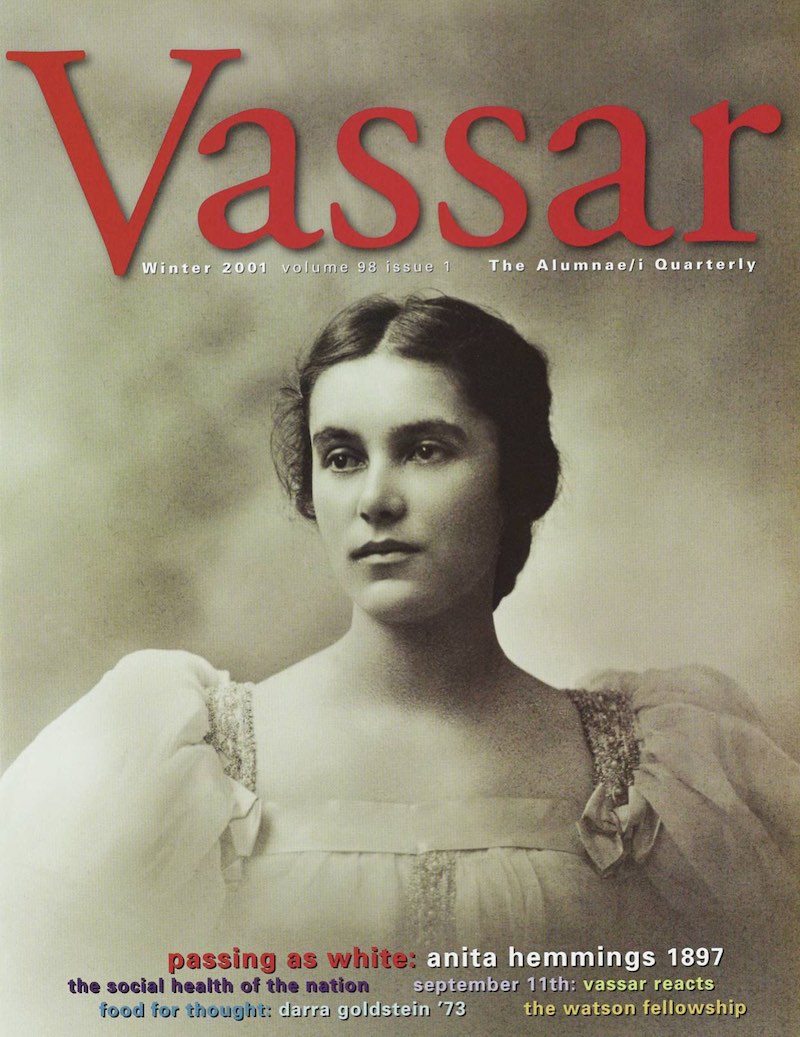
Passing as White: Anita Hemmings 1897

Posted in Articles, History, Media Archive, Passing, United States, Women on 2012-03-04 20:50Z by Steven

Passing as White: Anita Hemmings 1897

Vassar Alumnae/i Quarterly
Volume 98, Issue 1 (Winter 2001)
Features

Olivia Mancini ‘00

When Anita Florence Hemmings applied to Vassar in 1893, there was nothing in her records to indicate that she would be any different from the 103 other girls who were entering the class of 1897. But by August 1897, the world as well as the college had discovered her secret: Anita Hemmings was Vassar’s first black graduate — more than 40 years before the college opened its doors to African Americans.

In the late 19th century, Vassar’s atmosphere might have been best described as aristocratic. Since its opening in 1861, the prestigious women’s school had catered almost exclusively to the daughters of the nation’s elite. Had Hemmings marked her race as “colored” on her application, her admittance to the college most certainly would have been denied.

“She has a clear olive complexion, heavy black hair and eyebrows and coal black eyes,” a Boston newspaper wrote of a 25-year-old Hemmings in August 1897. “The strength of her strain of white blood has so asserted itself that she could pass anywhere simply as a pronounced brunette of white race.”

And pass she did, until her white roommate voiced suspicions about Hemmings’ background to her own father only a few weeks before the class was due to graduate.

The father hired a private investigator to travel to Hemmings’ hometown of Boston. There it was discovered that homemaker Dora Logan and janitor Robert Williamson Hemmings had conspired with their daughter to keep her race a secret…

Read the entire article here.

Tags: , , ,

Population structure and admixture in Cerro Largo, Uruguay, based on blood markers and mitochondrial DNA polymorphisms

Posted in Anthropology, Articles, Caribbean/Latin America, Health/Medicine/Genetics, Media Archive on 2012-03-04 18:29Z by Steven

Population structure and admixture in Cerro Largo, Uruguay, based on blood markers and mitochondrial DNA polymorphisms

American Journal of Human Biology
Volume 18, Issue 4 (July/August 2006)
pages 513–524
DOI: 10.1002/ajhb.20520

Mónica Sans
Departamento de Antropología Biológica, Facultad de Humanidades y Ciencias de la Educación
Universidad de la República

D. Andrew Merriwether
Department of Anthropology
Binghamton University, Binghamton, New York

Pedro C. Hidalgo
Laboratorio de Inmunogenética e Histocompatibilidad
Instituto Nacional de Donación y Trasplante de Células, Organos y Tejidos
Hospital de Clínicas “Manuel Quintela”

Nilo Bentancor
Laboratorio de Inmunogenética e Histocompatibilidad
Instituto Nacional de Donación y Trasplante de Células, Organos y Tejidos
Hospital de Clínicas “Manuel Quintela”

Tania A. Weimer
Laboratório de Biotecnologia Veterinária
Universidade Luterana do Brasil

Maria Helena L.P. Franco
Departamento de Genética, Instituto de Biociências
Universidade Federal do Rio Grande do Sul

Inés Alvarez
Laboratorio de Inmunogenética e Histocompatibilidad
Instituto Nacional de Donación y Trasplante de Células, Organos y Tejidos
Hospital de Clínicas “Manuel Quintela”

Brian M. Kemp
Department of Anthropology
University of California, Davis

Francisco M. Salzano
Departamento de Genética, Instituto de Biociências
Universidade Federal do Rio Grande do Sul

Recent studies of the Uruguayan population revealed different amounts of Amerindian and African genetic contributions. Our previous analysis of Afro-Uruguayans from the capital city of the Department of Cerro Largo showed a high proportion of African genes, and the effects of directional mating involving Amerindian women. In this paper, we extended the analysis to a sample of more than 100 individuals representing a random sample of the population of the whole Department. Based on 18 autosomal markers and one X-linked marker, we estimated 82% European, 8% Amerindian, and 10% African contributions to their ancestry, while from seven mitochondrial DNA site-specific polymorphic markers and sequences of hypervariable segment I, we determined 49% European, 30% Amerindian, and 21% African maternal contributions. Directional matings between Amerindian women and European men were detected, but differences involving Africans were not significant. Data about the specific origins of maternal lineages were also provided, and placed in a historical context.

Read the entire article here.

Tags: , , , , , , , , , , , , , , ,

Before state’s high court: role of race in identifying a face

Posted in Articles, Law, Media Archive, United States on 2012-03-04 03:45Z by Steven

Before state’s high court: role of race in identifying a face

Seattle Times
2012-03-03

Ken Armstrong, Staff Reporter

In a case out of Seattle’s University District, the Washington State Supreme Court is being asked to determine whether jurors should be told that eyewitnesses who identify strangers across racial lines — for example, a white man identifying a black man — are more likely to be mistaken.

In State of Washington v. Bryan Edward Allen, two issues intersect that could hardly be of greater importance to the functioning of the criminal-justice system: the role of race, and the reliability of eyewitnesses.

The case, argued Thursday before the state Supreme Court, is also about sunglasses. We’ll get to that later.

On an August evening in 2009, in Seattle’s University District, Gerald Marcus Kovacs called 911 and said a stranger on the street had just threatened to kill him. Within minutes, police picked up Bryan Allen at a nearby bus stop. Officers took Kovacs to Allen and asked: Is this the guy? “Yeah, definitely, that is 100 percent him,” Kovacs told police.

Two months later, Allen was convicted of felony harassment. He received a sentence of 14 months.

Kovacs is white. Allen is black.

Allen’s appeal argues that when the case was tried in King County Superior Court, the judge should have instructed jurors that when someone from one race identifies a stranger from another race, the chances of a mistake go up.

An assemblage of professors and legal advocacy groups — including the Innocence Network, the Washington Association of Criminal Defense Lawyers, the American Civil Liberties Union of Washington Foundation, and the Fred T. Korematsu Center for Law and Equality — filed briefs in support, saying a wealth of research shows that people often struggle to distinguish faces outside their own racial group…

…Arguing the other side, Deborah Dwyer, a King County prosecutor, did not challenge the science on cross-racial identifications. Instead, she took issue with having a trial judge tackle the matter rather than having an expert witness testify.

The proposed instructions would not only violate the state’s constitution, Dwyer said, but invite all kinds of “practical difficulties.”

“Our society now is increasingly made up of mixed-race people. Well, what race are they? To take an example we could all relate to: President Obama. He is of mixed racial heritage. If he’s an eyewitness to a crime, is he presumed to be able to identify white people and black people? Or, perhaps, neither?”

Dwyer also asked: “Does race include ethnicity?” Some studies say Chinese people struggle to distinguish Japanese people, and vice versa. Would trial judges need to instruct jurors in cases like that? And if someone’s race isn’t entirely clear, how is a judge to figure that out?…

Read the entire article here.

Tags: , , , ,

Race is a Social Construction

Posted in Anthropology, Articles, Media Archive on 2012-03-04 03:33Z by Steven

Race is a Social Construction

Living Anthropologically
2012-02-18

Jason Antrosio, Associate Professor of Anthropology
Hartwick College, Oneonta, New York

I usually avoid the phrase “race is a social construction.” It’s become too much of a mantra, it’s too much of a shortcut, and it is wildly misunderstood and misinterpreted. A perhaps better phrase–still concise but more accurate, and hopefully less susceptible to misinterpretation, is from John H. Relethford: Race is a “culturally constructed label that crudely and imprecisely describes real variation” (Race and global patterns of phenotypic variation 2009:20).

It is important to spell out what that means, and what people were after with the “race is a social construction” phrase. I am going to go out on an optimistic limb here and say that some recent posts on popular genetic-sorting blogs–Gene Expression and Dienekes–demonstrate these bloggers 1) acknowledge the genetic clustering data exhibits much more complexity and tells a much more complex story of human movement and mixing than is popularly understood; and 2) therefore acknowledge that the lived experience of racial classification can be much more real than the kinds of genetic clustering they are outlining; so that 3) correctly understood they are at least tacitly acknowledging that indeed “race is a social construction.”

Now before any of these bloggers or the people who inhabit their comment streams jump in and crush me, I want to make clear that this is an optimistic reading of some recent posts; that these comments apply to the main bloggers and not necessarily the commenters; and that since I am not a regular reader of these blogs, this may not be a new development even as I am reading a difference in tone…

Read the entire article here.

Tags: ,

The “ethnology” of Josiah Clark Nott

Posted in Anthropology, Articles, Literary/Artistic Criticism, Media Archive, Slavery, United States on 2012-03-04 02:23Z by Steven

The “ethnology” of Josiah Clark Nott

Journal of Urban Health
Volume 50, Number 4 (April 1974)
pages 509–528.

C. Loring Brace, Ph.D.
Museum of Anthropology
University of Michigan

It is only rarely that a person so completely transcends the ethos of his age that the recorded results of his scientific endeavors can be read a century or more later with any real profit, and apart from the desire to gain some historical perspective on the time in question. Copernicus, Darwin, and Einstein, among others, can still be read with instruction, not so much for their conclusions, but for the methods by which these were reached. This is because the conclusions, while now taken for granted, are no more intuitively obvious today than when they were first advanced.

Except for the rare transcending genius, the best minds of an age tend to typify the thinking of the time rather than to advance it. It is no surprise, then, to discover that the ablest figures in the American South prior to the Civil War, including Josiah Clark Nott, were unanimous in the defense of their “peculiar institution,” slavery. Although educated Southerners were unanimous in their defense of slavery, they diverged widely in their justification for doing so. As the 19th century progressed, two camps emerged which were engaged in vigorous, prolonged, and often acerbic debate at the time the Civil War broke out. Both sides took it as self-evident that Negroes were inferior and slavery justified, but they differed in their attempts to explain how racial differences arose in the first place.

The issue, at bottom, involved the relation between scientific and historical reality, and the written accounts in the Protestant Bible. On the one side it was argued that the words in the Bible were inspired by God and must therefore be literally true-all men, black and white, slave and free, were the descendants of Adam and Eve. On the other, the argument suggested that the inspiration in Holy Writ was largely moral and that the geographic and scientific information reflected the human fallibility and ignorance of the human authors. Neither side questioned the rectitude of a world view dominated by Protestant Christianity; both declared that, by definition, the basic teachings of science and religion must be in agreement. However, since there were apparent discrepancies between the views of the two realms, disputes arose over which should bend to accommodate the other…

…On August 12, 1845, Nott wrote to his friend John Henry Hammond, governor of South Carolina, that “the negro question was the one that I wished to bring out and embalmed it in Egyptian ethnography, etc., to excite a little more interest.”‘ He was referring specifically to his second published foray into the realm of “anthropology,” which had appeared just the year before and which set the tone and the dimensions of everything he was to write in an anthropological vein for the next 20 years. Once started, his involvement snowballed. As he wrote Hammond in a subsequent letter, September 4, 1845, “the nigger business has brought me into a large and heterogeneous correspondence,” and he declared his intention “to follow out the Negro, moral and physical in all his ramifications.”

Nott’s first anthropological contribution, entitled “The Mulatto a Hybrid-Probable Extermination of the Two Races If the Whites and Blacks Are Allowed to Intermarry,” was published in i843 in the highly respectable American Journal of the Medical Sciences.’ In this article, Nott became the first American public figure to declare that whites and blacks belonged to separate species of the genus Homo. As he stated, “this I do believe, that at the present day the Anglo-Saxon and Negro races are, according to common acceptation of the terms, distinct species, and that the offspring of the two is a Hybrid” (italics Nott’s) . To support this conclusion he reprinted figures from a paper that had appeared the year before in the Boston Medical and Surgical Journal, written by an anonymous author who signed himself Philanthropist.

The figures purported to show that the life spans of mulattoes are the shortest of any kind of human population, indicating that in the long run they were destined for eventual extinction. While it was not so acknowledged, the data on which these conclusions were based originally came from the census of  1840, which was filled with unverifiable claims and gross errors and slanted in a blatantly proslavery manner. Nott could hardly have been ignorant of the problems associated with the data of the census since these had been exposed in the very same Boston Medical and Surgical Journal, but he used them anyway without apology or qualification. In this instance, as in many others in his “anthropological” career, it is clear that the lip-service he gave to science was mainly camouflage to cover the racist advocacy that lay beneath.

Despite the weakness in his case, Nott’s hybridity argument drew favorable notice from Morton and helped enlist the latter in the ensuing debate. The ostensible issue was the criterion for the establishment of valid species. If members of different populations either could not crossbreed or, having done so, could only produce offspring that were sterile or of reduced viability and fertility, then the populations could be considered as different biological species. All agreed that the failure to crossbreed or the production of sterile offspring-the mule, for example-indicated a valid specific difference. The argument concerned the evidence for cases of reduced viability and fertility. In Mobile, Ala., Nott lacked the library resources as well as the time and inclination to pursue the matter beyond its initial stages. Morton, however, had the inclination; he also had the collections of the Philadelphia Academy of Natural Sciences. He had just completed the second of his two principal contributions to anthropological research, his Crania Aegyptiaca, in which he had demonstrated that the physical characteristics of Caucasian and Negro populations were just as distinct in ancient Egypt as they are today. With the dates of Egyptian antiquity established by the follow-up of Champollion’s translation of the Rosetta stone, and with a concept of the antiquity of human existence assumed to be on the order of those appended to the English Bible by Archbishop Ussher, Morton felt that human racial distinctions must have existed “in the beginning. Realizing that such an opinion was likely to stir up controversy, Morton was diffident about advancing it, but he finally did so with qualified caution in his defence and expansion of Nott’s hybridity position…

Read the entire article here.

Tags: , , , , , ,

The Mulatto a Hybrid-probable extermination of the two races if the Whites and Blacks are allowed to intermarry

Posted in Articles, Health/Medicine/Genetics, Media Archive on 2012-03-04 01:55Z by Steven

The Mulatto a Hybrid-probable extermination of the two races if the Whites and Blacks are allowed to intermarry

The American Journal of the Medical Sciences
Volume 6, Issue 11 (July 1843)
pages 252-256

Josiah C. Nott, M.D.
Mobile, Alabama

The reader will probably be astonished at this late clay to sec so novel an assertion us that the mulatto is a hybrid; but I hope ho will read and ponder upon the diets given below before be concludes that it has no foundation in reason.

A writer in the Boston Medical and Surgical Journal, under the signature of ” Philanthropist,” has made the following important and interesting statements:—

  • “From authentic statistics and extensive corroborating information, obtained from sources, to me of unquestionable authority, together with my own observation, I am led to believe that the following statements are substantially correct.
  • 1st, ” That the longevity of the pure Africans is greater than that of the inhabitants of any other part of the globe.”
  • 2d, “That the mulattoes, i. e. those born of parents one being African and the other Caucasian or white, are decidedly the shortest lived of any class of the human race.”
  • 3d, “That the mulattoes are no more liable to die under the age of 25* than the whites or blacks; but from 85 to 40, their deaths are as 10 to 1 of either the whites or blacks between those ages—from 40 to 55, 50 to 1–and from 55 to 70, 100 to 1.”
  • 4th, “That the mortality of the free people of colour in the United States, is more than 100 per cent, greater than that of the slaves.”
  • 5th, “That those of unmixed African extraction in the “free states” are not more liable to sickness or premature death than the whiles of their rank and condition in society; but that the striking mortality, so manifest amongst the free people of colour, is in every community and section of the country, invariably confined to the mulattoes.”

The following extracts are from the same writer:—

“It was remarked by a gentleman eminent for his intellectual attainments and distinguished for his correct observation, and who had lived many years in the Southern States, that he did not believe be had ever seen a mulatto 70 years of age.”…

Read or purchase the article here.

Tags: , , , ,