Present Status of Miscegenation Statutes

Posted in Articles, Law, Media Archive, United States on 2012-03-13 02:33Z by Steven

Present Status of Miscegenation Statutes

William and Mary Law Review
Volume 4, Issue 1 (January 1963)
Article 4
pages 28-35

Edmund L. Walton Jr., Founder
Walton & Adams, P.C., Reston, Virginia

With the influx of so called “civil rights” cases in recent years it seems that a reappraisal of state legislation and constitutional prohibitions concerning intermarriage of persons of different races is in order.

A total of twenty-four states currently have prohibitions against miscegeneous marriages, fourteen more have repealed such laws, and the supreme courts of two states have held that their miscegenation statutes are in violation of the Fourteenth Amendment of the United States Constitution but one of these reversed itself five years later. The highest courts of twelve other” states have affirmed the constitutionality of their respective statutes.  The Supreme Court of the United States has once had the opportunity to rule upon the question in recent years but sidestepped the issue.

The statutes, while varied in scope and legal consequences for violation are unanimous in condemning marriage between Negroes and whites. Three representative statutes are those of Virginia, Maryland, and Arkansas. Both Maryland and Virginia have criminal penalties as well as civil prohibitions and both declare the parties to a miscegenous marriage to be felons. Arkansas declares such a marriage to be illegal and void.” Virginia prohibits the marriage of whites with colored persons;  Arkansas, white persons with Negroes or mulattoes; and Maryland forbids any intermarriage between members of the white, Negro or Malayan races. Virginia describes a “white person” as one with no other admixture of blood other than white or one-sixteenth or less American Indian blood.

The challenge of the constitutionality of these and other state miscegenation statutes has been made and met in the state courts, but as yet the United States Supreme Court has not seen fit to make a final judgment. What are the major factors to be discussed and when will the court meet the challenge?…

Read the entire article here.
Tags: , , ,

Between black and white: Rethinking Coloured identity

Posted in Africa, Articles, Identity Development/Psychology, Media Archive, Philosophy, South Africa on 2012-03-13 01:15Z by Steven

Between black and white: Rethinking Coloured identity

African Identities
Volume 1, Issue 2 (2003)
pages 253-280
DOI: 10.1080/1472584032000173139

Pal Ahluwalia, Pro Vice Chancellor of Education, Arts and Social Sciences
University of South Australia

Abebe Zegeye
Goldsmiths College, University of London

Identity who we are, where we come from, what we are is difficult to maintain … we are the ‘other’, an opposite, a flaw in the geometry of resettlement, an exodus. (Said 1986: 16 17)

The photographs

Stephen Greenblatt offers two models for the exhibition of works of art resonance and wonder. Resonance, he argues, equates with the ‘power of the displayed object to reach out beyond its formal boundaries to a larger world, to evoke in the viewer the complex, dynamic cultural forces from which it has emerged and for which it may be taken by a viewer to stand’ (Greenblatt 1991: 42). Clearly a work of art that evokes such resonance creates its own context albeit that it is far removed from its original site. In contrast, by wonder, he means, ‘the power of the displayed object to stop the viewer in his or her tracks, to convey an arresting sense of uniqueness, to evoke an exalted attention’ (ibid.).

Greenblatt argues that what has increasingly happened in the practice of mounting exhibitions is the triumph of resonance over wonder. For an exhibition to have maximum impact, he argues (ibid.: 54), it is important that there should be ‘a strong initial appeal to wonder, a wonder that then leads to the desire for resonance, for it is generally easier in our culture to pass from wonder to resonance than from resonance to wonder’. It is in this context that we urge readers to make acquaintance with Chris Ledochowski’s photographs. First and foremost, they are works of art that evoke wonder. These works of art, however, are deeply resonant with the racial quagmire that has dominated and continues to dominate   South Africa’s culture, history and politics…

Read or purchase the article here.

Tags: , , ,

Multiracial Identity [Film Review by Patricia B. McGee]

Posted in Articles, Book/Video Reviews, Media Archive, Social Science, United States on 2012-03-12 21:11Z by Steven

Multiracial Identity [Film Review by Patricia B. McGee]

Educational Media Reviews Online
2011-07-19

Patricia B. McGee, Coordinator of Media Services
Volpe Library & Media Center
Tennessee Technological University, Cookeville, Tennessee

Multiracial Identity
2010
Distributed by Bullfrog Films, PO Box 149, Oley, PA 19547; 800-543-FROG (3764)
Produced and Directed by Brian Chinhema
DVD, color, 77 min. and 56 min.
Jr. High – General Adult
African American Studies, Anthropology, Multicultural Studies, Sociology

Highly RecommendedHighly Recommended

Multiracial Identity explores the complexities of what it means to be a person of mixed race heritage in the United States, and how the concept of mixed race “challenges racial perceptions and boundaries.” Race is a concept with its origins in custom and mores; in America persons with both black and white ancestry are viewed as black, a legacy of the ‘one drop rule’ intended to preserve the racial purity of the white race. The film explores the history of how multiracial individuals have been treated in America, how the mixed race class provided a shield between blacks and whites, and how the paper bag, blue vein or comb tests would be used to determine racial membership…

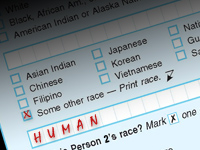
…For multiracial people the lack of a mixed race categorization can be a source of conflict and distress. Many find the categorization “other” on many forms to be dehumanizing, or they feel they “don’t really have a place.” Others, when forced to choose membership in a single group, feel they are denying half their heritage. Sometimes they end up without the strong support of the very cultural group they are forced to identify with. Yet, if the concept of race were eliminated, America would no longer be able to track racial discrimination. Muddying the water still further is the question where to place Hispanics—which is a linguistic rather than a racial group…

Read the entire review here.

Tags: , , ,

Birth in the Briar Patch: Charles W. Chesnutt and the Problem of Racial Identity

Posted in Articles, Literary/Artistic Criticism, Media Archive, United States on 2012-03-12 18:48Z by Steven

Birth in the Briar Patch: Charles W. Chesnutt and the Problem of Racial Identity

The Southern Literary Journal
Volume 41, Number 2, Spring 2009
pages 1-20
DOI: 10.1353/slj.0.0040

Daniel Worden, Assistant Professor of English
University of Colorado, Colorado Springs

In his speech “The Courts and the Negro,” written around 1908, Charles W. Chesnutt faults the American government’s geographic location for the limits and widespread denials of the Fourteenth Amendment’s power. The government’s central location in Washington, D.C. perpetuated racism, Chesnutt argued, for “inevitably the administration, the courts, the whole machinery of government takes its tone from its environment” (Charles 896). This racism, present within the “clubs and parlors” of the South, feeds the “attitudes of presidents and congressmen and judges toward the Negro,” and therefore, “to men living in a community where service and courtesy in public places is in large measure denied the Negro, there seems to be no particular enormity in separate car laws” (897). Chesnutt goes on to reference the U. S. Supreme Court’s 1896 Plessy v. Ferguson decision, which ruled in favor of Louisiana’s segregated railroad cars: “And under Plessy v. Ferguson, there is no reason why any Northern State may not reproduce in its own borders the conditions in Alabama and Georgia. And it may be that the Negro and his friends will have to exert themselves to save his rights in the North (903). The federal government’s southern context, then, both defers any institutional remedy to America’s racism and produces racism through association…

Read or purchase the article here.

Tags: , , , , ,

Barack Obama is a White Man

Posted in Articles, Barack Obama, Media Archive, Social Science, United States on 2012-03-12 05:55Z by Steven

Barack Obama is a White Man

The Language Guy
2008-06-09

Michael Geis
, Professor Emeritus in Linguistics
Ohio State University

I don’t get it. Obama is seen as a Black man. Why not see him as a White man. He is, if I understand his parentage, 50% White and 50% Black. Moreover, he went to Harvard. This constitutes unimpeachable evidence (sort of) that Obama is a White man. Tiger Woods is 50% Black and 50% Thai. How in hell does that make him into a Black man. His father raised him, it seems, to be White in that he taught him a mostly White sport and sent him to mostly White Stanford University (the last is a guess). I suspect that Tiger has more White friends than Black ones. I hereby claim him as a White man.

Back when I was a full time faculty remember I looked over a class I was about to teach Sociolinguistics for the first time and remarked that it was too bad there were no African Americans in the class since we would be talking about issues of interest to them. A girl right in front of me said, “What makes you think that there aren’t any Blacks in this room?” I took a good look at her essentially White freckled face and her red hair and said, on observing that her hair was “kinky” in the way the hair of Blacks can be and replied, “If you say so.” The next class two relatively clear cases of Black students showed up.

Since that “error” on my part, I have observed all manner of athletes on TV whose race I find it impossible to tell. They could be very light skinned “Black” people or White people. Certainly their skin color is often lighter than that of certain so-called “White” people from Europe…

Read the entire article here.

Tags: ,

Catholic records of slave baptisms in colonial New Orleans go online

Posted in Articles, Census/Demographics, History, Louisiana, Media Archive, Religion, Slavery, United States on 2012-03-12 05:22Z by Steven

Catholic records of slave baptisms in colonial New Orleans go online

New Orleans Times-Picayune
2011-02-01

Bruce Nolan, Beat Reporter

On Sunday, the 6th of May, 1798, an enslaved New Orleans woman named only Manon, owned by Mr. LeBlanc, presented her 2-year-old child, Antoine Joseph, at St. Louis Cathedral on the Plaza de Armas to be baptized at the hands of Father Luis Quintanilla, a Capuchin friar there.

Manon was probably accompanied by her owner, as was the custom of the day, according to Emilie Leumas, an expert on the era and the keeper of the Archdiocese of New Orleans’ sacramental records.

In racially complex, laissez-faire New Orleans, where categories of race were faithfully noted then sometimes dismissed, Quintanilla noted the pertinent details. Manon was a mulatto, or mixed-race woman, and the baby’s father was officially unrecognized but apparently white, as the baby is described with the Spanish term “quarteroon,” which means three-fourths white.

The record of that event has always been preserved in the rich archives of the Archdiocese of New Orleans. But it has never been easily accessible.

But Tuesday, the 1798 baptism of Antoine Joseph, with thousands of similar baptismal records from colonial New Orleans, were posted on the Internet as a new tool for genealogists everywhere.

“Now people can sit in their slippers at 11 o’clock at night and read away,” said Leumas, the archdiocese’s archivist…

..In Antoine Joseph’s case, the godparents were there: Marie Joseph and Antonio, neither with a family name. Still attentive to the complex categories of race and color, Quintanilla noted that the baby’s godfather was “metis”—another mixed-race classification, perhaps suggesting American Indian blood, according to Leumas.

By the end of 2012, the archdiocese hopes to go both forward and backward in time, posting all of its sacramental records—baptisms, marriages, funerals and other life cycle events—from the founding of the city in 1718 to the date of Louisiana’s admittance to the union in 1812, Leumas said…

Read the entire article here.

Tags: , , ,

Treating a medical mosaic, doctors develop a new appreciation for the role of ethnicity in disease

Posted in Articles, Asian Diaspora, Canada, Health/Medicine/Genetics, Media Archive on 2012-03-12 03:53Z by Steven

Treating a medical mosaic, doctors develop a new appreciation for the role of ethnicity in disease

The Globe and Mail
Toronto, Canada
2012-02-15

Dakshana Bascaramurty, Reporter

Baby X is born in a Canadian hospital and her tiny, wrinkled body is placed on a scale that reads 3,061 grams, or 6 pounds and 12 ounces.

Things can go one of two ways for Baby X, whose parents are immigrants from India.

According to the standard birth-weight curves used in Canada, which are modelled after norms for Caucasian newborns, this baby could be labelled as underweight, a classification that comes with a higher risk of death and lower cognitive ability. She could be subjected to a battery of unnecessary tests and follow-ups. Her concerned mother might overfeed her in hopes of speeding up her growth.

Or, if a new birth-weight curve developed at Toronto’s St. Michael’s Hospital – one that takes into account a wide range of ethnicities – is used, Baby X will be classified as having a perfectly normal weight and will be sent home. South Asian newborns are typically smaller than those of many other ethnicities.

It’s just one example of why there is a move in Canada and other countries to collect data on their diverse populations to deliver better patient care.

Doctors and researchers are putting greater stock in ethnicity as a variable in health outcomes. A large body of research suggests certain groups are at a higher genetic risk for particular diseases. And physiologically, what is accepted as “normal” and “healthy” varies between ethnicities.

But there are no universal standards or terms of reference used to classify ethnicity, which has made it a highly fraught subject. Some say it shouldn’t be considered a variable at all, arguing that the link between ethnicity and health is manufactured. The Canadian Institute for Health Information doesn’t collect data on ethnicity, and the Canadian Medical Association has no formal policy on the best way to classify the diverse backgrounds of Canadians.

Joel Ray, who led the St. Michael’s Hospital team that developed the new newborn birth-weight curve, is baffled that an old model developed in 1969 based on the weights of 300 Caucasian newborns in Montreal – a population unreflective of modern Canada – is still used in some parts of the country. In a study published Wednesday in the Journal of Obstetrics and Gynaecology Canada, his team analyzed 760,000 live births in Ontario and, by their measure, more than one in 10 South Asian babies was at risk of being misclassified if one of the standard Canadian birth-weight curves was used.

“They’re completely archaic – there’s no other sweet word for it,” Dr. Ray said.

Dr. Ray previously studied rates of gestational diabetes among women of various ethnic groups and found South Asians had the highest risk levels, followed by those from East Asia and the Middle East. Previous studies have lumped these three groups together under the catch-all category “Asian” – missing the heterogeneity within.

“You may as well call them human if you’re going to call someone Asian,” he said…

Read the entire article here.

Tags: , , , ,

Black German Cultural Society of New Jersey 2012 Annual Convention: Call for Papers

Posted in Articles, Europe, Forthcoming Media, United States, Wanted/Research Requests/Call for Papers on 2012-03-12 02:00Z by Steven

Black German Cultural Society of New Jersey 2012 Annual Convention: Call for Papers

Black German Cultural Society of New Jersey
2012-01-31

Building on the success of the inaugural 2011 conference, the second annual convention of the Black German Cultural Society of New Jersey (BGCSNJ) will be held at Barnard College in New York City on August 10-11, 2012.  This year’s convention will focus on the theme of “What Is the Black German Experience?” The conference will feature a keynote address by Yara Colette Lemke Muniz de Faria, screenings of the films “Hope in My Heart: The May Ayim Story” and “Audre Lorde – The Berlin Years 1984-1992,” and readings by Black German poet-performers Olumide Popoola and Philipp Khabo Köpsell.

The BGCSNJ Review Committee invites proposals for papers that engage the multiplicity and diversity of the experiences of Blacks of German heritage and on Blackness in Germany. We welcome submissions for twenty-minute presentations on three academic panels and two sessions devoted to life writing, oral history and memoir. To participate please send a one-page abstract and a CV or short biographical statement to: bgcsinc@gmail.com. Deadline for proposals: March 15, 2012

For more information, click here.

Tags: , , , , , , ,

Assimilating to a White Identity: The Case of Arab Americans

Posted in Articles, Identity Development/Psychology, Media Archive, Social Science, United States on 2012-03-11 03:46Z by Steven

Assimilating to a White Identity: The Case of Arab Americans

International Migration Review
Volume 41, Issue 4, December 2007
pages 860–879
DOI: 10.1111/j.1747-7379.2007.00103.x

Kristine J. Ajrouch
, Adjunct Associate Research Professor in the Life Course Development Program
Institute for Social Research
University of Michigan

Amaney Jamal, Associate Professor of Politics
Princeton University

Racial identity is one of the primary means by which immigrants assimilate to the United States. Drawing from the tenets of segmented assimilation, this study examines how the ethnic traits of immigrant status, national origin, religious affiliation, and Arab Americaness contribute to the announcement of a white racial identity using a regionally representative sample of Arab Americans. Results illustrate that those who were Lebanese/Syrian or Christian, and those who felt that the term “Arab American” does not describe them, were more likely to identify as white. In addition, among those who affirmed that the pan-ethnic term “Arab American” does describe them, results illustrated that strongly held feelings about being Arab American and associated actions were also linked with a higher likelihood of identifying as white. Findings point to different patterns of assimilation among Arab Americans. Some segments of Arab Americans appear to report both strong ethnic and white identities, while others report a strong white identity, yet distance themselves from the pan-ethnic “Arab American” label.

Read or purchase the article here.

Tags: , ,

New Geographic Categories Listings for MixedRaceStudies.org

Posted in Articles, My Articles/Point of View/Activities on 2012-03-11 02:51Z by Steven

New Geographic Categories Listings for MixedRaceStudies.org

2012-03-10

Steven F. Riley

Over the next few days, I will be removing several frequently used geographic tags (indexed items) and converting them into categories (which are listed on the right-hand side).  The current tags (that will be placed under the parent tag United States) are: Louisiana, Mississippi, Virginia, and Texas. South Africa will be placed under Africa. The last tag, Mexico will be placed under Caribbean/Latin America.

Thanks again to Dr. G. Reginald Daniel for letting me flush out my ideas with him.