2010 Census Shows Interracial and Interethnic Married Couples Grew by 28 Percent over Decade

Posted in Articles, Census/Demographics, New Media, United States on 2012-04-25 23:27Z by Steven

2010 Census Shows Interracial and Interethnic Married Couples Grew by 28 Percent over Decade

United States Census Bureau
Newsroom
2012-04-25

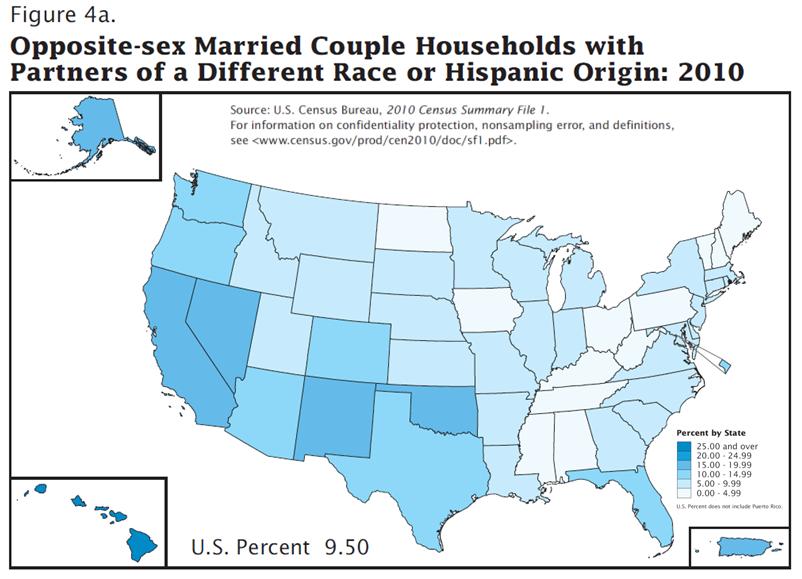
The U.S. Census Bureau today released a 2010 Census brief, Households and Families: 2010, that showed interracial or interethnic opposite-sex married couple households grew by 28 percent over the decade from 7 percent in 2000 to 10 percent in 2010. States with higher percentages of couples of a different race or Hispanic origin in 2010 were primarily located in the western and southwestern parts of the United States, along with Hawaii and Alaska.

A higher percentage of unmarried partners were interracial or interethnic than married couples. Nationally, 10 percent of opposite-sex married couples had partners of a different race or Hispanic origin, compared with 18 percent of opposite-sex unmarried partners and 21 percent of same-sex unmarried partners.

Read the entire press release here.

Tags:

“Nearly White” and Clinging to “Bits of Finery”: Jim Crow Logic, Brazil, and Evelyn Scott’s Escapade

Posted in Articles, Literary/Artistic Criticism, Media Archive on 2012-04-25 21:15Z by Steven

“Nearly White” and Clinging to “Bits of Finery”: Jim Crow Logic, Brazil, and Evelyn Scott’s Escapade

Women’s Studies: An inter-disciplinary journal
Volume 41, Issue 4, 2012
Special Issue: Women and Travel
DOI: 10.1080/00497878.2012.663249

Amy Schmidt, Supervisor of Supplemental Instruction
Lyon College, Batesville, Arkansas

Evelyn Scott’s Escapade (1923) illustrates both the similarities and the differences between the U.S. South and South American Brazil, highlighting the former’s privileged position as part of the U.S.  Through depictions of elite southern American women living in Brazil, Scott’s Escapade demonstrates how identity performances are disrupted when the stage for them changes and denaturalizes identity through parody, revealing how performances depend upon material means. However, it also demonstrates how the ideology governing performances remains, unfortunately, quite consistent; while her critiques of American capitalism reveal its international consequences, Scott inadvertently illustrates how Jim Crow logic translates rather easily into other regions and countries. Scott’s text demonstrates an impulse towards social justice but simultaneously reveals ambivalence about relinquishing privilege.

Scott left the South to escape the constraints of Jim Crow logic, which entails more than racial segregation laws; as all identities intersect with one another under a “matrix of domination,” race- cannot be divorced from gender, class, or nationality (see Collins 228). Thus, the gender constraints Scott faced in the U.S. South are just as much a part of Jim Crow logic as racial segregation is. and travel taboos are a notable illustration of how Jim Crow governs both race and gender. When Scott left the South in 1913, elite white women were not allowed to travel without a white male chaperone; despite the energy while southerners spent on…

Read or purchase the article here.

Tags: , ,

The Social Construction of Race and Monacan Education in Amherst County, Virginia, 1908–1965: Monacan Perspectives

Posted in Articles, History, Media Archive, Native Americans/First Nation, Politics/Public Policy, Social Science, United States, Virginia on 2012-04-25 00:37Z by Steven

The Social Construction of Race and Monacan Education in Amherst County, Virginia, 1908–1965: Monacan Perspectives

History of Education Quarterly
Volume 47, Issue 4 (November 2007)
pages 389–415
DOI: 10.1111/j.1748-5959.2007.00107.x

Melanie D. Haimes-Bartolf
Virginia Commonwealth University, Richmond, Virginia

That’s all you heard, everywhere we went, or whatever we done, “oh, he’s one of those issues.” We couldn’t work with white people, we couldn’t be in schools with them, we couldn’t associate with them, we couldn’t eat |with them). I think they came up with the slang word “free issue.” They had this hatred; they just had this ungodly hatred. They couldn’t accept you as a human.

At the prodding of Thomas Jefferson, the Virginia General Assembly in 1782 passed legislation that allowed slave owners to manumit their slaves by issuing slaves a copy of their emancipation papers and making them “free issues.”‘ Nevertheless, in Amherst County, Virginia, the meaning of “free issue” evolved to connote something very different than it did at its inception for a small mountain community.

In 1953, the school board of Amherst County, Virginia, approved plans for new white and black high schools, and the State Board of Education made it possible for Pamunkey and Mattaponi Indian children of Virginia’s tidewater to finish their education beyond the eighth grade at accredited Indian high schools outside Virginia. Notwithstanding, there was a group of children living in the Tobacco Row Mountains at the base of the Blue Ridge Mountains for whom educational opportunity beyond the seventh grade would remain largely out of reach for another decade…

Read or purchase the article here.

Tags: ,

The short life of a race drug

Posted in Articles, Health/Medicine/Genetics, Media Archive, Politics/Public Policy, United States on 2012-04-23 23:44Z by Steven

The short life of a race drug

The Lancet
Volume 379, Issue 9811 (2012-01-14 through 2012-01-20)
pages 114-115
DOI: 10.1016/S0140-6736(12)60052-X

Sheldon Krimsky, Professor of Urban & Environmental Policy & Planning; Adjunct Professor of Public Health and Family Medicine
Tufts School of Medicine
Tufts University, Medford, Massachusetts

The headlines back in June, 2005, read “FDA approves a heart drug for African Americans”. The decision that gave the company NitroMed approval for its drug BiDil exclusively to a “racial group” represented a milestone in US drug policy. The decision ignited a debate that polarised the African American community, confounded proponents of personalised medicine, and dismayed groups opposed to reinscribing racial categories into science. Ever since Ashley Montagu published Man’s Most Dangerous Myth: The Fallacy of Race in 1964 [1942?], scientists have reached a broad consensus that “race” applied to human populations has no standing in science…

…In a historical context too, the use of such racial classification is shown to be a subjective process. The concept of “race” in the USA grew out of slavery when state laws dictated racial identity by percentage admixture. A person who self-identifies as African American could have one great-grandfather (or about one-eighth of his or her genome) as the exclusive source of that identity. Homer Plessy was the plaintiff in an 1896 US Supreme Court decision (Plessy v. Ferguson) that established the “separate but equal” foundations of segregation in the USA. Plessy, who was escorted off a train for whites only, was considered black based on the infamous “one drop rule”, even though he considered himself seven-eighths white. By contrast, Jean Toomer, author of the 1923 book Cane, which chronicled the lives of black Americans, sometimes identified himself as black and sometimes as white. Thus, two individuals, both with one-eighth African ancestry, might either be defined by others as black or self-identify as white or black. Why should the drug’s approval for a differentiated group be based upon such quixotic criteria? Despite all the reasons why “race” has no role in science, it was a science-based agency that approved BiDil for a racial group…

…While many commentators who supported the approval of BiDil for black patients state that “race” is not a scientifically precise term for identifying relevant genomic or physiological characteristics that differentiate population groups, nevertheless, they argue that “self-identified race” is a useful proxy for those characteristics. However, what is the evidence that the proxy “self-identified race” is a reliable surrogate? The best evidence derives from the fact that genetic variation conferring disease susceptibility is not equally distributed among ancestral populations. For example, sickle cell anaemia is more prevalent in populations whose ancestry can be traced to sub-Saharan Africa. However, “self-identified race” is a subjective term, influenced by cultural factors, and not even grounded in the ancestral genomics of, for example, the International HapMap Project. For the purpose of the clinical trials, “self-identified race” is interpreted as a dichotomous variable (black or non-black). If race were used as a proxy for ancestral African genomics it should be a continuous function (10%, 30%, 70%, etc). It makes no scientific sense to map a continuous function onto a dichotomous variable…

Read the entire article here or here.

Tags: , ,

Obama as Anti-American: Visual Folklore in Right-Wing Forwarded E-mails and Construction of Conservative Social Identity

Posted in Articles, Barack Obama, New Media, Social Science, United States on 2012-04-23 20:03Z by Steven

Obama as Anti-American: Visual Folklore in Right-Wing Forwarded E-mails and Construction of Conservative Social Identity

Journal of American Folklore
Volume 125, Number 496, Spring 2012
pages 177-203
DOI: 10.1353/jaf.2012.0018

Margaret Duffy, Associate Professor of Journalism
University of Missouri

Janis Teruggi Page
George Washington University

Rachel Young
Missouri School of Journalism

This paper investigates the group-building potential of forwarded e-mails through a visual analysis of negative images about President Barack Obama. We argue that these e-mails are a form of political digital folklore that may contribute to constructing participants’ individual and group identities. Images amplify the impact and believability of the messages, especially when linked to familiar cultural references and experiences and may lead to increased political polarization and hostility.

Read or purchase the article here.

Tags: , , , ,

‘Mutts like Me’: Multiracial Students’ Perceptions of Barack Obama

Posted in Articles, Barack Obama, Campus Life, Media Archive, Social Science, United States on 2012-04-22 22:24Z by Steven

‘Mutts like Me’: Multiracial Students’ Perceptions of Barack Obama

Qualitative Sociology
Volume 35, Number 2 (2012)
pages 183-200
DOI: 10.1007/s11133-012-9226-4

Michael P. Jeffries, Assistant Professor of American Studies
Wellesley College, Wellesley, Massachusetts

Existent sociological studies of multiracialism in the United States focus on identity construction, the cultural and legislative battle over multiracial categorization, and the implications of demographic shifts towards an increasingly “mixed race” population. This article engages literature from each of these areas, and uses data from in-depth interviews with self-identified multiracial students to document their perceptions of President Barack Obama and trace the symbolic boundaries of multiracial identity. Interviews are specifically directed towards the influence of race on Obama’s identity management and political career, the relationship between Obama and respondents’ multiracial identity, and Obama’s impact on America’s racial history. Respondents hold favorable opinions of the President despite his inconsistent affirmation of multiracial identity. They believe that emphasis on Obama’s blackness rather than multiracialism is the unfortunate result of both personal choices and political pressures. In addition, the cohort insists that racism remains is a major factor in Obama’s career and in America at large.

Read the entire article here.

Tags: , ,

Role of identity integration on the relationship between perceived racial discrimination and psychological adjustment of multiracial people

Posted in Articles, Identity Development/Psychology, Media Archive on 2012-04-22 22:12Z by Steven

Role of identity integration on the relationship between perceived racial discrimination and psychological adjustment of multiracial people

Journal of Counseling Psychology
Volume 59, Number 2 (April 2012)
pages 240-250

Kelly F. Jackson, Assistant Professor of Social Work
Arizona State University, Phoenix

Hyung Chol (Brandon) Yoo, Assistant Professor of Asian Pacific American Studies
Arizona State University, Tempe

Rudy Guevarra, Assistant Professor of Asian Pacific American Studies
Arizona State University, Tempe

Blair A. Harrington

This study examined relations between perceived racial discrimination, multiracial identity integration (i.e., racial distance and racial conflict), and psychological adjustment (i.e., distress symptoms, positive affect, and negative affect) of 263 multiracial adults, using an online cross-sectional survey design. As hypothesized, higher levels of perceived racial discrimination was related to lower levels of psychological adjustment (i.e., higher distress symptoms and negative affect). Also, higher levels of multiracial identity integration with low racial conflict was related to higher levels of psychological adjustment (i.e., lower distress symptoms and negative affect), whereas higher levels of multiracial identity integration with low racial distance was related to higher levels of psychological adjustment (i.e., lower negative affect). Finally, multiracial identity integration (i.e., lower racial conflict) moderated the relationship between perceived racial discrimination and psychological adjustment (i.e., negative affect) with results suggesting multiracial identity integration related to low racial conflict buffers the negative effects of perceived racial discrimination on psychological adjustment. Findings from this study are discussed in terms of future research on the psychological well-being of multiracial individuals and implications for clinical practice with multiracial adults.

Tags: , , , , , , , ,

Imagining Jefferson and Hemings in Paris

Posted in Articles, Europe, History, Media Archive, United States on 2012-04-22 21:43Z by Steven

Imagining Jefferson and Hemings in Paris

TransAtlantica: American Studies Journal
1 | 2011 : Senses of the South / Référendums populaires
10 pages, 20 paragraphs

Suzanne W. Jones, Professor of English
University of Richmond

In Yearning: Race, Gender, and Cultural Politics, cultural critic bell hooks argues that “no one seems to know how to tell the story” of white men romantically involved with slave women because long ago another story supplanted it: “that story, invented by white men, is about the overwhelming desperate longing black men have to sexually violate the bodies of white women.” Narratives of white exploitation and black solidarity have made it difficult to imagine consensual sex and impossible to imagine love of any kind across the color line in the plantation South. hooks predicted that the suppressed story, if told, would explain how sexuality could serve as “a force subverting and disrupting power relations, unsettling the oppressor/oppressed paradigm” (57-58). By rethinking and reimagining the relationship between Thomas Jefferson and Sally Hemings, contemporary novelists, filmmakers, and historians have exposed this “suppressed story,” the bare bones of which were first made public in 1802 by journalist James Callendar during Jefferson’s first term as U.S. President and then covered up by professional historians for almost 175 years.

As novelist Ralph Ellison pointed out, historical fiction must sometimes serve as the repository for historical truth when the collective historical memory has repressed the facts. In 1979 Barbara Chase-Riboud’s best-selling novel Sally Hemings allowed readers to enter the mind and heart of the shadowy figure that historian Fawn Brodie had brought back into the public consciousness in 1974, and in so doing enabled readers to believe that Jefferson might have had a long-term relationship with her. Chase-Riboud’s fictional portrait clearly upset Jefferson’s defenders, but the word that CBS might make the novel into a miniseries unnerved them, causing historians Virginius Dabney and Dumas Malone to intervene. Although they claimed that they were worried about historical accuracy, historian Annette Gordon-Reed believes that they were even more worried by the nature of the medium itself: “If a beautiful woman appears on screen as a capable and trustworthy person, […] all talk about impossibility [of a liaison] would be rendered meaningless” (Jefferson and Hemings, 182-83). Over fifteen years later, the film and the miniseries that eventually were produced have proved Gordon-Reed right. Today visitors to Jefferson’s Monticello routinely view, seemingly without surprise or dismay, a twenty-minute documentary that briefly mentions the liaison…

Read the entire article in HTML or PDF format.

Tags: , , , ,

‘Too black or not black enough’: Social identity complexity in the political rhetoric of Barack Obama

Posted in Articles, Barack Obama, Identity Development/Psychology, Media Archive, United States on 2012-04-22 18:27Z by Steven

‘Too black or not black enough’: Social identity complexity in the political rhetoric of Barack Obama

European Journal of Social Psychology
Volume 42, Issue 5, August 2012
pages 564–577
DOI: 10.1002/ejsp.1868

Martha Augoustinos, Professor of Psychology
University of Adelaide, Adelaide, Australia

Stephanie De Garis
School of Psychology
University of Adelaide, Adelaide, Australia

The election of the first African-American President of the United States, Barack Obama, has been widely recognised as an extraordinary milestone in the history of the United States and indeed the world. With the use of a discursive psychological approach combined with central theoretical principles derived from social identity and self-categorisation theories, this paper analyses a corpus of speeches Obama delivered during his candidacy for president to examine how he attended to and managed his social identity in his political discourse. Building on a social identity model of leadership, we examine specifically how Obama mobilises political support and social identification by building an identity for himself as a prototypical representative of the American people, notwithstanding the protracted public debate within both the White and Black American communities that had questioned and contested Obama’s identity. Moreover, we demonstrate how Obama managed the dilemmas around his identity by actively crafting an in-group identity that was oriented to an increasingly socially diverse America—a diversity that he himself exemplified and embodied as a leader. As an ‘entrepreneur’ of identity, Obama’s rhetorical project was to position himself as an exceptional leader, whose very difference was represented as ‘living proof’ of the widely shared collective values that constitute the ‘American Dream’. Drawing on social identity complexity theory, we suggest that by providing more inclusive and complex categories of civic and national identity, Obama’s presidency has the potential to radically transform what it means to be a prototypical in-group member in America.

Read or purchase the article here.

Tags: , ,

Race (Part 1)

Posted in Anthropology, Articles, Media Archive on 2012-04-22 15:05Z by Steven

Race (Part 1)

The Chronicle of Higher Education
Blog: Brainstorm—Ideas and culture.
2012-04-09

David Barash, Professor of Psychology
University of Washington, Seattle

Here’s a delicate subject, especially given the nationwide anguish over what appears to have been the cold-blooded, racially lubricated if not racially motivated murder of Trayvon Martin: race itself. More specifically and more delicately: whether race is a “socio-cultural construct.” My response, and one that may well disappoint and annoy many readers, regardless of their ideology (but perhaps especially my fellow travelers on the left): It is and it isn’t, but mostly isn’t. That is to say, an objective, science-based look at the subject and at its use in other contexts requires us to conclude that race is both socially constructed and biologically “real,” but probably more the latter than the former.

Of course, in the old days of racist pseudoscience, it was universally assumed that the human races were genuine biological entities, and moreover, that they were linearly arrayed with whites on top, then Asians, then blacks at the bottom. From that bizarre and altogether unscientific misuse of biology, there was, not surprisingly, a backlash that went overboard in the other direction, maintaining as a matter of faith that there is simply no such thing as human races, that they are purely an arbitrary figment of our sociocultural proclivities. Sad to say, this is arrant nonsense … just as was the earlier insistence that the human races could be evaluated in terms of “modernity,” “distance from the apes,” or simply, “degree of advancement” or “intelligence.”

If we’re going to talk about the alleged reality or unreality of human races, we need first to discuss the meaning of “race” itself. When biologists talk about races in other species, they are essentially concerned with a convenient grouping of individuals that comprise phenotypically distinguishable populations characterized by some consistent genetic differences between themselves and other, comparable populations, and that typically inhabit different geographic regions, and are therefore normally prevented from interbreeding (which was essential to the initial distinctiveness of each race in the first place). Of course, human races are all capable of interbreeding; hence, we know for certain that they are all members of one species, Homo sapiens. Moreover, we are not restricted to separate, non-overlapping (“allopatric”) populations. Nonetheless, there is no question that what are generally identified as different human races have historically been allopatric, with much of the geographic and genetic mixing being a comparatively recent phenomenon…

…When Barack Obama identifies himself similarly, only an idiot would deny him the right to make such a self-designation. Clearly the President had a choice, and thus his identification as “black” is also to some degree a socio-cultural decision: his. But equally clearly, it was made possible by the fact that his biological father was black (which is why, incidentally, the president noted that if he had a son, he would “probably look like” Trayvon). On the other hand, if Obama’s mother had reproduced with someone as Caucasian as she was, their offspring would most certainly have been Caucasian, not black. Moreover, when Toni Morrison called Bill Clinton our “first black president,” it was obvious to everyone that she was speaking allegorically: Bill Clinton is no more African-American than Trayvon Martin was Caucasian…

Read the entire article here.  Read “Playing With Fire: Race (Part 2)” here.
Tags: , , ,