the greek

Posted in Articles, Campus Life, Media Archive, United States on 2012-06-25 16:36Z by Steven

the greek

Story Week Reader
Story Week Reader 2011
pages 31-32

Chris “C.T.” Terry, Writer, Editor, Educator

I was nervous on my first day working in the African-American Cultural Affairs section of my school’s Multicultural Office. My boss Kim introduced me to coworkers, and I imagined my blue eyes to be the subject of appraising gazes. I shook hands—no daps—and wondered if the brief, polite greetings I received were typical professional interactions, or if each person was thinking, “The nerve of this white boy, disturbing the sanctity of African-American Cultural Affairs!”

My mother is white, Irish-American. My father is black. I’m pale, with freckles. Usually, black people can tell that I’m mixed, and white people go, “Oh, I thought you were white, but, like, with an Afro.”

After growing up in a white area outside of white Boston, and having so many people mistake me for white, I get self-conscious around black people. If they don’t recognize my blackness, does it exist? At a party, I’ll screw up an elaborate handshake, clasping when I should be bumping, and one of the other black guys there looks away in shame. Then I die inside a little bit and vow to delete all Hank Williams from my iPod…

Read the entire essay here.

Tags: , ,

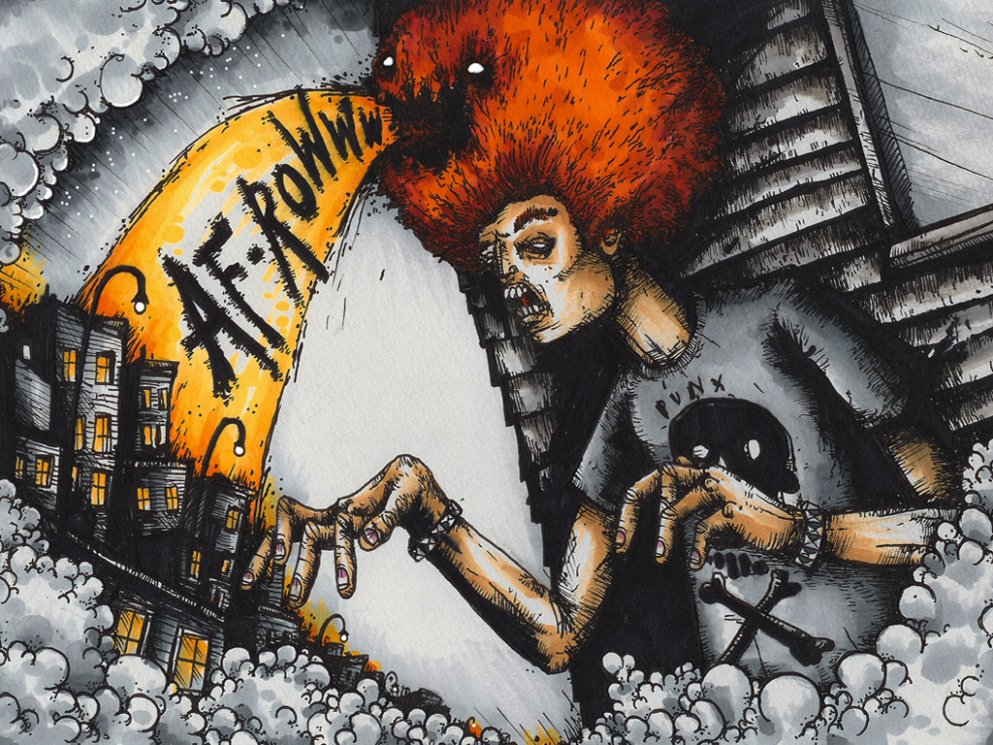
The Language of Hairzilla

Posted in Articles, Media Archive on 2012-06-25 02:44Z by Steven

The Language of Hairzilla

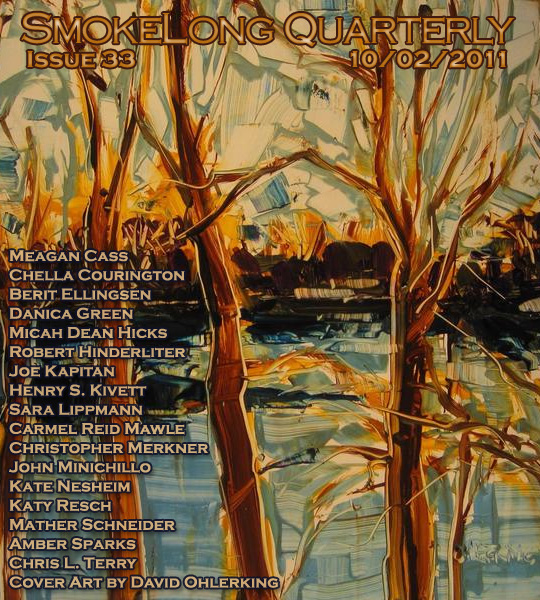
SmokeLong Quarterly
Issue 33 (2011-10-02)

Chris Terry, Writer, Editor, Educator


cover art “Sparta, NJ” by David Ohlerking
 
Art by Myles Karr

Punk is a revelation the first time your skateboarding friend takes you to a show. You’re fifteen in saggy jeans. You watch bands emerge from the audience, lay waste to your eardrums for twenty minutes, then slip back into the crowd to joke with their friends. Anyone could do it and everyone was equal. You knew it was as close as you’d ever get to finding a world of people like you.

You are biracial. In the Boston suburbs, you were a black kid at a white school and everyone urged you to “grow an af-rowww.” Say “af-rowww” in the valley girl voice that trite black comedians use to mimic white folks. Af-rowww. Pause between the syllables to pull your top front teeth from your bottom lip. Af-rowww.

Your hair covers the tops of your ears. You haven’t cut it since you moved, but The Af-rowww People can’t see you in Virginia. You weren’t out to make them happy anyway. Now, you’re a white kid at a black school and your classmates call you Kermit thee Frog because of the way you sound reading.

After that first punk show, the energy of the music and the anger boiling in your apartment combine to ignite a punk bomb inside of you. You try to do something good with the explosion. You somersault out the door, stapling show flyers to telephone poles. Punk is for everyone, even people whose families can’t hold on to their houses, whose parents lecture by saying, “We’re done with you. Don’t expect anything else from us besides a roof and some of this spaghetti.” You try to be indignant and stonefaced, but start crying. You ask why. They pull out a yellow legal pad with a list of your infractions…

Read the entire essay here.

Tags: , ,

Mixed race: Fastest growing demographic in Canada

Posted in Articles, Canada, Health/Medicine/Genetics, Media Archive on 2012-06-25 02:37Z by Steven

Mixed race: Fastest growing demographic in Canada

The Province
Vancouver, British Columbia
2012-06-24

Sam Cooper

…And the hardest in the world to find a match for blood cells; one in millions, literally

Brutal. Intensive. Without hope. Those are words that just don’t translate when you hear the voice of 14-year-old Lourdess Sumners, of Duncan.

She’s a happy teen who liberally sprinkles her speech with giggles and words like, “Gee . . . Woo-hoo! . . . No big whup.”

You’d never know she’s spent half her young life facing death, with survival chances many times lower than other children, because of her diverse genetic makeup.

She was diagnosed with acute myeloid leukemia, an aggressive cancer of the blood and bone marrow, in 2006. She endured eight months of chemotherapy, seemed to beat the fast-growing cancer, but relapsed.

The doctors at Children’s Hospital in Vancouver said her last hope was a life-saving bone marrow transplant.

The medical process is harrowing enough for any child. But with a Filipino and Caucasian background, doctors could not find Lourdess a bone marrow match, after several worldwide searches.

As a child of mixed race—the fastest growing demographic in Canada, and especially B.C.—she is representative of a demographic group that is disadvantaged, in terms of medical blood work…

Read the entire article here.

Tags: , , ,

The overlapping concepts of race and colour in Latin America

Posted in Articles, Caribbean/Latin America, Media Archive, Social Science on 2012-06-22 20:45Z by Steven

The overlapping concepts of race and colour in Latin America

Ethnic and Racial Studies
Volume 35, Issue 7, (July 2012)
pages 1163-1168
DOI: 10.1080/01419870.2012.657209

Edward Telles, Professor of Sociology
Princeton University

I thank Ethnic and Racial Studies for the opportunity to participate in this symposium and I am honoured to be in conversation with Michael Banton. an esteemed contributor to the Sociology of Race (and Colour), with whom I respectfully differ.

Banton argues that ‘U.S. scholars followed the ordinary language trend of using race instead of color’, as W. E. B. DuBois originally had, and that my use of the term ‘race’ erringly uses the experience of North American ‘black white relations as a paradigm case to offer a conceptual framework for the analysis of relations in Brazil.’ Banton objects to my use of race and colour as rough equivalents. For him, colour refers to a ‘first order abstraction’, which describes physical differences that are used in society as markers of social distinction, while race is a ‘second order abstraction’ that is neither visible nor measurable and that varies from place to place, ‘making it more difficult to identify what has to be explained’ (p. 4). Banton (p. 6) seems to find it odd that my book. Race in Another America, should bear the subtitle ”The Significance of Skin Color in Brazil’. But the title of my book simply reflects one of its central findings: that, in Brazil, conceptions of ‘race’ and conceptions of ‘color’ overlap.

Banton is right to separate folk and analytical concepts, but I think he goes about it in the wrong way. Race is clearly a folk concept, and it lacks analytical validity, but his race/colour distinction begs more questions than it resolves. Race and colour are both folk concepts but race and many references to colour are based on the social process of racialization, which classifies people according to race, privileging some while excluding others. Racial and colour inequality and discrimination in Brazil and the USA are rooted in a common western racial ideology, although one that has been interpreted in different ways in both countries. Whereas colour might be seen as merely descriptive, it also elicits a racial ideology where Brazilians are keenly aware of human colour variation, which they often place on a naturalized hierarchy of worth…

Read or purchase the article here.

Tags: , , ,

Using Brazil’s Racial Continuum to Examine the Short-Term Effects of Affirmative Action in Higher Education

Posted in Articles, Brazil, Caribbean/Latin America, Economics, Media Archive, Politics/Public Policy on 2012-06-22 03:05Z by Steven

Using Brazil’s Racial Continuum to Examine the Short-Term Effects of Affirmative Action in Higher Education

The Journal of Human Resources
Volume 47, Number 3 (Summer 2012)
pages 754-784

Andrew M. Francis, Assistant Professor of Economics
Emory University

Maria Tannuri-Pianto, Professor of Economics
University of Brasilia

In 2004, the University of Brasilia established racial quotas. We find that quotas raised the proportion of black students, and that displacing applicants were from lower socioeconomic status families than displaced applicants. The evidence suggests that racial quotas did not reduce the preuniversity effort of applicants or students. Additionally, there may have been modest racial disparities in college academic performance among students in selective departments, though the policy did not impact these. The findings also suggest that racial quotas induced some individuals to misrepresent their racial identity but inspired other individuals, especially the darkest-skinned, to consider themselves black.

…Theoretical research explores the relationship between preferences in admissions and preuniversity investments (Fryer and Loury 2005a; Fryer, Loury, and Yuret 2008; Holzer and Neumark 2000). Changes in admissions standards might relocate some individuals who otherwise would have had little chance of selection to the margin of selection, thereby inspiring effort. Alternatively, changes in admissions standards might relocate some individuals who otherwise would have been at the margin of selection to an intra-marginal position, thus reducing effort. Essentially, these studies maintain that affirmative action has a theoretically ambiguous effect on effort. This is largely an open question empirically. Ferman and Assunção (2005) use data from Brazil to study the issue. They find that black secondary school students who resided in states with a university with racial quotas had lower scores on a proficiency exam, which they argue indicates that racial quotas lowered effort. Nevertheless, Ferman and Assunção (2005) are unable to identify which students applied to college and which did not. The estimates are rather large given that the average black secondary school student would have had only a small chance of admission. Moreover, self-reported racial identity may be correlated with the adoption of quotas making the results challenging to interpret. This paper aims to build on this work by focusing on applicants and students, employing multiple measures of effort, and using both selfreported and non-self-reported race/skin tone.

Second, this paper contributes to the literature on race and skin shade. A number of papers demonstrate the significance of skin tone—beyond the influence of race—in education, employment, and family (Bodenhorn 2006; Goldsmith, Hamilton, and Darity 2006, 2007; Hersch 2006; Rangel 2007). For example, using survey data from the US, Goldsmith, Hamilton, and Darity (2007) find evidence consistent with the notion that the interracial and intraracial wage gap increases as the skin tone of the black worker darkens. Analogously, Hersch (2006) finds evidence that black Americans with lighter skin tone tend to have higher educational attainment than those with darker skin tone. Allowing the possibility that the policy might impact applicants and students of different skin tone in different ways, this paper estimates separate effects by selfreported race/skin tone (branco, pardo, preto) and by skin tone quintile derived from photo ratings.

Lastly, this paper contributes to the literature on identity. A growing body of literature analyzes the construction of identity and the role of identity in behavior (Akerlof and Kranton 2000, 2002; Austen-Smith and Fryer 2005; Darity, Dietrich, and Hamilton 2005; Darity, Mason, and Stewart 2006; Francis 2008; Fryer et al. 2008; Golash-Boza and Darity 2008; Ruebeck, Averett, and Bodenhorn 2009). To explain a wide range of behaviors and outcomes, Akerlof and Kranton (2000) propose a model where utility is a function of identity, the actions taken by the individual, and the actions taken by others. Darity, Mason, and Stewart (2006) develop a game theoretic model to study the relationship between racial identity formation and interracial disparities in outcomes. Exploring the construction of identity empirically, Darity, Dietrich, and Hamilton (2005) report that despite high African-descended population shares in some Latin American countries, Latinos living in the US largely demonstrate a preference for selfidentifying as white and an aversion to self-identifying as black. They emphasize that racial selfidentification involves choice and suggest that future research on race and social outcomes treat race as an endogenous variable. Theories of identity are complex and challenging to test. This paper is one of the few to study the construction of racial identity in the context of a relatively simple policy change. Isolating one dimension of the dynamic forces that shape identity, this paper offers evidence that racial identity may respond to the incentives created by an affirmative action policy…

Read or purchase the article here.

Tags: , , , ,

Terrance Hayes and Natasha Trethewey: Contemporary Black Chroniclers of the Imagined South

Posted in Articles, Literary/Artistic Criticism, Media Archive, United States on 2012-06-19 15:17Z by Steven

Terrance Hayes and Natasha Trethewey: Contemporary Black Chroniclers of the Imagined South

The Southern Literary Journal
Volume 44, Number 2, Spring 2012
pages 122-135
DOI: 10.1353/slj.2012.0009

William M. Ramsey
, Professor of English
Francis Marion University, Florence, South Carolina

“I Don’t Hate the South.”
— book title by Houston Baker, Jr.

“The past is never dead. It’s not even past,” William Faulkner famously wrote in Requiem for a Nun (73). His assumption—that the southern writer is a chronicler accessing the essence of a wholly objective place, transparently “explaining” a history to outsiders who misunderstand it—has been undermined by the theorizing in New Southern Studies. To chronicle the historical South as a special space enacts a social construction positing an ideologically reductive, essentialist regional myth. As Richard Gray argues, the invented South is an “imagined community” as well as a real and given space (xix). Diane Roberts terms it “the South of the mind” (371). Faulkner, conflicted and ghost-haunted by memories of the past, saw himself in the grip of a concrete reality so palpable that it could not be wiped away with time. But multiple communities, genders, and races lived in that past, and they stimulate divergent takes on it. Thus Houston Baker, Jr., borrowing from Faulkner’s Quentin Compson in Absalom, Absalom!, ambivalently titled a recent book I Don’t Hate the South.

Black writers ghost-haunted by the southern past are highly wary of being possessed by the grip of a mythical mystique that marginalized black experience into historical invisibility. They know, as Martyn Bone argues, that the idealized southern geography rested economically on a social geography of slavery and it sequel segregation—realities that were suppressed in definitions of southern. As Bone notes, “this strategic exclusion is a structural and ideological necessity” for Agrarian-derived myth-making (3). For black writers, then, to perform southern chronicling one must enter history as a self-aware, reconfiguring maker of history. Resourcefully imaginative excavations are required to recover materials deeply buried and long suppressed. The result is an ongoing birthing of a multi-vocal history that presupposes the chronicler engages not in neutral reception but in a constructive act. The past is never past, and yet it must be newly conceived.

Two contemporary black chroniclers, Terrance Hayes and Natasha Trethewey, interrogate the nature of the South with highly revealing metaphors of southern space and soil. They diverge from the familiar anxiety that the region is losing distinctiveness and that its culture is coming to an end. Against that fear of dispossession—of being uprooted from one’s communal memory by time and new cultural infusions—they express the need to take possession of the soil, to put roots into it so as to occupy new space instead of a tenuous space apart. Their poetry thus reflects the literary sensibility of black writers born after the civil rights gains of the mid-1960s. Growing up during profound cultural transitions—a social order of change and adaptive adjustments—they came to perceive historical inquiry not as monumentalizing the past into granite fixity but as excavation of pliable materials for revised narratives. Their poems are keen moments of individual consciousness in which the poet feels free to find and reshape the clay sediments of dug-up history.

In this respect they crack a barrier that confronted earlier black writers, namely the problem of occupying what I term “a space apart,” on the margin, where black life was kept out of history. In the post-bellum era, Charles W. Chesnutt’s dialect conjure tales ironically undermined the white nostalgic plantation tradition while tapping into oral black folk traditions. Yet, in adopting the plantation tale convention of a white frame narrator (his publisher Houghton Mifflin not indicating his racial identity due to his request that the work be judged on its merits rather than the author’s social status), Chesnutt subtly marginalized himself. Unfortunately this approach, a tactic of an era of accommodation, enfolded black materials inside the dominant white discourse domain, subtly distancing folk life to a quaint space apart. Zora Neale Hurston’s Their Eyes Were Watching God reflects a new advance born of…

Tags: , , , , ,

Slavery, Race, and Reunion: The NY Times White Washes the Rape of Michelle Obama’s Ancestors (Again)

Posted in Articles, Barack Obama, History, Media Archive, Politics/Public Policy, Slavery, Social Science, United States on 2012-06-18 21:26Z by Steven

Slavery, Race, and Reunion: The NY Times White Washes the Rape of Michelle Obama’s Ancestors (Again)

We Are Respectable Negroes
2012-06-18

Chauncey DeVega

Why would any person honor rapist’s blood?

In an effort to write the Obamas, who are de facto American royalty, back into a larger post-racial narrative that ostensibly makes some white folks feel more comfortable about having a black President, such a move seems par for the course.

In 2009, the NY Times featured a very problematic story about how genealogical researchers had reconstructed Michelle Obama’s family tree. There, the NY Times offered up a story about one of the First Lady’s ancestors who was a child slave and in all likelihood repeatedly raped by her white master. Just as was done in Saturday’s Meet Your Cousin, the First Lady: A Family Story, Long Hidden by Rachel Swarns, the realities of power and exploitation under the chattel regime were conveniently overlooked and (quite literally) white washed away.

Family tree DNA research is in vogue: networks such as PBS and ABC have found it a compelling means to craft a narrative about a shared “American experience.” Given the country’s demographic shifts, and the election of its first black President, there is a coincidence of interests who are deeply invested in furthering a narrative of multicultural America, one where it is imagined that we are all in one way or another related.

In this racial project, the color line is broken in some deeply dishonest ways which do nothing to challenge power, illuminate deeper truths about racial inequality in the United States, overturn white privilege, or challenge the Racial State. For example, Henry Louis Gates Jr. can discover his Irish roots. Tina Turner can find out she is not significantly related to the Cherokees. Latino stars and starlets can find out about their “exciting” Anglo-African-Indigenous roots. Asian Americans can find out about their long history of respect for education, family, and the arts…

..Because the President and First Lady are the symbolic leaders of a country in which black people were historically considered anti-citizens, less than human, property, and not fit for inclusion in the polity, the DNA citizenship project’s goals are robust. The discovery of Michelle Obama’s white ancestors—while no surprise to her family—is a way for white folks to find kinship with her…to “own” her. Ironically, this will do nothing to soothe the anxieties of Michelle Obama’s among reactionary white conservatives—to them she is a black woman who has no business being in the White House except as a chambermaid.

Likewise, President Obama may be “half-white.” Nevertheless, he is the blackest man alive (despite all efforts to distance himself from policies that would uniquely assist African-Americans) for the Tea Party GOP and the racially resentful, reactionary white public. Race is a double bind for the President. Obama’s whiteness is a means to excuse-make for their racism; Obama’s blackness is a means for white bigots to overtly disrespect and diminish him…

In response to the Times’ first foray into these ugly, ahistorical waters, I offered a commentary and rewrite. I would like to pivot off of that intervention again.

Let’s work through a few particularly rich passages in Meet Your Cousin, the First Lady: A Family Story, Long Hidden and offer some correctives and commentary…

…The politics of language are rich here as they advance a multicultural, conservative, colorblind racial agenda that imposes contemporary standards onto the past in an effort to remove the grounds of historical grievance in the present. Melvinia did not give birth to a “biracial” child. She was raped and had a black child who would be considered human property unless freed by his “father.”

The Slaveocracy and America’s racial order was based on the “one-drop rule” where a child’s racial status and freedom was determined by that of the mother. Thus, a white man (and slave owner) could rape, exploit, and do as he wished with black women (and men). The children would be born slaves. The logic of hypodescent was also operative as well. Race is not about the reality of genetic makeup and admixture. Racial identity is about perceptions by the in-group regarding who belongs and who does not.

Despite all of the efforts by the multiracial movement in contemporary America to create a “mixed race” census category—what is really a desire to access white privilege through the creation of a buffer race or colored class—being perceived as “black” or as having “African” ancestry, marks a person as having a connection to that group.

The NY Times is working to frame the story of Michelle’s ancestors, and the child rapist, slave owning white Tribble family, as a human story and drama, one about “ordinary” people…

…The racial project of reading America as a multiracial project historically, in the service of a post-racial fiction about the Age of Obama in the present, is operative throughout the above passage. Rachel Swarns’ allusion to a “multiracial” stew ignores the role of law, practice, social norms, and the State in carefully policing the colorline.

These Americans of “mixed ancestry” were not celebrated. White authorities saw them as a problem to be corrected, “cured,” eliminated, and as a threat to American society. For example, white race scientists labored over what to do about the Whind tribe who were of mixed black, native American, and white ancestry. Strict laws about miscegenation, segregation, schooling, and other areas of racialized civil society, were enforced through violence in order to protect the purity of America’s “white racial stock.”

These racially ambiguous people knew that to “pass” into whiteness was to move up the class and racial hierarchy. This was a common story in the black community, but also extended to Melungeons, the Mississippi Chinese, and others who in acts of racial realpolitik ran away from blackness in order to secure some share of whiteness as a type of property.

Meet Your Cousin, the First Lady: A Family Story, Long Hidden‘s last paragraph is a potpourri of historical flattening and misrepresentation.

Black Americans are a “multiracial” people. This is a byproduct of mass rape and exploitation. White blood has purchased little if any social currency in white society for those blacks able to leverage it. The Irish are an object less in how white ethnics transitioned from some type of racial Other into full whiteness. They were a group that were once considered “black,” but who “earned” whiteness through racial violence against people of color. While a common misunderstanding that yearns for alliances across racial lines among oppressed peoples, the Cherokees, like many other Native American tribes, owned blacks as human property and participated in the slave trade…

Read the entire article here.
Tags: , , , , ,

How Obama became black

Posted in Articles, Barack Obama, Biography, Media Archive, United States on 2012-06-17 23:45Z by Steven

How Obama became black

The Washington Post
2011-06-14

David Maraniss

He was too dark in Indonesia. A hapa child — half and half — in Hawaii. Multicultural in Los Angeles. An “Invisible Man” in New York. And finally, Barack Obama was black on the South Side of Chicago. This journey of racial self-discovery and reinvention is chronicled in David Maraniss’s biography, “Barack Obama: The Story,” to be published June 19. These excerpts trace the young Obama’s arc toward black identity, through his words and experiences, and through the eyes of those who knew him best.

“How come his mother’s skin is bright while her son’s is way darker?”

Everything about Barry seemed different to his classmates and first-grade teacher, Israela Pareira, at S.D. Katolik Santo Fransiskus in Jakarta, Indonesia. He came in wearing shoes and socks, with long pants, a black belt and a white shirt neatly tucked in. The other boys wore short pants above the knee, and they often left their flip-flops or sandals outside the classroom and studied in bare feet. Barry was the only one who could not speak Bahasa Indonesia that first year. Ms. Pareira was the only one who understood his English. He was a fast learner, but in the meantime some boys communicated with him in a sign language they jokingly called “Bahasa tarzan.”…

Read the entire article here.

Tags: , ,

Meet Your Cousin, the First Lady: A Family Story, Long Hidden

Posted in Articles, Biography, History, Media Archive, Slavery, United States, Women on 2012-06-17 15:47Z by Steven

Meet Your Cousin, the First Lady: A Family Story, Long Hidden

The New York Times
2012-06-16

Rachel L. Swarns

This article is adapted from “American Tapestry: The Story of the Black, White and Multiracial Ancestors of Michelle Obama” by Rachel L. Swarns, to be published by Amistad, an imprint of HarperCollins Publishers, on Tuesday.

REX, Ga. — Joan Tribble held tightly to her cane as she ventured into the overgrown cemetery where her people were buried. There lay the pioneers who once populated north Georgia’s rugged frontier, where striving white men planted corn and cotton, fought for the Confederacy and owned slaves.

The settlers interred here were mostly forgotten over the decades as their progeny scattered across the South, embracing unassuming lives. But one line of her family took another path, heading north on a tumultuous, winding journey that ultimately led to the White House.

The white men and women buried here are the forebears of Mrs. Tribble, a retired bookkeeper who delights in her two grandchildren and her Sunday church mornings. They are also ancestors of Michelle Obama, the first lady.

The discovery of this unexpected family tie between the nation’s most prominent black woman and a white, silver-haired grandmother from the Atlanta suburbs underscores the entangled histories and racial intermingling that continue to bind countless American families more than 140 years after the Civil War.

The link was established through more than two years of research into Mrs. Obama’s roots, which included DNA tests of white and black relatives. Like many African-Americans, Mrs. Obama was aware that she had white ancestry, but knew little more.

Now, for the first time, the white forebears who have remained hidden in the first lady’s family tree can be identified. And her blood ties are not only to the dead. She has an entire constellation of white distant cousins who live in Georgia, South Carolina, Alabama, Texas and beyond, who in turn are only now learning of their kinship to her…

…DNA Testing

The discovery comes as an increasing number of Americans, black and white, confront their own family histories, taking advantage of widespread access to DNA testing and online genealogical records. Jennifer L. Hochschild, a professor of African and African-American studies at Harvard who has studied the impact of DNA testing on racial identity, said this was uncharted territory.

“This is a whole new social arena,” Professor Hochschild said. “We don’t have an etiquette for this. We don’t have social norms.”

“More or less every white person knows that slave owners raped slaves,” she continued. “But my great-grandfather? People don’t know what they feel. They don’t know what they’re supposed to feel. I think it’s really hard.”

Read the entire article here.  Watch the video here.

Tags: , , , , , ,

“Passing” and the American dream

Posted in Articles, Literary/Artistic Criticism, Media Archive, Passing, United States on 2012-06-16 02:04Z by Steven

“Passing” and the American dream

Salon Magazine
2003-11-03

Baz Dreisinger

These days we’re supposed to think race doesn’t matter. But as “The Human Stain” and a raft of recent writing makes clear, we’re just as fascinated by its slippery boundaries as ever.

Every now and then, cultural and social critics fashion an axiom that’s flippant, succinct and thus darling enough to render its truth value irrelevant. Such is the case with a phrase coined by culture-mongers in the 1960s that’s finding new currency today: “Passing is passé.”

“Passing” is shorthand for “racial passing,” and “racial passing” means people of one race (generally African-American) passing for another (usually white). Anybody who’s surprised that there’s a shorthand terminology for what might seem a pretty unlikely scenario will be more surprised that the phenomenon, with its lengthy history in American culture, isn’t all that unusual. Some of the earliest stories about passing reach back to the 19th century, when slaves — like Ellen Craft, who penned a mesmerizing slave narrative — used their light skin to escape, and novelists from Mark Twain to Charles Chesnutt mined the subject for their oeuvre.

Passing was a much-hyped subject during the Harlem Renaissance, which produced a plethora of rich fiction about it: Nella Larsen’sPassing,” Jessie Fauset’sPlum Bun,” Walter White’s “Flight.” The subject had its Hollywood heyday; melodramatic passing flicks from the ’30s, ’40s and ’50s include “Pinky,” “Lost Boundaries” and two big-screen versions of “Imitation of Life” (the latter version, directed by Douglas Sirk, probably still delights the Kleenex industry).

But along came the ’60s. And with it, Black Power and other ideologies that made the saga of passing — and the act of passing itself — soppy, weak-kneed and thus unhip. Passing was passé, critics said, because racial pride was where it’s at. Whether prophecy or prescription, their words proved accurate, for a while, at least: The subject never vanished from public or private sectors, but it did step aside for a hot minute or two.

That hot minute is over. Passing, these days, is anything but passé. This week Anthony Hopkins, neither a black man nor a Jew, saunters onto the big screen to play a black man passing as a Jew in the long-awaited screen version of Philip Roth’s “The Human Stain.” Last month, journalist Brooke Kroeger’s collection of case studies, “Passing: When People Can’t Be Who They Are,” earned solid reviews and prompted a National Public Radio program on passing. Brent Staples recently penned a series of New York Times editorials on the subject…

Read the entire article here.

Tags: , ,