Pets, Playmates, Pedagogues (From Chapter Four of Oreo)

Posted in Articles, Books, Chapter, Media Archive, Religion, United States on 2015-07-10 17:30Z by Steven

Pets, Playmates, Pedagogues (From Chapter Four of Oreo)

The Offing: A Los Angeles Review of Books Channel
2015-07-06

Fran Ross

Oreo, Fran Ross’s ground-breaking satire, was originally published in 1974. It is being re-issued this week by New Directions, with an introduction by Danzy Senna and a foreword by Harryette Mullen. Mat Johnson of NPR called it “one of the funniest books I have ever read” and writer Paul Beatty deemed it “hilarious.” We are honored to present an excerpt of this extraordinary novel.

— The Fiction Editors

Christine and Jimmie C.

From the Jewish side of the family Christine inherited kinky hair and dark, thin skin (she was about a 7 on the color scale and touchy). From the black side of her family she inherited sharp features, rhythm, and thin skin (she was touchy). Two years after this book ends, she would be the ideal beauty of legend and folklore — name the nationality, specify the ethnic group. Whatever your legends and folklore bring to mind for beauty of face and form, she would be it, honey. Christine was no ordinary child. She was born with a caul, which her first lusty cries rent in eight. Aside from her precocity at mirror writing, she had her mother’s love of words, their nuance and cadence, their juice and pith, their variety and precision, their rock and wry. When told at an early age that she would one day have to seek out her father to learn the secret of her birth, she said, “I am going to find that motherfucker.” In her view, the last word was merely le mot juste

Read the entire chapter here.

Tags: , ,

What It Really Means To Be Transracial And Black

Posted in Articles, Media Archive, Social Work, United States on 2015-07-09 02:32Z by Steven

What It Really Means To Be Transracial And Black

The Huffington Post
2015-07-08

Zeba Blay


Photo by Luke Ratan

It’s been weeks since the nation became obsessed with — then subsequently forgot about — Rachel Dolezal. In choosing to identify as a black woman, Dolezal introduced the concept of being transethnic or “transracial” into the mainstream. Faulty comparisons to Caitlyn Jenner and the transgender community abounded, and many commentators (including myself) rejected them, arguing that being transracial “is not a thing.”

I’ve since learned that being transracial is a thing — just not in the way Dolezal interpreted it. The first known use of the word dates back to the 1970s. Transracial applies to those adopted by parents of another race. It’s an experience often overlooked, and a vibrant community of transracial speakers, writers, and activists have come forward in the wake of Dolezal to take back ownership of the word and their unique identities.

What have their experiences been, not only in the wake of the scandal, but in their day to day lives? What does it mean to be transracial?

For many transracial adoptees, to reclaim “transracial” is to reclaim themselves…

…Transracial identity, like all identity, can be such a nebulous thing. Some adoptees feel untethered, or as if they’re forced to choose between sides. Many experience an intimate, insider relationship with whiteness and white privilege while simultaneously experiencing racism. Blogger Katakasrainbow described that in-between plainly as the word “transracial” began to trend. “I wasn’t really black due to a lack of present black parents and family, but I could never ever ever really be white either,” she wrote…

Read the entire article here.

Tags: , , ,

It’s official: Latinos now outnumber whites in California

Posted in Articles, Census/Demographics, Latino Studies, Media Archive, United Kingdom on 2015-07-09 02:03Z by Steven

It’s official: Latinos now outnumber whites in California

The Los Angeles Times
2015-07-08

Javier Panzar


Source: The Los Angeles Times

The demographers agreed: At some point in 2014, Latinos would pass whites as the largest ethnic group in California.

Determining when exactly that milestone would occur was more of a tricky question. Counting people isn’t like counting movie ticket receipts.

The official confirmation had to wait until new population figures were released by the Census Bureau this summer. The new tally, released in late June, shows that as of July 1, 2014, about 14.99 million Latinos live in California, edging out the 14.92 million whites in the state.

The shift shouldn’t come as a surprise. State demographers had previously expected the change to occur sometime in 2013, but slow population growth pushed back projections. In January 2014, the state Department of Finance estimated the shift would take place at some point in March.

Either way, the moment has officially arrived…

Read the entire article here.

Tags: , , , ,

The Divine Auditor

Posted in Articles, Autobiography, Media Archive, United States on 2015-07-09 01:51Z by Steven

The Divine Auditor

Prarie Schooner: Stories, Poems, Essays, and Reviews since 1926
Volume 87, Issue 2 (2013 Summer)

Sarah Valentine, Visiting Assistant Professor of English
Northwestern University, Evanston, Illinois

It is still dark when my cell phone begins to buzz. When I flip it open, my mother’s voice comes through a connection often interrupted by the apartment building’s iron girders. We make some awkward small talk and then she says:

“I guess you want to talk about the email you sent me last week.”

“Yes,” I whisper, trying not to wake my boyfriend, Zoran, who is asleep beside me. I glance at the clock and realize it is 6:30 a.m..

“Before I say anything,” she says after a long pause, “tell me if you think we’ve always loved you.”

I begin to tear up at this, and I feel my body grow weak. I know what is coming.

“Of course,” I manage.

She too begins to cry and through sobs tells me a disconnected story about when she was at a spring break house party as a sophomore in college. Someone put something in her drink… She woke up the next day knowing something had happened, someone had taken advantage of her.

“Are you saying . . . you were raped,” I ask, trying to soften my voice as I do so. She cries and does not answer. “Was he . . .” I continue but cannot finish the sentence.

“Yes,” she says. “He was African American.”

“He was black . . .”

“He was,” she says.

“Who was it?” I ask, clambering over Zoran in my underwear, taking the phone into the hallway so as not to wake him.

“I don’t know,” she says. “I don’t remember.”

Now I don’t know what to say. I want to know more, but her crying, her hurt sounds make me afraid to push. I know that I am sounding harsh when I speak again, but I can’t help it. She doesn’t know who it was, but she knows he was black. She knows that. How does she remember that? But I don’t ask her that.

“Why are you only telling me this now?” I say.

“Because you asked. I have to go, I’m going to be late,” she says.

Then she hangs up and goes to her shift at the hospital.

I stand there shivering in the dark. I cannot decide which is more shocking; that I was conceived in rape or that my father is not the man I’ve grown up with, but some black guy my mother went to school with, whose name she does not remember, who may or may not have drugged her. I have so many questions, but it is this that sticks in my head: both of my parents and my two younger brothers are white. After years of suspecting I was not, finally at the age of twenty-seven I gathered the courage to ask my mother about it. And this is how she tells me. I don’t even know if my father knows. I mean the man I have called my father for twenty-eight years. Is this a secret from him, too? Sadness mixes with anger and disbelief. But there is also a sense of resolution; so I’m not a freak of nature. There is a rational explanation for me after all. This is what I tell myself, but none of it is rational. My brain is still trying to make sense of it all…

Read an excerpt of the essay here.

Tags: ,

Q & A with Ana Carolina Vidal + her Afro-Futuristic project

Posted in Articles, Arts, Brazil, Caribbean/Latin America, Identity Development/Psychology, Media Archive on 2015-07-09 01:34Z by Steven

Q & A with Ana Carolina Vidal + her Afro-Futuristic project

Rooted In Magazine
2015-07-08

Annina Chirade


O Mestiço Revisited II, Ana Carolina Vidal

São Paulo native, Ana Carolina Vidal, is a multi-racial Brazilian artist who explores the dynamics of her country through her art. Her work is largely focused on portraiture; each piece in her ongoing Afro-Futuristic project is both an affirmation and reimagining of her identity. Through each subject, she pushes for us to see the ancestors that exist within us. Her gaze is filled with an emotional honesty towards a society still at odds with its past. Ana centres her Indigenous, African and European roots within a larger social framework; the political and personal can’t help but be intertwined in her work.

It’s precisely because of her honesty that one is able to understand the deep love she has for her homeland. In every conversation we’ve had, her knowledge and quest to share the fullness of her country’s many cultures leaves one wanting to know more. She embraces its music, art, film, literature, dance, food and politics with passion. Ana is part of a young generation looking to break down the simplistic images many have of Brazil, and to shape its future. She has even created a Tumblr page, Brasil of Color, to let fellow Brazilians learn and share their histories. So how does her art speak to a society so awash with culture and complexity? I set up an interview to find out.

Annina: What is your background as an artist – do you consider yourself as mostly self-taught?

Ana: When I was a child, my aunt was my first contact with art. She was a painter and inspired me to pursue what I love – even if it took me a lifetime – I should do it! I would bother my parents a lot as a child to put me in a local artisan group; they taught me some handicrafts and how to paint, but I took those classes for a short period. Then when I was very young at school I took extra-curricular painting classes. In my teenage years I stopped painting. I was mainly self-taught, I still feel I need to learn so much. I think it’s interesting to have that academic basis, not only of techniques, but ways of thinking and building your creative process; learning new ways to relate to art that are different from the ways you already do…

…Annina: In your work you give special focus to Afro-Brazilian and Indigenous people, why is that important to you?

Ana: I think it’s important to reaffirm myself to me. Although I have many privileges by being white-passing, my family is so multi-racial. I heard a lot of stories and encountered so many backgrounds which were extremely different. I always had the feeling that most of my family got lost in time; you don’t know the name of someone, you don’t know their story, because many of them were very poor. I always wanted to document them so that they would no longer be forgotten.

We have this myth of ‘Brazilian racial democracy’, but we know our [people of colour] experiences are different and I could always see that growing up. I could see how different my father’s life was from my mother’s; how my mother could get further being a white woman. In my father’s family, I could see the difference between him as a black man and my aunt’s as black women; how they stayed behind for obvious gender and race reasons. Although I am privileged enough to not go through a lot of that, I was still affected in many ways. I still hear comments – they are less offensive – I’m always questioned about my identity…

Read the entire interview here.

Tags: , , ,

Reclaiming Jewish Identity: An Aboriginal People of the Middle East

Posted in Articles, Census/Demographics, Judaism, Media Archive, Religion, United States on 2015-07-07 19:30Z by Steven

Reclaiming Jewish Identity: An Aboriginal People of the Middle East

The Huffington Post
2015-06-07

Binyamin Arazi

Starting this September, after decades of lobbying efforts by Arab-American organizations, the United States Census Bureau will begin testing a new category for Americans of Middle Eastern and North African origin. In conjunction with this new listing, no less than 19 subcategories will be made available, including ‘Israel.’ So where does this leave Jewish Americans? Should diaspora Jews follow the example of their Israeli co-ethnics and mark “Middle Eastern/North African,” or should they take the easy way out and mark “Other” or even “White,” as most Middle Eastern and North African Americans have done up to this point? Should there be a separate “Jewish” category?

These questions are likely to confuse many readers, particularly those who are more inclined to perceive “Jewishness” as a religious identity rather than an ethnic one. Nevertheless, contrary to the widespread belief that we merely constitute a religious faith, the Jewish people are an ethnic group/tribe of Southwest Asian origin, and one of the oldest extant native peoples of the region…

Read the entire article here.

Tags: , ,

Is it ’cause I’m not black?

Posted in Articles, Autobiography, Media Archive, United Kingdom on 2015-07-06 21:00Z by Steven

Is it ’cause I’m not black?

moniquerants: Education Lover. Discoverer of Healthy Eating. Headphone Raver. Opinionated Ranter.
2015-07-06

Monique Bell

Years of mistaken identity and assumed whiteness have understandably left me with a miniature chip on my shoulder, and what better way to deal with that chip than writing to the world about it? In case you were not aware I am mixed race. Yes, half and half, not a quarter, not a distant relative, not ‘a bit of a tan’, not ‘maybe Mediterranean’, not white, not black, but actually mixed race. My mother was born in the United Kingdom and is English, my father was born in the United Kingdom too but my grandmother on my dad’s side traveled over to the UK with my great-grandmother- who we called Mama – from Trinidad to the UK, and prior to that Mama had migrated from Grenada to Trinidad. So I am half Caribbean and half English.

Ethnic identity shapes part of one’s human identity as well as the influence of one’s primary and secondary socialisation. Human identity is also shaped by how you are perceived by others; if everyone told me I was a tomato, I’d likely start believing I was indeed a giant walking talking tomato, a bit like the story of The Emperor’s New Clothes by Hans Christian Anderson. My experience as a child was quite different to that of my peers. I grew up in an affluent predominantly White town in the Home Counties but I grew up in a far from nuclear family. Even though I regularly spent time with my dad, we were one of a few single-parent families in the town and my mum had to receive state support too. My older sister and I are different colours; in case you weren’t aware mixed race people come in a range of beautiful colours! And yes, some of us look white, some of us look black, caramel, toffee, vanilla and everything in between. This blew the shit off the heads of people in my town and even now one of the first assumptions is that we’re half sisters. Ironically, I am actually a closer skin colour to my half brother and sister who are my dads other children…

Read the entire article here.

Tags: , ,

When I Was White

Posted in Articles, Autobiography, Media Archive, United States on 2015-07-06 18:24Z by Steven

When I Was White

The Chronicle Review
The Chronicle of Higher Education
2015-07-06

Sarah Valentine, Visiting Assistant Professor of English
Northwestern University, Evanston, Illinois


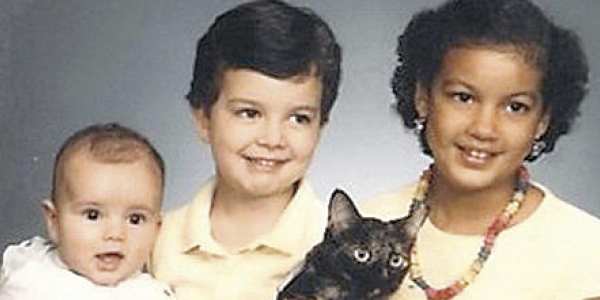
Sarah Valentine as a girl, with her two brothers (Source: Family photo)

Rachel Dolezal’s recent unmasking as a white woman living as black sparked a debate about the legitimacy of “transracial” experience. I cannot speak for Dolezal or anyone else, but I can state for a fact that racial transition is a valid experience, because I have gone through it.

While most people would look at this photo and see a black girl, two white boys, and a very surprised cat, they would be wrong. The girl in the photo is white, just like her brothers. I was raised in a white family from birth and taught to identify as white. For most of my life, I didn’t know that my biological father was black. Whenever I asked as a child about my darker skin, my mother corrected me, saying it was not dark but “olive.” When others asked if I was adopted, my mother ignored them. Eventually everyone, including me, stopped asking.

When, as an adult, I learned the truth of my paternity, I began the difficult process of changing my identity from white to black. The difficulty did not lie in an unwillingness to give up my whiteness. On the contrary, the revelation of my paternity was a relief: It confirmed that I was different from my parents and siblings, something I had felt deeply all my life.

The dilemma I faced was this: If I am mixed race and black, what do I do with the white sense of self I lived with for 27 years, and how does one become black? Is that even possible? Now, you may say that the rest of the world already saw me as black and all I had to do was catch up. True. But “catching up” meant that I had to blow the lid off the Pandora’s box of everything I thought I knew about myself and about race in America…

Read the entire article here.

Tags: , ,

The Caramel Variations

Posted in Articles, Arts, Media Archive, United States on 2015-07-06 12:44Z by Steven

The Caramel Variations

Ballet Review
Spring 2012
pages 18-30

Ian Spencer Bell

I am interested in black and mixed-race dancers, ballerinas in particular, because I see almost none in the major classical companies. Like me, the gay boy who didn’t want to be Prince Siegfied but Odette, they too are “other.” Now, when I am teaching “swan arms” to my students I think of Darci Kistler and Julie Kent. I wish an image of a black ballerina doing swan arms came to mind.

I was fourteen when I met Natalie Wright. She was walking toward me, or dancing, it was hard to tell which. We were in front of Studio One, on the fifth floor of Lincoln Center’s Rose Building, at New York City Ballet’s School of American Ballet. Her arms and legs were so long that when she walked her whole body seemed to make a swinging motion, like a chandelier earring, sparkling, dangling, golden. I fell in love with her immediately. She was everything I wanted to be: an exaggeratedly proportioned ballerina. She was exotic, too–caramel-colored, blond-streaked hair, eyes darker than the chocolate she ate every afternoon.

I’m not sure I knew she was black, or half black, rather. She was one of four black girls I befriended during my three summers at SAB. I recall only five black girls and four black boys during those months. I don’t know why I was drawn to the black girls, other than maybe because my mother, whom everyone in our small Southern town thought was a “communist,” made friends with the few black ladies who worked in our church, loved our nanny like a best friend, and picked up the old black guys in front of the Safeway and drove them wherever they needed to go. Maybe it was because I was a gay boy who, like the black girls, felt more than slightly out-of-place in that straight, white world.

Natalie wasn’t black like anyone I’d ever known. She didn’t wear her hair in tight braids with pink plastic poodle barrettes, like my friend Andrea. She didn’t shout and curse and slap my face and tell me she deserved to be the lead in the school musical, the way Porscha had. And she wasn’t like those timid, overly polite girls who hid in their mother’s skirt during one of those all-churches picnics, where we’d see the Baptists once a year.

At SAB, Natalie didn’t call people out like Nikkia had: “Oh, hell no. Someone tell that white girl to stop staring at me.” And she did not have a name like Aesha. She dressed like the ninety-nine other girls there: short denim shorts, Gap Ts, Keds, Lipsmackers lip gloss, hair tightly slicked back in a bun. In ballet class she was the same, too: black leotard, European pink tights. She looked like another girl I had fallen in love with, Riolama Lorenzo. I thought maybe Natalie was Latina, like Rio. They were both from Miami.

It was Natalie’s third summer at SAB in 1993 when we met. Balanchine’s muse, Suzanne Farrell, had recommended her for a scholarship and had taken her into the school a year early. Natalie had the highest extensions of anyone at SAB, except maybe Maria Kowroski. She could extend her leg to the front, and it would nearly touch her nose. To the side it tickled her ear. And when she lifted her leg to the back in arabesque, teachers occasionally looked concerned or told her to bring her leg down…

…I told Natalie I’d call her back. I was thinking of Misty Copeland, the only black female soloist in American Ballet Theatre. Misty is black like Natalie is black: caramel or mocha or dark cream, depending on the makeup and lighting. I see her as I saw Natalie: an extraordinarily attractive dancer with legs and feet so perfectly pretty for ballet that her racial ambiguity is secondary to her identity as a dancer. Misty is one of two black women in the company and one of three black women to have ever been a soloist in ABT. There has never been a black female principal dancer in ABT.

The first time I saw Misty dance was in ABT’s Studio Company. I watched her perform the wedding pas de deux from The Sleeping Beauty. Princess Aurora is one of the big three–along with the leads in Swan Lake and The Nutcracker–for a classical ballerina, designed to show off your technique and style. Copeland was exquisite. She was in control of the slightest details: the tilt of her head, the shape of her hands, the height of her legs. But in the decade she has danced for ABT, I have rarely seen her perform these classical roles. I see her onstage in contemporary work mostly. I wondered if it had anything to do with the color of her skin.

I met Misty in the lounge at the Mandarin Oriental Hotel, uptown near Lincoln Center. She had just come from a late afternoon rehearsal at the Metropolitan Opera House. She strolled in wearing black leggings and tall shoes and a chain necklace and hoop earrings. She was glamorous, sexy too, ready to work an MTV red carpet. But her soft manner and thoughtful gaze dispelled any notions of her as a strident starlet.

Up close, Misty has all the attributes of a classical ballerina: delicate hands, gentle countenance, warm and sweet and friendly. When she sat, she sat like Giselle on that little wooden bench in the first act of that “white ballet,” so called because of all those long white girls in long white tutus.

I had arrived early and was having tea and thinking about the opening of Nella Larsen’s 1929 novella, Passing. Irene Redfield is seated at a table in a fancy Chicago hotel restaurant observing her color rise as a woman stares at her. Irene wonders, “Did that woman, could that woman, somehow know that here before her very eyes on the roof of the Drayton sat a Negro?”

Thinking of Misty, I was wondering if passing for white or Latina has helped the twenty-eight-year-old achieve success in our “national ballet company.” I asked her if she had ever read the Larsen book. She said she hadn’t. She had been reading Brainwashed: Challenging the Myth of Black Inferiority, by Tom Burell.

Bell: How do you identify yourself?

Copeland: My mom told me I was black. I filled out paperwork at school that said I was black. Those were the boxes I checked. Misty laughed. She laughs a lot. But she’s serious when discussing race. Both of Misty’s parents were mixed race. Sylvia DelaCerna, Misty’s mother, was Italian and black, adopted and brought up by a black woman and her black husband in Kansas City, Missouri. DelaCerna’s adoptive mother worked for child services. DelaCerna grew up to be a professional cheerleader for the Kansas City Chiefs. Misty’s father split for Chicago when Misty was a child and left her mom with six kids.

Copeland: My mother was my role model. Growing up I felt close to Mariah Carey because she is a mixed-race woman. I’d dance to Mariah – lyrical, flowy movements – and I’d choreograph on friends.

Misty’s mother choreographed on her for talent shows. But Misty didn’t pursue dance training until she was thirteen. They were living in California, and at DelaCerna’s urging, Misty auditioned for the San Pedro Middle School drill team. Misty choreographed a routine to George Michael’sI Want Your Sex.” She became the team captain: “If I’m going to do this, I’m going to be captain.”…

Read the entire article here or here.
Tags: , , , , , , ,

5 black Chicagoans who passed for white

Posted in Articles, Biography, Media Archive, Passing, United States on 2015-07-06 01:59Z by Steven

5 black Chicagoans who passed for white

The Chicago Sun-Times
2015-06-16

Kim Janssen, Staff Reporter

A baseball player who broke baseball’s color line decades before Jackie Robinson was born.

A pioneering politician who has a West Side school named after him.

An Emmy-winning “blonde bombshell.”

A poet at the heart of the Harlem Renaissance.

And a brilliant novelist who wrote a noted novel on “passing.”

Unlike Rachel Dolezal — the white Spokane, Washington, NAACP head who has become the U.S.’s biggest viral news story after she was exposed for lying about her past to pose as a black woman — all five of these sometime Chicagoans were black. But just like Dolezal, they spent at least part of their lives pretending to be something they weren’t, historians now suspect.

Baseball player William Edward White, politician Oscar DePriest, bandleader Ina Ray Hutton, poet Jean Toomer and writer Nella Larsen all at times passed as white, it’s believed.

It’s part of the history that makes Dolezal’s masquerade so fascinating to many Americans: for centuries, African-Americans were far more likely to attempt to pass as white than the reverse. Writing in “Opportunity: The Journal of Negro Life” in 1927, one of Dolezal’s predecessors at the NAACP, William Pickens, vividly described how both the violent threat of racism and the lure of white privilege exacted a powerful pull toward passing for black Americans who were able:

“If passing for white will get a fellow better accommodations on the train, better seats in the theatre, immunity from insults in public places, and may even save his life from a mob, only idiots would fail to seize the advantage of passing, at least occasionally if not permanently.”

Passing, which had mostly died out by the latter part of the 20th century, also came with a series of heavy costs: families broken by one relative’s denial of their ties to another; the constant fear of exposure; and the psychological damage of denying one’s true identity. But for these five Chicagoans, it may have been a compromise they felt forced to make…

Read the entire article here.

Tags: , , , , , , ,