The Unperformative President

Posted in Articles, Barack Obama, Media Archive, Politics/Public Policy, United States on 2015-07-13 20:31Z by Steven

The Unperformative President

TDR: The Drama Review
Volume 59, Number 2, Summer 2015 (T226)
pages 7-8

Richard Schechner, University Professor; Professor, Performance Studies
New York University

Who is President Barack Obama? What will his legacy be? Why is he so unpopular that his own Democratic Party shunned him during the 2014 elections? The Dems got whupped in those elections, losing the Senate, falling further behind in the House and in governorships. Paradoxically, the defeat roused Obama to action. Even before the elections, Obama — sensing that he could not depend on a flaccid Senate and a toxic House — governed increasingly by executive order rather than legislation. The trend is accelerating. By means of executive order, Obama is reforming immigration policy, raising the minimum wage for Federal contract workers, extending rights to same-sex couples, giving paid parental leave to Federal employees, making it harder to buy guns, instituting major new limitations on greenhouse gas emissions, as well as signing a long-term agreement on climate control with China.

And of course the big turn around, one that will have reverberations for years to come: normalizing relations with Cuba.

Add to this, Obamacare (if it is not trashed by the Supreme Court). And don’t forget the stinks of the Bush years that Obama at least partly cleaned up: atrocities, dead-end wars, and economic collapse. Obama has not done enough, granted, but by comparison the nation is much better off now than in 2008.

If even a substantial part of what I’ve just written is true, why does the Obama presidency feel inadequate, to say the least? Why do so many on the Left disparage him while those on the Right despise him? A big part of the answer is the endemic racism of American culture. I won’t analyze this here except to note that Obama embodies a gap that he cannot transcend: African father, Euro-American mother; “black” Chicago street activist, “white” Harvard Law School graduate; country club golfer, ’hood high-fiver. Somewhere deep down Obama knows he isn’t having it both ways, or either way, so he has “chosen” (in quotation marks because I do not think it’s a conscious choice) to have it no way. He really wants his actions to speak for, of, and about him. He does not, or maybe cannot, perform himself as President.

He can’t be General Washington crossing the Delaware, pious Biblical Lincoln bringing his grief to Gettysburg, Rough-Rider Teddy Roosevelt leading the charge, patrician FDR having a “fireside chat” with 125 million Americans, camera-savvy Reagan ordering Mikhail Gorbachev to tear down the Berlin Wall, or beer buddy Dubya Bush landing on the flight deck of aircraft carrier Abraham Lincoln decorated with a banner boasting, “Mission Accomplished.” Obama’s public image is of a man who dislikes putting on a show. He’s not larger than life, holier than thou, or one of the folks.

Obama is the Unperformative President.

Which is both his greatness and his undoing.

Nowhere was Obama’s unperformativity more (in)visible than on 11 January 2015 when in Paris 40 world leaders led more than one million people marching for “free speech” and against the murder of 12 people at Charlie Hebdo, an officer directing traffic, and four hostages at a Paris kosher grocery. The front row — carefully staged for media — featured French President François Hollande, German Chancellor Angela Merkel, UK Prime Minister David Cameron, and — on either end of the line — Palestinian Authority Chairman Mahmoud Abbas and Israeli Prime Minister Benjamin Netanyahu. Obama and Vladimir Putin of Russia were conspicuously absent. Putin’s absence is explained by Russia’s behavior in the Ukraine and Putin’s former position with the KGB, the Soviet secret police. What was Obama’s excuse?

Clearly, he does not like to perform, if by perform one means playing the symbolic role assigned to him. Indeed, the US presidency has from its inception been a Great Figure in Jean Genet’s sense: in The Balcony the Great Figure is a necessary public performer representing one of the four quadrants of society: Queen, Police Chief, Judge, Bishop. Of course, other presidents have not wanted to play and some could not perform effectively. History also has its say. Crises have provided presidents with their best chances at performing well.

Obama took office at…
Tags: ,

Imperfect Unions: Staging Miscegenation in U.S. Drama and Fiction by Diana Rebekkah Paulin (review)

Posted in Articles, Book/Video Reviews, Literary/Artistic Criticism, Media Archive, United States on 2015-07-13 20:00Z by Steven

Imperfect Unions: Staging Miscegenation in U.S. Drama and Fiction by Diana Rebekkah Paulin (review) [Black]

TDR: The Drama Review
Volume 59, Number 2, Summer 2015 (T226)
pages 178-180

Alex W. Black
Rutgers, The State University of New Jersey

Imperfect Unions: Staging Miscegenation in U.S. Drama and Fiction. Diana Rebekkah Paulin. Minneapolis: University of Minnesota Press, 2012. 336 pages.

Imperfect Unions is Diana Rebekkah Paulin’s award-winning study of “the symbolic and material implications of interracial unions” in the United States from the Civil War to World War I (3). During this period, interracial sex was often “the black-white headliner that overwrote stories featuring other intersecting relationships,” including those of gender and class (xvi). For example: In her 1892 pamphlet Southern Horrors, Ida B. Wells demonstrated that black men were lynched in the postbellum South not because they were a sexual threat to white women, but because they were an economic threat to white men. Paulin calls the process through which miscegenation came to stand in for such conflict “demographic distillation” for the way it “elided other types of power relations” (x, xiii). Interpreting drama and fiction to investigate “the contours of the color line,” Paulin argues that “the black-white encounter overshadows the complex” identities of, and relations between, all Americans, regardless of their race or ethnicity (xi, ix).

Paulin’s “miscegenated reading practices” draw on performance studies and literary history to examine formally hybrid productions like Thomas Dixon’s play The Clansman, which he adapted from his own novel, and Pauline Hopkins’s Winona, which she began as a play but rewrote as a novel (xiii). If the name Paulin gives to her method is provocative (one may argue how parallel the lines of color and of scholarship are), the method itself is productive. Her approach is consistent with the objects of study, which often make their arguments in theatrical terms — many are filled with spectacular enactments of identity — and with their creators, who worked in multiple media. More than viewing performance as a metaphor, these writers saw their texts as “mediating between the imagined world and the realities of everyday experience” (3): Louisa May Alcott based “M.L.” on the well-known case of a black male professor eloping with a white female student (30); Charles Chesnutt sent a copy of The Marrow of Tradition to Congress (104); James Weldon Johnson wrote The Autobiography of an Ex-Colored Man while serving as an American consul to Venezuela and Nicaragua (206).

In the first chapter, “Under the Covers of Forbidden Desire: Interracial Unions as Surrogates,” Paulin shows that miscegenation was viewed as a threat to the family and the nation it represented. In the Civil War era, America was figured as a divided house and as a mixed race. The title character of Dion Boucicault’s 1859 play The Octoroon embodies and inspires transgression: the other characters respond to her resistance to classification by revolting against their own classes — and races and genders (13, 10). Both of Alcott’s 1863 short stories, “M.L.” and “My Contraband,” feature white women who desire mixed-race men and their own liberation from patriarchal society (32, 44).

In the book’s second chapter, “Clear Definitions for an Anxious World: Late Nineteenth-Century Surrogacy,” Paulin describes how Americans dramatized national issues on an international stage. In the period between Reconstruction and Plessy v. Ferguson, they imagined Europe as a place where miscegenation originated or where it could settle and be resolved. The ambiguous racial status of the heroines of Bartley Campbell’s 1882 play The White Slave and William Dean Howells’s 1892 novel An Imperative Duty are resolved through marriage. In the former, a man declares his granddaughter (fathered by a foreigner and born abroad) to be his slave’s daughter to hide her illegitimate birth; her whiteness and their property are redeemed when she marries her grandfather’s adopted son (70–71). In the latter, a woman who learns that her mother was an octoroon chooses marriage to a white man and emigration to Europe over the cause of black uplift (87).

In chapter 3, “Staging the Unspoken Terror,” Paulin finds that Americans at the turn of the century connected the future of the nation’s government to the issue of miscegenation (102). This is the first chapter to present texts by a black writer and a white writer who take opposing positions, even if they foresee the same outcome: In Chesnutt’s The Marrow of Tradition, a white woman is killed (and rumored to have been…

Read or purchase the review here.

Tags: , , , ,

“Canadian-First”: Mixed Race Self-Identification and Canadian Belonging

Posted in Articles, Canada, Identity Development/Psychology, Media Archive, Social Science on 2015-07-13 19:26Z by Steven

“Canadian-First”: Mixed Race Self-Identification and Canadian Belonging

Canadian Ethnic Studies
Volume 47, Number 2, 2015
pages 21-44
DOI: 10.1353/ces.2015.0017

Jillian Paragg
Department of Sociology
University of Alberta

Not being read or identified by others as “Canadian” was a common thread in semi-structured in-depth interviews I conducted with 19 young adults of mixed race in a Western Canadian urban context. In this paper, I address moments of (in)ability for people of mixed race to claim “Canadian.” Mixed race people have a complex relationship with identifying and narrating their identities as “Canadian” through the operation of race and ethnicity in the Canadian context, and because of ambivalent and contradictory readings of their bodies. I found that they deploy the term in three ways: by expressing a sense of being “Canadian-first,” by stating that there exists an understanding that “Canadian means white,” and by strategically using the term “Canadian” in their interactions with others, signaling an active appropriation of the term. However, none of these deployments are mutually exclusive: they overlap and bleed into each other, playing off and impacting one another. This paper adds to nascent Canadian Critical Mixed Race studies and also redresses a gap in the literature on “Canadian identity” by examining how the ability to claim “Canadian” is racialized through a consideration of the experiences of mixed race people.

Le fait de ne pas être lus ou identifiés par d’autres comme “Canadiens” était le dénominateur commun dans les entrevues semi-structurés que j’ai menées en profondeur avec 19 jeunes adultes de races mixtes dans un contexte urbain de l’Ouest Canadien. Dans cet article, je mets en exergue les moments d’ (in)aptitude des personnes de races mixtes de se réclamer “Canadiens”. Les gens de races mixtes ont une relation complexe avec l’identification et la narration de leurs identités en tant que “Canadiens”, à cause des perceptions ambivalentes et contradictoires de leurs corps. J’ai trouvé que ceux-ci déploient leur terme de trois façons: en exprimant le sens d’être “Canadien en premier”, en affirmant qu’il existe une compréhension du “Canadien qui veut dire Blanc” et en usant stratégiquement du terme “Canadien” dans leur interactions avec les autres, signalant une appropriation active du ce terme. Cependant, aucuns de ces déploiements ne s’excluent mutuellement: ils se chevauchent et s’empiètent entre eux, jouant au large et s’impactant l’un de l’autre. Ce papier s’ajoute aux études critiques canadiennes naissantes sur les races mixtes et répare aussi une lacune dans la littérature des “identités canadiennes”, en examinant comment l’aptitude de se réclamer “Canadien” est radicalisée à travers une considération des expériences des personnes de races mixtes.

Read or purchase the article here.

Tags: ,

Mexico’s hidden people

Posted in Anthropology, Articles, Caribbean/Latin America, History, Media Archive, Mexico on 2015-07-13 14:40Z by Steven

Mexico’s hidden people

Cable News Network (CNN)
2015-07-10

Abby Reimer, Special to CNN


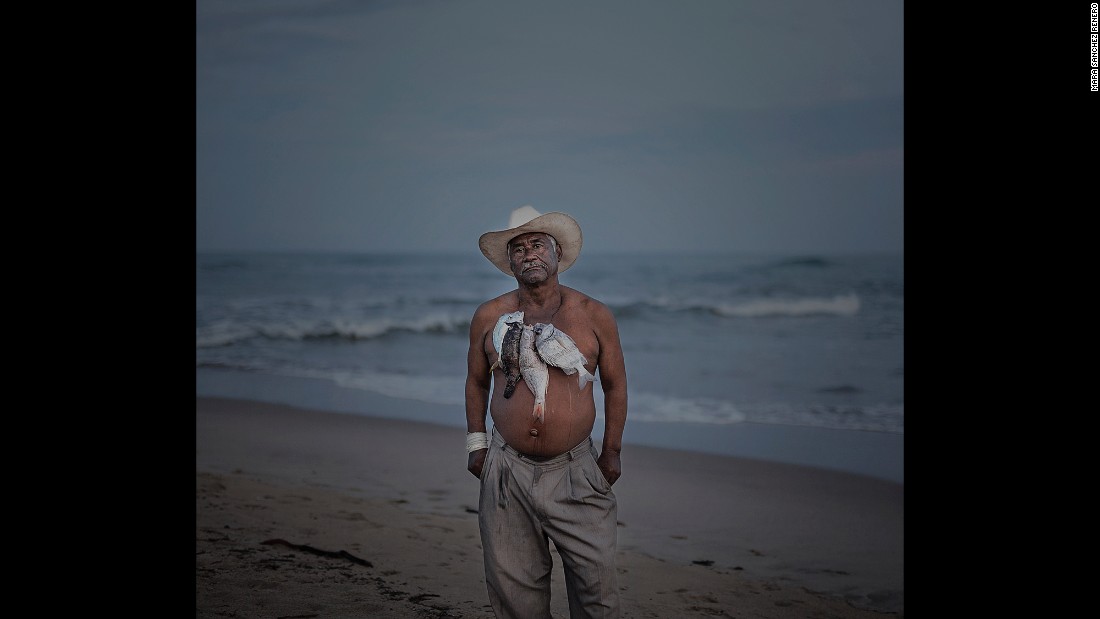
Photograph: Mara Sanchez Renero

(CNN)—An estimated 200,000 Africans were brought to Mexico under slavery, which ended in the country in 1829. Yet Afro-Mexicans remain a marginalized and often forgotten part of Mexico’s identity.

Photographer Mara Sanchez Renero first learned about Afro-Mexicans as a teenager, when she traveled to the Costa Chica region in southern Mexico. The black community there told her they were descendants of Africans shipwrecked off the Pacific coast in 1900.

But it wasn’t until she traveled back last year that she realized what little she knew. There, traditions and customs rooted in Africa — such as “La Danza del Diablos,” or the dance of the devils — have survived.

“I didn’t know there was that much African culture in Mexico,” Sanchez Renero said. “They didn’t teach me that in school.”

Sanchez Renero dug deeper into Afro-Mexican history and culture, ultimately deciding to tell the story of Afro-Mexicans through a series of photographs called “The Cimarron and Fandango.”…

Read the entire article and view the photographs here.

Tags: , , , , , ,

A Bias More Than Skin Deep

Posted in Articles, Census/Demographics, Media Archive, Social Science, United States on 2015-07-13 14:20Z by Steven

A Bias More Than Skin Deep

The New York Times
2015-07-13

Charles M. Blow

I will never forget the October 2013 feature on National Geographic’s website:

There was a pair of portraits of olive-skinned, ruby-lipped boys, one with a mane of curly black hair, the other with the tendrils of blond curls falling into his face.

The portraits rested above the headline: “The Changing Face of America: We’ve become a country where race is no longer so black or white.” It was about the explosion of interracial marriage in America and how it is likely to impact both our concept of race and the physical appearances of Americans.

As the Pew Research Center pointed out in a 2012 report: “About 15 percent of all new marriages in the United States in 2010 were between spouses of a different race or ethnicity from one another, more than double the share in 1980 (6.7 percent).”

People often think of the browning of America as a factor of immigration or racial/ethnic variances in birth rates, but it must also be considered this way: as a function of interracial coupling and racial identifications.

This freedom and fluidity is, on one level, a beautiful sign of societal progress toward less racial rigidity. But, at the same time, I am left with a nagging question: does this browning represent an overcoming, on some level, of anti-black racism, or a socio-evolutionary sidestepping of it?…

Read the entire article here.

Tags: , , ,

Dolezal and the Defense of the Community

Posted in Articles, Media Archive, Passing, United States on 2015-07-13 01:40Z by Steven

Dolezal and the Defense of the Community

Public Seminar
2015-07-09

Richard Kaplan

Reflections on the unique difficulties of passing from white to black in America

It strikes me that an incredible amount of media attention and denunciation has focused on a poor, perhaps deluded woman in Spokane, Washington. Rachel Dolezal’s crime was to lie and try and pass as black. While the media have seen fit to celebrate Caitlyn Jenner and her exceedingly forthright bursting of the boundaries dividing male from female, in the Dolezal case, commentators seem intent on reinforcing the walls dividing black from white, creating an effective DMZ one cannot pass. Perhaps Dolezal failed to pay the adequate dues and penance in trespassing the racial boundaries — unlike Jenner she didn’t lay under the bright lights of the surgery chamber and submit to the cuts of the surgeon’s scalpel nor withstand the prolonged glare of prior media dissection.

Nevertheless, it’s remarkable how much media commentary seems to revolve around reinforcing the racial boundary. All the more strange since every commentator at the same time is obliged to note that race has no biological underpinnings but is culturally constructed, as evidenced by the uniquely American rule of racial classification of “one drop.” Unlike the seemingly more biologically based binary of gender, indeed, we should recognize that America’s bizarre rule, where even slightest trace of “African” blood confines you in the black camp, is what allowed the very white Dolezal to pass as a very light-skinned black…

Read the entire article here.

Tags: , , ,

Who am I? Who do you think I am? Stability of racial/ethnic self-identification among youth in foster care and concordance with agency categorization

Posted in Articles, Identity Development/Psychology, Media Archive, Social Work, United States on 2015-07-12 01:29Z by Steven

Who am I? Who do you think I am? Stability of racial/ethnic self-identification among youth in foster care and concordance with agency categorization

Children and Youth Services Review
Volume 56, September 2015
pages 61–67
DOI: 10.1016/j.childyouth.2015.06.011

Jessica Schmidt
Regional Research Institute for Human Services
Portland State University, Portland, Oregon

Shanti Dubey
Regional Research Institute for Human Services
Portland State University, Portland, Oregon

Larry Dalton
Oregon Department of Human Services, Children, Adults and Families, Portland, Oregon

May Nelson
Portland Public Schools, Portland, Oregon

Junghee Lee
Regional Research Institute for Human Services
Portland State University, Portland, Oregon

Molly Oberweiser Kennedy
Regional Research Institute for Human Services
Portland State University, Portland, Oregon

Connie Kim-Gervey
Regional Research Institute for Human Services
Portland State University, Portland, Oregon

Laurie Powers
Regional Research Institute for Human Services
Portland State University, Portland, Oregon

Sarah Geenen
Regional Research Institute for Human Services
Portland State University, Portland, Oregon

Highlights

  • Examined stability of racial/ethnic self-identification among adolescents in foster care
  • Compared youth self-report with agency categorizations of race/ethnicity
  • Found especially high rates of agency-youth discordance for certain groups of youth
  • Child welfare system more likely to classify youth as White compared to school and youth themselves

While it has been well documented that racial and ethnic disparities exist for children of color in child welfare, the accuracy of the race and ethnicity information collected by agencies has not been examined, nor has the concordance of this information with youth self-report. This article addresses a major gap in the literature by examining 1) the racial and ethnic self-identification of youth in foster care, and the rate of agreement with child welfare and school categorizations; 2) the level of concordance between different agencies (school and child welfare); and 3) the stability of racial and ethnic self-identification among youth in foster care over time. Results reveal that almost 1 in 5 youth change their racial identification over a one-year period, high rates of discordance exist between the youth self-report of Native American, Hispanic and multiracial youth and how agencies categorize them, and a greater tendency for the child welfare system to classify a youth as White, as compared to school and youth themselves. Information from the study could be used to guide agencies towards a more youth-centered and flexible approach in regard to identifying, reporting and affirming youth’s evolving racial and ethnic identity.

Read the entire article here.

Tags: , , , , , , , , , ,

‘Mestizo’ and ‘mulatto’: Mixed-race identities among U.S. Hispanics

Posted in Articles, Census/Demographics, Latino Studies, Media Archive, United States on 2015-07-11 20:50Z by Steven

‘Mestizo’ and ‘mulatto’: Mixed-race identities among U.S. Hispanics

Pew Research Center
2015-07-10

Ana Gonzalez-Barrera, Research Associate

For many Americans, the term “mixed race” brings to mind a biracial experience of having one parent black and another white, or perhaps one white and the other Asian.

But for many U.S. Latinos, mixed-race identity takes on a different meaning – one that is tied to Latin America’s colonial history and commonly includes having a white and indigenous, or “mestizo,” background somewhere in their ancestry.

When asked if they identify as “mestizo,” “mulatto” or some other mixed-race combination, one-third of U.S. Hispanics say they do, according to a 2014 Pew Research Center survey of Hispanic adults

Read the entire article here.

Tags: ,

From ‘blood quantum’ to multiracial bill of rights, Dolezal saga ignites talk of identity

Posted in Articles, Identity Development/Psychology, Media Archive, Passing, United States on 2015-07-10 20:49Z by Steven

From ‘blood quantum’ to multiracial bill of rights, Dolezal saga ignites talk of identity

The Seattle Times
2015-06-17

Nina Shapiro, Seattle Times staff reporter

The endless fascination with the Rachel Dolezal story reveals our hunger to talk about racial identity in all its complexity.

When Amanda Erekson was in her early 20s, a friend introduced her to a Japanese-American woman at a party. “Amanda is Japanese-American, too!” her friend enthused.

“The person was shocked,” Erekson recalls. “I know white people who look more Japanese than you,” the woman said.

The comment stung. Erekson, who is multiracial, identifies strongly with her Japanese-American heritage, although her appearance leads most people to assume she is simply white.

This kind of skeptical reaction is one reason the 33-year-old New Yorker, president of MAVIN, an organization devoted to the multiracial experience, bemoans the international media sensation that is Rachel Dolezal. Because of the former Spokane NAACP president, who resigned from her post Monday after her parents said she had been posing as black, Erekson says “it will be that much harder” for people like her…

…Race — or more specifically racial identity — has been Topic A in the national conversation over the past week. And it is one of the most nuanced and interesting conversations we’ve ever had.

People obviously have a deep need to talk about the subject, and to talk about it in complex ways, says New Jersey filmmaker Lacey Schwartz. She saw that same need in the outpouring of personal stories sparked by the making of her recent film “Little White Lie,” a documentary about growing up in a Jewish family and discovering in college that her biological father is African American…

To some extent, the current conversation involves picking apart details of the Dolezal saga, which seems to get stranger by the day.

Witness Dolezal’s assertion Tuesday, despite a birth certificate produced by Lawrence and Ruthanne Dolezal, that there’s no proof that the couple are her biological parents. She evinced a similar squishiness on NBC’s “Today” show earlier in the day when she said that she “identified” as black.

Whatever story she has that prompts such a statement, she’s not “owning it’ by honestly talking about it, Schwartz says. The filmmaker also objects to Dolezal’s declaration on “Today” that she needed to present herself as black because otherwise it wouldn’t be “plausible” to assume guardianship, as she did, of one of her adopted African-American brothers.

“That is a real diss,” Schwartz says. “My mother is white. I know lots of white people raising children of color.”

Yet, Camille Gear Rich, a professor of law and sociology at the University of Southern California, points out that parents who look different from their children often face incredulous questions. That intrusiveness might have pushed her into “going too far” by lying about her race, Rich says…

…Backlash

Yet this insistence on racial labeling faces a backlash.

MAVIN arose in 1998 in response to a growing desire by multiracial people to identify themselves in ways that might differ from how they are perceived. The group looks to a landmark “bill of rights for people of mixed heritage” produced by Seattle psychologist Maria P.P. Root.

Some key passages: “I have the right … To identify myself differently than strangers expect me to identify. To identify myself differently than how my parents identify me. To identify myself differently than my brothers and sisters. To identify myself differently in different situations.” Also: “I have the right … To change my identity over my lifetime — and more than once.”…

Read the entire article here.

Tags: , , , , , , , , ,

Maybe White People Really Don’t See Race — Maybe That’s The Problem

Posted in Articles, Media Archive, Social Science, United States on 2015-07-10 19:04Z by Steven

Maybe White People Really Don’t See Race — Maybe That’s The Problem

Scenarios USA
2015-07-08

Ijeoma Oluo
Seattle, Washington

It started with a simple question: “When is the first time you became aware of your race?” But as answers from friends, acquaintances, and complete strangers started to roll in, the question came to represent more of a challenge about what I thought I knew about race relations today.

The idea started with the Rachel Dolezal fiasco. Like many people of color, I was completely baffled by the fervent defense many white people gave — people who had made it very clear that they didn’t want to be black were now arguing for the white Rachel Dolezal’s right to be black. “Race is just a construct,” they argued, “if you’re really anti-racist, you’ll recognize that people can be any race they want to be.”

Had the world gone mad? If people could really be “any race they wanted to be” there wouldn’t have been an NAACP for Rachel Dolezal to scam in the first place. I am, as are many of my friends, acutely aware of how definitive and unrelenting my blackness is. I tried to imagine any scenario where I could stop being black and even factoring for Halloween, I came up with nothing…

…As a Black woman myself, I used to always laugh at white people who claim to “not see color” as I imagined them running red lights and walking around in hilariously mismatched clothes; it’s impossible to be able to see the color of your shirt and not the color of someone’s skin. What I’ve begun to suspect after this survey is that when people say “I don’t see color” what they mean is “I don’t see race” – or, at least, they don’t see it accurately. My race as a Black woman doesn’t exist in a vacuum, it exists in relationship to and interaction with whiteness. Like so many POC, I know whiteness as a race – I know it from our media, our holidays, our government and our police. Whiteness is the measurement of success, the goal we’ll never obtain. Every day we have to be aware of whiteness. It is a matter of survival. For us, there is no place in the Western world where it can be escaped…

Read the entire article here.

Tags: ,