Q&A “Blaxicans of L.A.”: capturing two cultures in one

Posted in Anthropology, Articles, Arts, Latino Studies, Media Archive, United States on 2015-07-23 02:34Z by Steven

Q&A “Blaxicans of L.A.”: capturing two cultures in one

The Los Angeles Times
2015-07-21

Ebony Bailey

When race in this country is often discussed in black and white, where do those who don’t quite fit the dime fall?.

Walter Thompson-Hernandez, a researcher with the Center for the Study of Immigrant Integration at USC, is attempting to answer that question with the help of his full-frame Nikon camera.

Two years ago, he began a research project on “Blaxican” identity, interviewing individuals of African American and Mexican descent like himself. He thought it was important to share his research with audiences outside academia, so he started a project on Instagram called Blaxicans of L.A., capturing portraits of Blaxicans and their families…

Read the entire article here.

Tags: , , , , , , ,

First African-American woman novelist revisited

Posted in Articles, Autobiography, Biography, Media Archive, United States, Women on 2015-07-23 02:24Z by Steven

First African-American woman novelist revisited

Harvard University Gazette
Cambridge, Massachusetts
2005-03-24

Ken Gewertz, Harvard News Office

Harriet Wilson was a survivor. Now we have proof.

Wilson wrote “Our Nig; or Sketches From the Life of A Free Black,” the earliest known novel by an African-American woman. It tells the story of Frado, a young biracial girl born in freedom in New Hampshire who becomes an indentured servant to a tyrannical and abusive white woman. In 1859, when the book was published, the abolitionist movement had created a vogue among Northern readers for autobiographies of escaped slaves, but Wilson’s story of a free black abused by her Northern employer did not fit the established mold, and the novel soon fell into obscurity.

Henry Louis Gates Jr., the W.E.B. Du Bois Professor of the Humanities, found a copy of the novel in a used bookstore in the early 1980s and was intrigued by it. Among those specialists who were aware of the book, many doubted whether it was really the work of a black writer, but Gates wondered why anyone in 1859 would identify herself as black unless she were.

He started searching for evidence of Wilson’s existence and eventually succeeded in documenting her life up to 1863. The facts he uncovered closely resembled the events in the life of the novel’s protagonist. Gates, who published his findings in a 1983 edition of the novel, concluded that Wilson must have died around the time the historical trail went cold.

Now evidence has surfaced showing that Wilson survived almost another 40 years, demonstrating in other areas of endeavor the resilience and creativity that allowed her to try her hand at writing.

P. Gabrielle Foreman, associate professor of English and American Studies at Occidental College in California, and Reginald Pitts, a historical researcher and genealogical consultant, spoke Friday (March 18) about information they have uncovered about the latter half of Wilson’s life. The event was sponsored by the W.E.B. Du Bois Institute for African and African American Research and the Department of African and African American Studies. Foreman and Pitts have incorporated their research into an introduction to a new edition of Wilson’s novel (Penguin Classics, 2005)…

Read the entire article here.

Tags: , , , , , ,

SCIENTIFIC RACISM REDUX? The Many Lives of a Troublesome Idea

Posted in Articles, Book/Video Reviews, Health/Medicine/Genetics, Media Archive, Social Science on 2015-07-23 01:40Z by Steven

SCIENTIFIC RACISM REDUX? The Many Lives of a Troublesome Idea

Du Bois Review: Social Science Research on Race
Volume 12, Issue 1, Spring 2015
pages 187-199
DOI: 10.1017/S1742058X1500003X

Ann Morning, Associate Professor of Sociology
New York University

Nicholas Wade, A Troublesome Inheritance: Genes, Race and Human History. New York: Penguin Press, 2014, 278 pages, ISBN 978-1-5942-0446-3. $27.95.

What, if anything, does Nicholas Wade’s A Troublesome Inheritance: Genes. Race and Human History have to offer sociologists?

For most of us, the answer is “nothing.” Because simply put, this is not scholarly work. A Troublesome Inheritance is not an empirically-grounded monograph that offers substantiated arguments, but rather a trade book targeting general readers who are probably not interested in the literature reviews and citations that academics expect. All kinds of claims are made without reference to any supporting evidence or analysis. As a result, the book cannot serve as a source of data or credible theory regarding race, culture, social structure, or the relationship of genes to human behaviors.

But for sociologists of knowledge and of science, A Troublesome Inheritance is a gold mine. These scholars will no doubt delight in discovering the echoes of eighteenth-century race science, nineteenth-century polygenetic and Romantic thought, twentieth-century eugenics and development theory, as well as enduring sexism and the occasional tirade against “Marxists.” This book may also well become a classic for students of racial ideology, right up there with Herrnstein and Murray’s The Bell Curve: Intelligence and Class Structure in American Life (1994). Both books are poignant cultural artifacts that testify to the ways in which biological science is invoked in the United States to shore up belief in races and to justify inequality between groups…

Tags: , , ,

Crossing Borders, Crossing Boundaries: How Asian Immigrant Backgrounds Shape Gender Attitudes About Interethnic Partnering

Posted in Articles, Asian Diaspora, Census/Demographics, Media Archive, Social Science, United States on 2015-07-22 20:39Z by Steven

Crossing Borders, Crossing Boundaries: How Asian Immigrant Backgrounds Shape Gender Attitudes About Interethnic Partnering

Journal of Family Issues
Volume 36, Number 10 (August 2015)
pages 1324-1350
DOI: 10.1177/0192513X13504920

Charlie V. Morgan, Assistant Professor of Sociology
University of Ohio

How do gender attitudes affect second-generation Asian Americans’ decisions to enter into interethnic heterosexual partnerings? A grounded theory approach was applied to 88 in-depth interviews, which represent a subsample of the respondents from Wave III of the Children of Immigrants Longitudinal Study. I find that second-generation Asian women seek relationships across ethnic and racial lines as a way to resist patriarchal and gendered attitudes that they perceive are held by men from their own co-ethnic group and often stereotype Asian American men in the process. Cohabitation was also an important aspect of interethnic partnering: Whereas men cohabitated across ethnic and racial lines but typically married co-ethnics (in a process I term imagining the future), women were more likely to resist co-ethnic relationships and crossed ethnic and racial boundaries regardless of the type of relationship.

Read or purchase the article here.

Tags: , ,

Cosmopolitanism, Black Culture and the Case of Rachel Dolezal

Posted in Articles, Media Archive, Passing, Social Science, United States on 2015-07-22 16:07Z by Steven

Cosmopolitanism, Black Culture and the Case of Rachel Dolezal

Rooted In Magazine
2015-06-16

Annina Chirade

In this past week the internet has been captivated by the unfolding tale of Rachel Dolezal, a white woman who reportedly has been passing for black since 2007. She was, until recently, the President of the NAACP chapter in Spokane, Washington and a very vocal proponent of black issues within that community. Her construction of a ‘black’ identity is both intricate and mystifying, it’s a deceit that forces us to ask – how did no one know she was white? Rachel’s performance of black womanhood has thrust global scrutiny onto debates about the constructions of blackness. In the book ‘The Conservation of Races’, W.E.B. Du Bois argues that race is a ‘socio-historical construct’: a construct defined as much by the emotional, spiritual and psychological, as it is by the societal. The historical context comes from inheritance of a struggle, black culture has been defined by its resistance – a place where we can explore and celebrate our complexity. The resistance is also coupled with a struggle for autonomy, and as black culture is continually absorbed into popular culture, one must ask: Is Rachel a signal for what’s to come?…

Read the entire article here.

Tags: , , , ,

Not Your Post-Racial Future: Why Interracial Families Need to Talk About Race

Posted in Articles, Asian Diaspora, Autobiography, Family/Parenting, Media Archive, Oceania, Social Science on 2015-07-22 15:16Z by Steven

Not Your Post-Racial Future: Why Interracial Families Need to Talk About Race

ARMED
2015-05-17

Sophie Steains

I have this memory that’s been troubling me for a while.

I was 18 and out in Kings Cross for the night. As I was waiting to order at the bar, a man came up and offered to buy me a drink. He was in his early 30s or so, white, built. He told me it was his birthday and that he wanted to celebrate. I knew he was coming on to me, but I was young and naïve, so I let him do it. Anyway, the lady at the bar made up this special blue birthday cocktail for him. She set it on fire, everyone around us cheered. I couldn’t help but join in on the celebration too. But then, as the man motioned to pay, I noticed a photograph tucked into the front pocket of his wallet. It was a young, beautiful Asian woman holding a Eurasian baby. My blood ran cold…

…Growing up half-Okinawan and half-white Australian has left me with a lot of these unanswered questions. It’s led me to the belief that our society just isn’t equipped to discuss mixed-race, despite the fact that I’m seeing mixed-race faces everywhere I look today. Despite the fact that mixed-race people existed on this land well before white people were even a blip on the radar. Watching Japanese-Canadian Jeff Chiba Stearns’ documentary “One Big Hapa Family,” I was struck by how much his own reflections mirrored my own:

“After thinking back on some bizarre identity related experiences that I had growing up mixed, I started to wonder if interracial couples ever considered how their marriages might affect their children? I got the sense that my relatives never discussed multiracial identity with their kids. I mean, not once growing up did I tell my parents that I experienced cultural confusion.”

Often when mixed-race identities are discussed today, they are conflated with this idea of our “post-racial future.” A future where race is no longer an issue and everyone looks like Halle Berry. The kinds of people who seem to be the most vocal about mixed-race are the people who claim that, “Everyone is a bit mixed-race” or “I don’t see race, we are beyond it” etc. There is this belief that Love and its mixed-race children will help break down the barriers that have been so doggedly safe-guarded for the past several hundred years. Parents of mixed-race children often believe this too, I’ve heard it coming from their mouths many times…

Read the entire article here.

Tags: , ,

Rachel Dolezal’s True Lies

Posted in Articles, Interviews, Media Archive, Passing, United States on 2015-07-21 02:29Z by Steven

Rachel Dolezal’s True Lies

Vanity Fair
2015-07-19

Allison Samuels

Justin Bishop, Photography


Photograph by Justin Bishop.

For a time this summer, it seemed all anyone could talk about was the N.A.A.C.P. chapter president whose parents had “outed” her as white. The tornado of public attention has since moved on, but Rachel Dolezal still has to live with her choices—and still refuses to back down.

It’s safe to say that Rachel Dolezal never thought much about the endgame. You can see it on her face in the local-TV news video—the one so potently viral it transformed her from regional curiosity to global punch line in the span of 48 hours in mid-June. It is precisely the look of a white woman who tanned for a darker hue, who showcased a constant rotation of elaborately designed African American hairstyles, and who otherwise lived her life as a black woman, being asked if she is indeed African American.

It is the look of a cover blown…

Read the entire interview here.

Tags: , , , , , ,

Tessa Souter sets her story to music

Posted in Articles, Arts, Interviews, Media Archive, United States on 2015-07-21 02:14Z by Steven

Tessa Souter sets her story to music

The Rochester Democrat and Chronicle
Rochester, New York
2014-06-23

Jeff Spevak, Staff writer


(Photo: JOSEPH BOGGESS/PROVIDED BY XRIJF)

Tessa Souter is known as a New York City singer-songwriter, but her biography runs much deeper. She’s taken a few detours on her way to the jazz clubs.

A runaway at 16, a magazine journalist writing for Elle and Vogue, a student of the legendary hipster scat singer Mark Murphy, a house cleaner while waiting for the singing career to blossom.

Souter, who has released four albums, is at the Xerox Rochester International Jazz Festival, performing at 6 and 10 p.m. Tuesday at Montage Music Hall. While in Spain a week and a half ago, she took a little time to answer some questions.

On your most-recent album, Beyond the Blue, you add sultry lyrics to classical pieces such as Beethoven’s Symphony No. 7, Movement 2. What’s it like collaborating with a guy who’s been dead for 187 years?

It’s fantastic because you don’t feel inhibited. If you can’t come up with anything, you don’t have to show it to them. And they’re not wondering what you are going to do with it, or if you will understand what they meant. Of course that doesn’t mean Ludwig isn’t rolling over in his grave right now. But he did write some wonderful vocal music, so he clearly wasn’t anti the whole idea of lyrics…

You were born in London, your mother was English, your father was from Trinidad. How does that multicultural heritage work its way into that most-American of music genres, jazz?

When I first moved to New York, I sang at a cabaret open mic once, and the pianist said, “You’re not a cabaret singer. You are a jazz singer.” But I don’t try to be “jazz.” A friend, and one of my mentors, an amazing singer called Mansur Scott, once told me, “Just sing your story.” Mine includes the musical influences of my life — my mum singing to me, songs we sang together, my tween obsession with Sandy Denny, Fairport Convention, Pentangle and Joni Mitchell, my discovery of Miles Davis when I was 16 on Cannonball Adderly’sSomethin’ Else.” Then I found Milton Nascimento and through him Sarah Vaughan and Wayne Shorter, whose Native Dancer is still my favorite album of all time. There are so many styles of jazz. Definitely American in origin. But isn’t jazz kind of like gumbo? It is itself multicultural. One of my very favorite “jazz” singers — Youn Sun Nah, who I discovered relatively recently (and who was a favorite at last year’s jazz festival) — is Korean…

Read the entire interview here.

Tags: , , , ,

(Collective) Memory of Racial Violence and the Social Construction of the Hispanic Category among Houston Hispanics

Posted in Articles, Latino Studies, Media Archive, Social Science, Texas, United States on 2015-07-21 01:51Z by Steven

(Collective) Memory of Racial Violence and the Social Construction of the Hispanic Category among Houston Hispanics

Sociology of Race and Ethnicity
Volume 1, Number 3 (July 2015)
pages 424-438
DOI: 10.1177/2332649215576757

Elizabeth Korver-Glenn
Department of Sociology
Rice University, Houston, Texas

Prior U.S.-based research examining the collective remembrance of racially charged events has focused on the black-white binary, largely bypassing such remembrance among U.S. Hispanics. In this article, I ask how a group of Mexican-origin Hispanics in an historic Houston barrio remember two racially charged events as well as whether and how these events are publicly commemorated. Additionally, race and collective memory research has often highlighted the role of collective memory in shaping race relations. I argue that collective memory can also be an institution, structuring macro- and micro-level representations of race. Thus, I ask whether and how respondents’ memories shape the social construction of the Hispanic category. I find strong memory convergence with respect to one event—the case of Jose Campos Torres—and divergence in three directions with respect to the Moody Park riot. The former corresponds to a collective understanding of what Hispanic meant in the past while the latter corresponds to a fractured understanding of what Hispanic means in the present. I also explore how respondents’ racial self-perceptions coincide with their various interpretations of the riot. Overall, I theorize that a fractured collective memory of a racially charged event suggests a fractured collective identity and contributes to an ambiguous Hispanic category. I conclude by discussing suggestions for future research.

Read or purchase the article here.

Tags: , , ,

Irish Immigrants and the Underground Railroad

Posted in Articles, History, Media Archive, Slavery, United States on 2015-07-21 01:35Z by Steven

Irish Immigrants and the Underground Railroad

Medium
2015-07-02

Liam Hogan
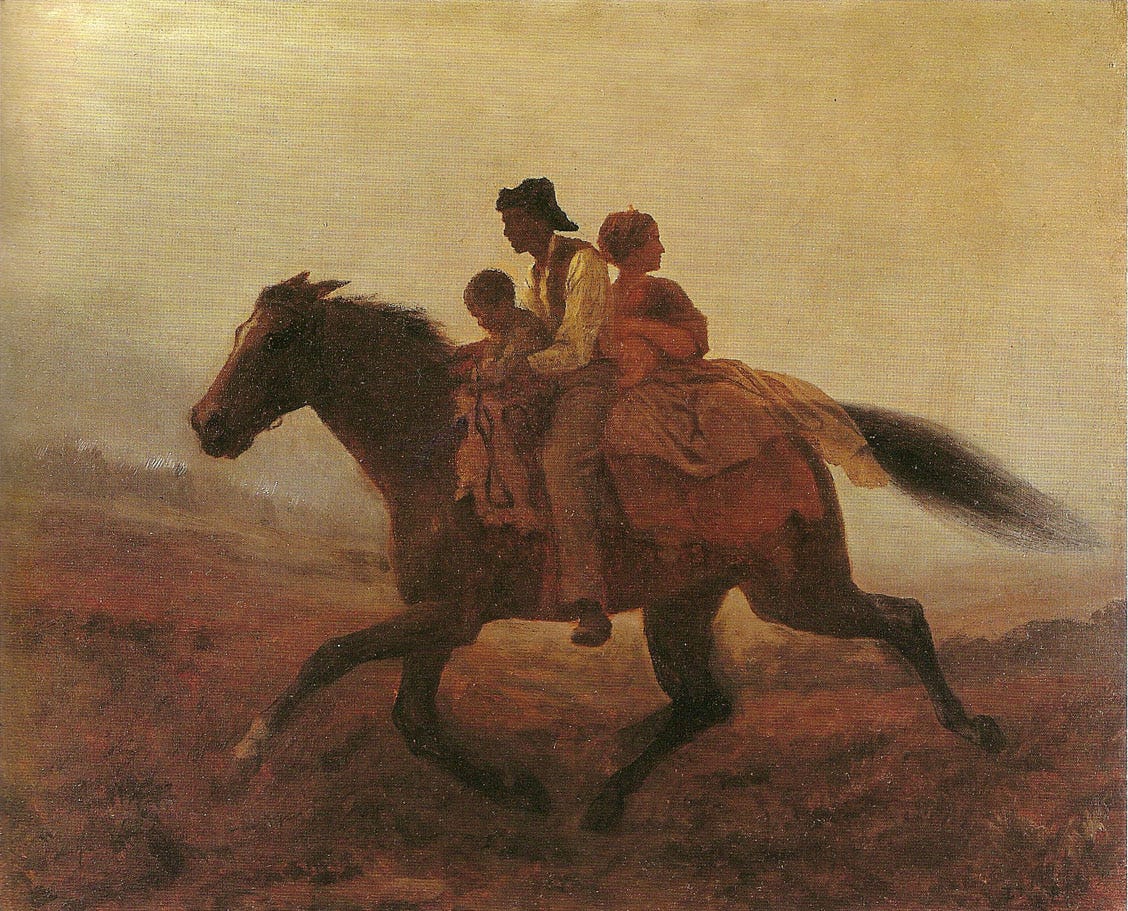

A Ride for Liberty — The Fugitive Slaves, oil on paperboard, ca. 1862, Brooklyn Museum

But the Irish are indeed a strange people. How varied their aspect — how contradictory their character.
William Wells Brown (1852)

What William Wells Brown should have said was “the Irish are human.”

The sad history of anti-black violence perpetrated by some Irish immigrants in the United States is well known. This was often the abominable product of racism, political self-interest, craven leadership and labour competition. While these incidents, such as the New York Draft riots (1863) or the Memphis massacre (1866), were committed by a fraction of Irish immigrants who settled in the United States, they have certainly cast a long shadow over the historical relationship between the Irish-American and African-American communities. Some Irish were also active in disrupting the activities of the Underground Railroad. See the famous case of the self-emancipated slave Anthony Burns who was arrested under the Fugitive Slave Law in 1854 and held in custody in Boston. When a group of African Americans and white anti-slavery activists attempted to rescue him by force, it was an Irish militia which suppressed their advances. One of their deputised number was stabbed and killed during the altercation. When African Americans held a vigil before Burns was sent back to his owners they were subjected to the “jeers and insults of pro-slavery Irishmen.” Sojourner Truth witnessed how Burns was marched on to the ship, a solitary figure, under the armed guard of two thousand armed white men. Some of those in the crowd, likely to be Irish-Americans, cheered at this pathetic procession. They also pointed at prominent abolitionists in the crowd, shouting “there go [the] murderers” of an Irish labourer. The historian Noel Ignatiev has described the actions of the Boston Irish militia as being evidence that the Irish were “the Swiss Guards of the Slave Power.”

William Still included an account of a group of Irishmen who attacked fugitive slaves in his seminal work The Underground Railroad, A Record (1872) According to his correspondent, these Irish attackers were either a group of slave-catchers following up on a bounty or racist thugs looking to attack African Americans as part of their Halloween entertainment. Either way, they got more than they bargained for…

…Perhaps it is for these reasons that the role of a number of Irish immigrants in helping slaves escape their bondage has been overlooked. It helps to explain why the cordial relationships and marriages, although the latter were relatively rare, between Irish immigrants and African Americans in the early nineteenth century have been mostly forgotten. This complex relationship is illustrated well by Frederick Douglass’ guarded reaction to two sympathetic Irish labourers in Baltimore

Who were these Irish born “conductors”?

Because of the nature of this surreptitious activity, attempts to verify what actually happened are often difficult, if not impossible. While it may make the academic historian wince, this history generally relies on oral tradition. From the few names I have found, it seems that the Irish immigrants who supported the Underground Railroad were mostly middle class, some were Presbyterian, others were Catholic, and a majority hailed from Ulster. The class aspect is not a surprise as it mirrors the general make up of the anti-slavery movement in Ireland in the late eighteenth to mid-nineteenth century. The following list is far from exhaustive, so please get in touch if you know of more individuals from Ireland who were involved…

Name: Mary Weaver
From: Ireland
Location of UR Activity: Richmond, Virginia
Narrative: The remarkable story of Mary Weaver is recounted by William Still. Mary Weaver and John Hall, a slave, fell in love and wished to marry. Hall was the property of a slave owner named John Dunlap but he singled out his prior owner, a man named Burke, as being especially cruel. Both of these men might also have been Irish. Mary then proceeded to save money and make arrangements to pay for his escape via the Underground Railroad to Canada. She later joined him there and the two were soon married.

“[Hall] was also under the influence and advice of a daughter of old Ireland. She was heart and soul with John in all his plans which looked Canada-ward. It is very certain, that this Irish girl was not annoyed by the kinks in John’s hair. Nor was she overly fastidious about the small percentage of colored blood visible in John’s complexion. It was, however, a strange occurrence and very hard to understand. Not a stone was left unturned until John was safely on the Underground Rail Road. Doubtless she helped to earn the money which was paid for his passage. And when he was safe off, it is not too much to say, that John was not a whit more delighted than was his intended Irish lassie, Mary Weaver. John had no sooner reached Canada than Mary’s heart was there too.”

“Circumstances, however, required that she should remain in Richmond a number of months for the purpose of winding up some of her affairs. As soon as the way opened for her, she followed him. It was quite manifest, that she had not let a single opportunity slide, but seized the first chance and arrived partly by means of the Underground Rail Road and partly by the regular train. Many difficulties were surmounted before and after leaving Richmond, by which they earned their merited success. From Canada, where they anticipated entering upon the matrimonial career with mutual satisfaction, it seemed to afford them great pleasure to write back frequently, expressing their heartfelt gratitude for assistance, and their happiness in the prospect of being united under the favorable auspices of freedom!”…

Read the entire article here.
Tags: , , ,